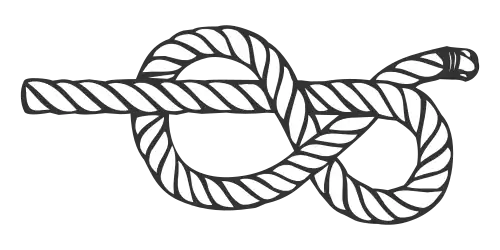
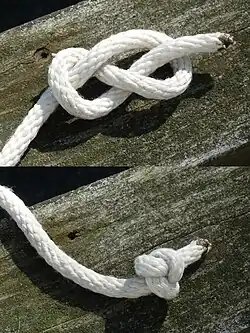
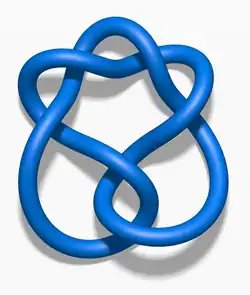
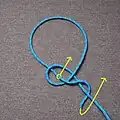
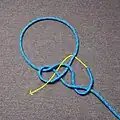
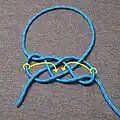
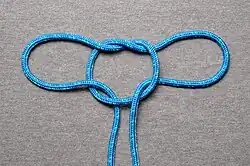
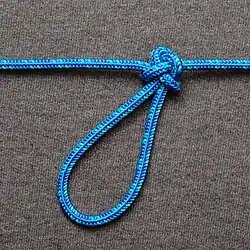
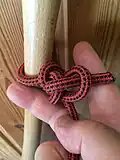
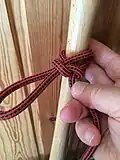
The figure-eight knot or figure-of-eight knot is a type of stopper knot. It is very important in sailing, rock climbing and caving as a method of stopping ropes from running out of retaining devices. Like the overhand knot, which will jam under strain, often requiring the rope to be cut, the figure-eight will also jam, but is usually more easily undone than the overhand knot.
When used as a stopper knot, the figure eight takes a more compact tightened form.
The figure-eight or figure-of-eight knot is also called (in books) the Flemish knot. The name figure-of-eight knot appears in Lever’s Sheet Anchor; or, a Key to Rigging (London, 1808). The word “of” is nowadays usually omitted. The knot is the sailor’s common single-strand stopper knot and is tied in the ends of tackle falls and running rigging, unless the latter is fitted with monkey’s tails. It is used about ship wherever a temporary stopper knot is required. The figure-eight is much easier to untie than the overhand, it does not have the same tendency to jam and so injure the fiber, and is larger, stronger, and equally secure.
The stevedore knot is an extension of simple figure-eight knot with an additional turn before the end is finally tightened.
Different types
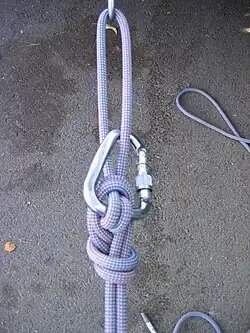
Figure-eight loop
The figure-eight loop is frequently used in climbing. It is the most common knot used to attach a rope to a harness, sometimes being described as the most important knot in the sport[2]. It forms a strong knot that’s relatively easy to tie, although can be difficult to untie after heavy loading.[3]
Figure-eight bend
The figure-eight bend knot is used to “splice” together two ropes, not necessarily of equal diameter. This knot is tied starting with a loose figure-eight knot on one rope (the larger-diameter one if unequal), and threading of the other rope’s running end through the first figure eight, starting at the first figure-eight’s running end and paralleling the path of the first rope through the figure eight until the second’s ropes running end lies parallel against the firsts standing end. The result is two figure-eight knots, each partly inside the other and tightening its hold on the other when they are pulled in opposite directions. This can be a permanent or temporary splice. While it precludes the ropes’ slipping relative to each other, it is a typical knot in having less strength than the straight ropes.
Offset figure-eight bend
The offset figure-eight bend is a poor knot that has been implicated in the deaths of several rock climbers.[4]
Stein knot
Stein knot
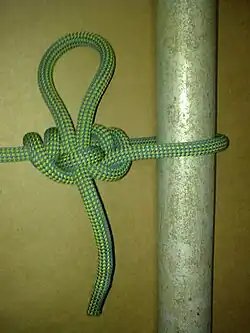
The stein knot (also known as a stone knot) is a variation of the figure-eight knot. It is used to secure a rope that is already passed around a post or through a ring. It is quick and easy to tie and untie. It is a device rigging rather than a true knot. In canyoneering, it is used to isolate rope strands to allow one person to rappel while another is getting on the rappel, or allow rappellers the option of using a single or a double rope. It is also used in basketmaking.
In the United States Navy, a figure-of-eight badge was formerly worn by enlisted men who had successfully completed the apprentice rating.[6]
In The Scout Association in the United Kingdom, awards for gallantry and long service are represented by a cloth figure-of-eight knot emblem in various colours.[7]
↑Turner, John Christopher; Van de Griend, P C, eds. (1996). History and Science of Knots. Singapore: World Scientific Publishing Company. p.390. ISBN978-9810224691.
Adams, Colin C. (1994). The knot book: an elementary introduction to the mathematical theory of knots. W. H. Freeman.
This article is adapted from “Figure-eight knot” on Wikipedia, written by its contributors, and used under CC BY-SA 4.0. Text on this page is available under the same licence. Source snapshot: Wikipedia via Kiwix, 2026-07-20.
In mathematics, a transverse knot is a smooth embedding of a circle into a three-dimensional contact manifold such that the tangent vector at every point of the knot is transverse to the contact plane at that point.
Any Legendrian knot can be C0-perturbed in a direction transverse to the contact planes to obtain a transverse knot. This yields a bijection between the set of isomorphism classes of transverse knots and the set of isomorphism classes of Legendrian knots modulo negative Legendrian stabilization.
J. Epstein, D. Fuchs, and M. Meyer, Chekanov–Eliashberg invariants and transverse approximations of Legendrian knots, Pacific J. Math. 201 (2001), no. 1, 89–106.
This article is adapted from “Transverse knot” on Wikipedia, written by its contributors, and used under CC BY-SA 4.0. Text on this page is available under the same licence. Source snapshot: Wikipedia via Kiwix, 2026-07-20.
In knot theory, a branch of mathematics, a knot or link
in the 3-dimensional sphere is called fibered or fibred (sometimes Neuwirth knot in older texts, after Lee Neuwirth) if there is a 1-parameter family of Seifert surfaces for , where the parameter runs through the points of the unit circle , such that if is not equal to
then the intersection of and is exactly .
The Alexander polynomial of a fibered knot is monic, i.e. the coefficients of the highest and lowest powers of t are plus or minus1. Examples of knots with nonmonic Alexander polynomials abound, for example the twist knots have Alexander polynomials , where q is the number of half-twists.[1] In particular the stevedore knot is not fibered.
Related constructions
Fibered knots and links arise naturally, but not exclusively, in complex algebraic geometry. For instance, each singular point of a complex plane curve can be described
topologically as the cone on a fibered knot or link called the link of the singularity. The trefoil knot is the link of the cusp singularity ; the Hopf link (oriented correctly) is the link of the node singularity . In these cases, the family of Seifert surfaces is an aspect of the Milnor fibration of the singularity.
A knot is fibered if and only if it is the binding of some open book decomposition of .
Gompf, Robert E.; Scharlemann, Martin; Thompson, Abigail (2010). “Fibered knots and potential counterexamples to the property 2R and slice-ribbon conjectures”. Geometry & Topology. 14 (4): 2305–2347. arXiv:1103.1601. doi:10.2140/gt.2010.14.2305. MR2740649.
This article is adapted from “Fibered knot” on Wikipedia, written by its contributors, and used under CC BY-SA 4.0. Text on this page is available under the same licence. Source snapshot: Wikipedia via Kiwix, 2026-07-20.
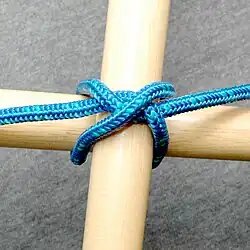
The transom knot is a simple lashing knot used to secure two linear objects, such as spars, at right angles to each other.
Relation to other knots
While often described in relation to the constrictor knot, the underlying structure of the transom knot is the strangle knot.[1][2] The introduction of a second, perpendicular spar into a loose strangle knot tied around another spar will illustrate this point. In relation to the upper spar, the crossings of the knot come to very closely resemble those of a constrictor knot.
Perhaps because of this Clifford Ashley described the transom knot as both “a modification of”[3] and “closely related to”[4] the constrictor knot. Despite these descriptions the transom knot is consistently illustrated in The Ashley Book of Knots as being based on a strangle knot.
Use
Suggested for binding kite sticks by Ashley,[5] it is useful generally as a light-duty or temporary square lashing. To reinforce, a second transom knot can be made on the opposite side and at a right-angle to the first.[2][5]
References
↑Budworth, Geoffrey (1985) [1983], The Knot Book, New York: Sterling Publishing, pp.63–65
12Warner, Charles (1992), A Fresh Approach to Knotting and Ropework, NSW, Australia, p.83, ISBN0-9592036-3-X{{citation}}: CS1 maint: location missing publisher (link)
↑Ashley, Clifford W. (1944), The Ashley Book of Knots, New York: Doubleday, p.62
This article is adapted from “Transom knot” on Wikipedia, written by its contributors, and used under CC BY-SA 4.0. Text on this page is available under the same licence. Source snapshot: Wikipedia via Kiwix, 2026-07-20.
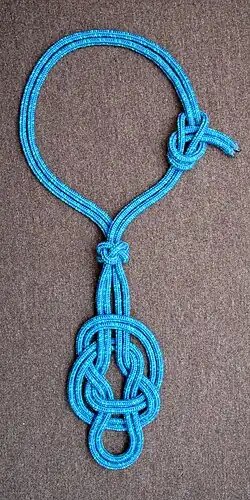
The fiador knot (also Theodore knot) is a decorative, symmetrical knot used in equine applications to create items such as rope halters, hobbles, and components of the fiador on some hackamore designs. As traditionally described, it is a four strand diamond knot in which six of the eight ends loop back into the knot, thus allowing it to be tied with a single line.[1] While a specific knot is discussed in this article, the fiador knot has also been treated as an entire class of multi-strand knots similarly made with a single line.[2][3]
Etymology
The origin of the variant name “Theodore knot”, used in the United States, is a corruption of the Spanish fiador. American cowboys likewise corrupted a number of other closely related terms, substituting “hackamore” for jaquima and “McCarty” for mecate.[4]
Knotting authority Clifford Ashley relates Philip Ashton Rollins’s suggestion that, “When Theodore Roosevelt, ‘the hero of San Juan Hill,’ visited the Southwest, shortly after the Spanish–American War, it was a foregone conclusion that the Spanish name ‘Fiador’ would be corrupted to ‘Theodore’ in his honor.”[1]
Tying
Considered a difficult knot to tie, cowboys were said to have been able to collect a fee for tying it.[5] Ashley went so far as to include it in a chapter covering trick knots in The Ashley Book of Knots stating archly, “the trick is to succeed in tying it.”[6]
Many methods have been devised to tie the fiador knot,[7] including fixtures used to hold the parts in shape while tying.[4][8] More recent sources have shown a simpler method of forming the fiador knot using a flat precursor knot.[9][10][11]
The following images show a method for tying the fiador knot:
Tight face and loose face
Careful inspection reveals the two faces of the completed fiador knot, where the four strands emerge, are not identical. One has the appearance of a crown knot surrounding the emerging strands and is somewhat resistant to spreading when they are pulled apart. By comparison, the strands emerging from the other face of the knot are not nearly as well-contained and if pulled apart, the fiador knot easily distorts and splays. Depending on how the fiador knot is tied, these distinct faces can be positioned differently with respect to the side of the knot with the two loops and the side with a single loop and the two free ends.
While most sources fail to discuss and differentiate the two faces, those that do suggest the tight face is best oriented towards single loop and two free ends if the knot is to be used in a rope fiador.[10][12] The rationale stated is that the single loop and free end side of the knot will be subject to more spreading when it passed around the neck of the horse. By contrast, the strands on the two-loop side of the fiador knot will generally be kept together by the double hackamore knot immediately below it.[13][14]
Regardless of the original tying method, the orientation of the tight and loose faces can be swapped in the completed knot.[11] By loosening the fiador knot, the tight face can be pressed towards, over, and around the rest of the knot. The knot will invert, “much the same as a mitten is turned inside out.”[15] When retightened, the tight and loose faces will have been exchanged.
Uses by equestrians
A mockup of the three knots used on a hackamore’s fiador with the fiador knot in the center.
There are several ways the fiador knot is used with certain types of horse tack:
The knot is used on, and shares its name with, the fiador of a hackamore.[16] The fiador knot holds the four strands of the fiador together under the horse’s jaw, while a doubled bottle sling—sometimes called a “hackamore knot” in this context—is used to attach the fiador to the heel knot of the bosal, or noseband, of the hackamore. A becket hitch is used to secure the fiador around the throatlatch of the horse.[3] In North America, again according to Ashley, “…the method originated in the South American pampas and worked its way, via Mexico, to the Southwestern cow country, arriving there soon after the conclusion of the Spanish–American War.”[1]
On knotted rope halters, the knot often is used under the jaw both as a decorative knot, and also to fashion the lower loop onto which a lead rope is attached. On a rope halter, the fiador knot is made from one continuous piece of rope, and is, along with a series of double overhand knots, one of two types of knots that comprise most rope halters.
For one style of rope hobbles, a brass ring may be attached to the double loops on one side of the knot to join the hobble for the horse’s other front foot. On the other side, a diamond knot terminates the two loose ends and the single loop is placed over this to encircle the horse’s fetlock. A small rope slide (melted with a solder iron) on this single loop is pushed against the diamond knot to prevent the loop from slipping off the foot.
123Ashley, Clifford W. (1944), The Ashley Book of Knots, New York: Doubleday, pp.43 & 201
↑Schaake, A.G.; Turner, J.C.; Sedgwick, D.A. (1990), Braiding – Regular Fiador Knots, A Series of Books on Braiding, vol.2/1, Hamilton, NZ: University of Waikato, ISBN0-908830-02-5
This article is adapted from “Fiador knot” on Wikipedia, written by its contributors, and used under CC BY-SA 4.0. Text on this page is available under the same licence. Source snapshot: Wikipedia via Kiwix, 2026-07-20.
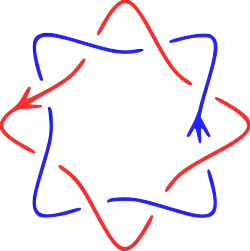
the (2,−3)-torus knot, also known as the left-handed trefoil knot(2,8) torus link with two components
In knot theory, a torus knot is a special kind of knot that lies on the surface of an unknotted torus in R3. Similarly, a torus link is a link which lies on the surface of a torus in the same way. Each torus knot is specified by a pair of coprime integers p and q. A torus link arises if p and q are not coprime (in which case the number of components is gcd(p, q)). A torus knot is trivial (equivalent to the unknot) if and only if either p or q is equal to 1 or −1.
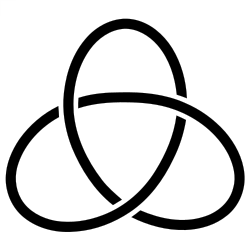
The simplest nontrivial example is the (2,3)-torus knot, also known as the trefoil knot.
Geometrical representation
A torus knot can be rendered geometrically in multiple ways which are topologically equivalent (see Properties below) but geometrically distinct. The convention used in this article and its figures is the following.
The (p,q)-torus knot winds q times around a circle in the interior of the torus, and p times around its axis of rotational symmetry.[note 1]. If p and q are not relatively prime, then we have a torus link with more than one component.
The direction in which the strands of the knot wrap around the torus is also subject to differing conventions. The most common is to have the strands form a right-handed screw for p q > 0.[3][4][5]
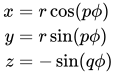
The (p,q)-torus knot can be given by the parametrization
where and . This lies on the surface of the torus given by (in cylindrical coordinates).
Other parameterizations are also possible, because knots are defined up to continuous deformation. The illustrations for the (2,3)- and (3,8)-torus knots can be obtained by taking , and in the case of the (2,3)-torus knot by furthermore subtracting respectively and from the above parameterizations of x and y. The latter generalizes smoothly to any coprime p,q satisfying .
Properties
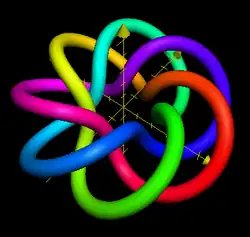
A (3,−7)-3D torus knot.
A torus knot is trivial if and only if either p or q is equal to 1 or −1.[4][5]
The (p,q) torus knot is equivalent to the (q,p) torus knot.[3][5][7] The (p,−q) torus knot is the obverse (mirror image) of the (p,q) torus knot.[5] The (−p,−q) torus knot is equivalent to the (p,q) torus knot except for the reversed orientation.
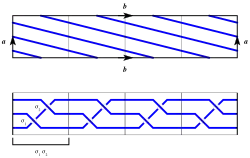
The (3, 4) torus knot on the unwrapped torus surface, and its braid word
Any (p,q)-torus knot can be made from a closed braid with p strands. The appropriate braid word is [8]
(This formula assumes the common convention that braid generators are right twists,[4][8][9][10] which is not followed by the Wikipedia page on braids.)
The crossing number of a (p,q) torus knot with p,q > 0 is given by
The complement of a torus knot in the 3-sphere is a Seifert-fibered manifold, fibred over the disc with two singular fibres.
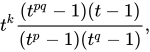
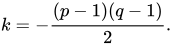
Let Y be the p-fold dunce cap with a disk removed from the interior, Z be the q-fold dunce cap with a disk removed from its interior, and X be the quotient space obtained by identifying Y and Z along their boundary circle. The knot complement of the (p, q) -torus knot deformation retracts to the space X. Therefore, the knot group of a torus knot has the presentation
Torus knots are the only knots whose knot groups have nontrivial center (which is infinite cyclic, generated by the element in the presentation above).
The stretch factor of the (p,q) torus knot, as a curve in Euclidean space, is Ω(min(p,q)), so torus knots have unbounded stretch factors. Undergraduate researcher John Pardon won the 2012 Morgan Prize for his research proving this result, which solved a problem originally posed by Mikhail Gromov.[11][12]
Connection to complex hypersurfaces
EureleA Award showing a (2,3)-torus knot.
The (p,q)−torus knots arise when considering the link of an isolated complex hypersurface singularity. One intersects the complex hypersurface with a hypersphere, centred at the isolated singular point, and with sufficiently small radius so that it does not enclose, nor encounter, any other singular points. The intersection gives a submanifold of the hypersphere.
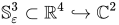
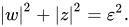
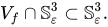
Let p and q be coprime integers, greater than or equal to two. Consider the holomorphic function given by Let be the set of such that Given a real number we define the real three-sphere as given by The function has an isolated critical point at since if and only if Thus, we consider the structure of close to In order to do this, we consider the intersection This intersection is the so-called link of the singularity The link of , where p and q are coprime, and both greater than or equal to two, is exactly the (p,q)−torus knot.[13]
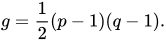
A g-torus knot is a closed curve drawn on a g-torus. More technically, it is the homeomorphic image of a circle in S³ which can be realized as a subset of a genus g handlebody in S³ (whose complement is also a genus g handlebody). If a link is a subset of a genus two handlebody, it is a double torus link.[14]
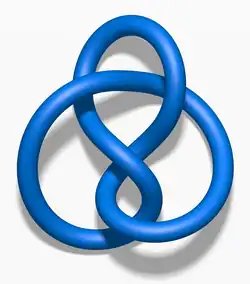
For genus two, the simplest example of a double torus knot that is not a torus knot is the figure-eight knot.[15][16]
Notes
↑Note that this use of the roles of p and q is contrary to what appears on.[1] It is also inconsistent with the pictures that appear in: [2]
↑Baker, Kenneth (2011-03-28). “p q is q p”. Sketches of Topology. Retrieved 2020-11-09.
123Lickorish, W. B. R. (1997). An Introduction to Knot Theory. Springer. p.. ISBN0-387-98254-X.
↑Dehornoy, P.; Dynnikov, Ivan; Rolfsen, Dale; Wiest, Bert (2000). Why are Braids Orderable?(PDF). p.. Archived from the original(PDF) on 2012-04-15. Retrieved 2011-11-12.
↑Birman, J. S.; Brendle, T. E. (2005). “Braids: a Survey”. In Menasco, W.; Thistlethwaite, M. (eds.). Handbook of Knot Theory. Elsevier. p.. ISBN0-444-51452-X.
↑Kehoe, Elaine (April 2012), “2012 Morgan Prize”, Notices of the American Mathematical Society, vol.59, no.4, pp.569–571, doi:10.1090/noti825.
This article is adapted from “Torus knot” on Wikipedia, written by its contributors, and used under CC BY-SA 4.0. Text on this page is available under the same licence. Source snapshot: Wikipedia via Kiwix, 2026-07-20.
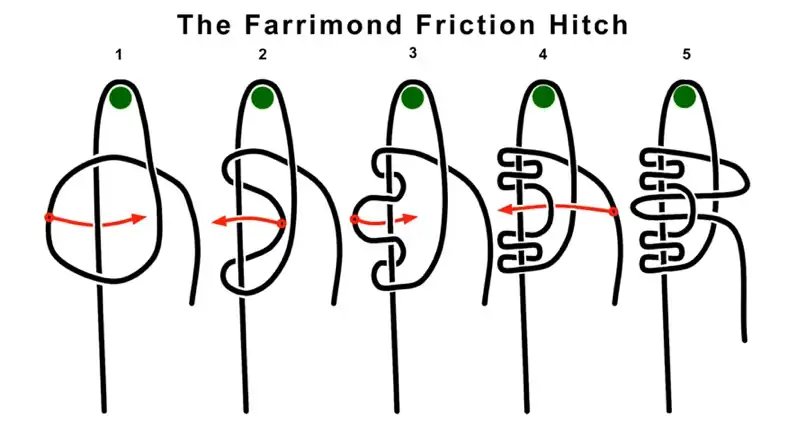
The Farrimond friction hitch is a quick release adjustable friction hitch for use on lines under tension. It is useful when the length of a line will need to be periodically adjusted in order to maintain or adjust tension whilst remaining quick and easy to untie; such as when hanging the ridge line for a Basha. It can be used in very effective conjunction with the Siberian hitch for this purpose. It can also be used as a mooring knot.
History
The first known presentation of this knot was made by British actor Barry Farrimond MBE in 2008 during a demonstration at the Yellow Wood Bush Camp, Wales.
Tying
The diagram below is shown from a birds eye perspective with the green dot representing a fixed point such as a tree or post which a ridge line might be attached to. After passing the working end around the back of this fixed point, create a loop that is then placed on top of the ridge line as in fig 1. Once this has been done take the loop and wrap it around the ridge line (following the directions shown by the red arrows) until you reach fig 4. Next take the working end of the rope and create a bight in it. Follow the red arrow in fig 4 which shows the bight being passed under and through the hoop of rope to form the knot’s quick release mechanism. Once the knot has been tightened up it should be able to resist considerable load on the ridge line whilst remaining easy to adjust and quick to release.
This article is adapted from “Farrimond friction hitch” on Wikipedia, written by its contributors, and used under CC BY-SA 4.0. Text on this page is available under the same licence. Source snapshot: Wikipedia via Kiwix, 2026-07-20.
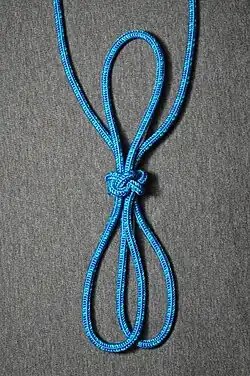
The Tom fool’s knot, also called the conjurer’s knot or bow knot, is sometimes considered a handcuff knot but is somewhat inferior for this purpose to the knot which usually bears that name.[1]:208 It is a good knot with which to commence a slightly fancy sheepshank.[1]:210 It is also used as a trick knot due to the speed with which it can be made.[1]:406
History
Tom fool’s knot is believed to be the knot epankylotos brokhos described by the 1st Century Greek physician Heraklas.[2]
Tying
It is formed by making two loops, not exactly overlaying each other. The inner half of each hitch or loop is pulled under and through the outer side of the opposite loop.
See also
Handcuff knot, a similar knot sometimes incorrectly identified as a Tom fool’s knot
123Ashley, Clifford W. (1944), The Ashley Book of Knots, New York: Doubleday
↑Hage, J. Joris (2008). “Heraklas on Knots: Sixteen Surgical Nooses and Knots from the First Century A.D.”. World Journal of Surgery. 32 (4): 648–655. doi:10.1007/s00268-007-9359-x. PMID18224483. S2CID21340612.
This article is adapted from “Tom fool's knot” on Wikipedia, written by its contributors, and used under CC BY-SA 4.0. Text on this page is available under the same licence. Source snapshot: Wikipedia via Kiwix, 2026-07-20.
If pulled with one hand holding one end, the other hand holding the start side of the loop that is the continuation of the same end, before tightening the knot of the loop, it may capsize to a slip knot with a complicated and heavy knot.
It is tied on one hand to make a loop about twice the size of that hand (use fingers for a smaller one, thumb-hook-to-elbow for a large one), as follows:[3][4][5]
start with the rope 3 times around the palm of one hand, let the ends hang down,
then pull the initial middle turn up from the top edge and place it over to the right (of the right loops top edge)
then pull the now new middle turn up from the top edge and place it over to the left
then pull the now new middle turn up from the top edge and place it over to the right
then pull the now new middle turn up to form the loop, dress and tighten before use
The knot is a good one on all three counts—lead, security, and strength. Moreover, the method of tying is both ingenious and distinctive, and once mastered, it is not apt to be forgotten.
To tie: Take three turns around the left arm or hand, according to the size of the material being used. Move the center turn to the outside three times, as indicated by the arrows, first right, then left, and finally right again. Finally, pull out (extend) the center turn, and the knot is ready for use.
Cornell University professor Howard W. Riley published this knot in an agricultural extension pamphlet devoted to farming knots in 1912.[2] He was shown the knot by a farmer at the 1910 Genesee County Fair in Batavia, New York. Riley noted that he had never seen the knot described in any reference book.[6]
↑Riley, Howard W. (January 1912). “Knots, Hitches, and Splices”. The Cornell Reading-Courses. Rural Engineering Series No. 1. 1 (8). Ithaca, NY: New York State College of Agriculture at Cornell University: 1438. Retrieved 2011-11-08. As collected in Documents of the Assembly of the State of New York, 136th Session, 1913, Vol. 19, No. 29, Part 5.
This article is adapted from “Farmer's loop” on Wikipedia, written by its contributors, and used under CC BY-SA 4.0. Text on this page is available under the same licence. Source snapshot: Wikipedia via Kiwix, 2026-07-20.
The falconer’s knot is a knot used in falconry to tether a bird of prey to a perch. Some sources show this knot to be identical to the halter hitch,[1] but with a specific method of single-handed tying needed when the other hand is occupied holding the bird, which makes this knot very useful.
Tying
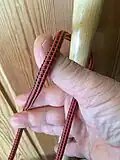
The falconer’s knot is usually tied one handed with the right hand (using two fingers to hold the end, and the thumb to hook behind the end) as follows:
The rope is passed around the perch, with the tail end to the further side extending to the left.
The right hand, is placed palm up, underneath both pieces of rope and a middle point of the tail piece is pinch/gripped between the index and middle fingers, as if one were cutting the rope with scissors.
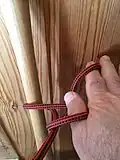
The thumb reaches over the main part, and over the “scissoring fingers”, points first down to the right under the tail side, then upwards to hook the tail side rope with the back of the thumbnail,
Keeping the thumb in the same position hooking the tail side, the wrist with the pinched tail is then rotated to the right as if signalising “GO AWAY!” so that the back of the hand ends up facing up at the near side of both ropes while the scissoring fingers still hold the tail, and pulled now under the main part to the right.
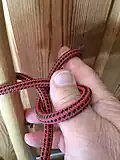
Due to the rotation, the thumb (still over the main part) will have a loop of the tail side wrapped around. The “scissored” rope (still under the main part) is then to be put through the loop around the thumb, pushing with the fingers. The thumb may also help it through the loop.
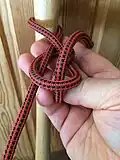
The result is an Overhand knot of the tail, where the knot is around the main part, with a slip i.e. a Halter hitch. This is achieved without involving the left hand which usually is busy holding the animal attached to the main part. The knot is then tightened towards the perch, then the free tail end passed through the new slip loop, to secure (just in case the animal has learned to untie the slip knot by pulling the end).
To untie, one simply pulls out the free end, tugs hard, and it should untie. When securing birds of prey, two knots will often be used as birds can learn to untie them.
Falconer’s knot 1: pinching fingers from below, hooking thumb from above
Falconer’s knot 2: hand rotated counterclockwise
Falconer’s knot 3: Loop around the thumb, end between fingers
Falconer’s knot 4: End bight slipped through loop around thumb
This article is adapted from “Falconer's knot” on Wikipedia, written by its contributors, and used under CC BY-SA 4.0. Text on this page is available under the same licence. Source snapshot: Wikipedia via Kiwix, 2026-07-20.