| Tom fool’s knot | |
|---|---|
 |
|
| Names | Tom fool’s knot, Tom fool knot, Conjurer’s knot, Bow knot |
| Category | Trick |
| Related | Handcuff knot, Sheepshank, Fireman’s chair knot |
| ABoK | #1141, #2290, #2291, #2534 |
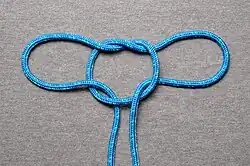
The Tom fool’s knot, also called the conjurer’s knot or bow knot, is sometimes considered a handcuff knot but is somewhat inferior for this purpose to the knot which usually bears that name.[1]: 208 It is a good knot with which to commence a slightly fancy sheepshank.[1]: 210 It is also used as a trick knot due to the speed with which it can be made.[1]: 406
History
Tom fool’s knot is believed to be the knot epankylotos brokhos described by the 1st Century Greek physician Heraklas.[2]
Tying
It is formed by making two loops, not exactly overlaying each other. The inner half of each hitch or loop is pulled under and through the outer side of the opposite loop.
See also
- Handcuff knot, a similar knot sometimes incorrectly identified as a Tom fool’s knot
- List of knots
References
External links
- Ian Knot, shoelace knot based on Tom fool’s knot
This article is adapted from “Tom fool's knot” on Wikipedia, written by its contributors, and used under CC BY-SA 4.0. Text on this page is available under the same licence. Source snapshot: Wikipedia via Kiwix, 2026-07-20.