| Cinquefoil | |
|---|---|
 |
|
| Common name | Double overhand knot |
| Arf invariant | 1 |
| Braid length | 5 |
| Braid no. | 2 |
| Bridge no. | 2 |
| Crosscap no. | 1 |
| Crossing no. | 5 |
| Genus | 2 |
| Hyperbolic volume | 0 |
| Stick no. | 8 |
| Unknotting no. | 2 |
| Conway notation | [5] |
| A–B notation | 51 |
| Dowker notation | 6, 8, 10, 2, 4 |
| Last / Next | 41 / 52 |
| Other | |
| alternating, torus, fibered, prime, reversible | |
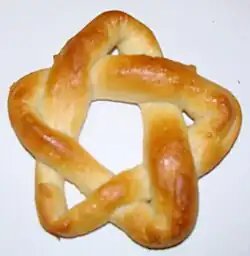
In knot theory, the cinquefoil knot, also known as Solomon’s seal knot or the pentafoil knot, is one of two knots with crossing number five, the other being the three-twist knot. It is listed as the 51 knot in the Alexander-Briggs notation, and can also be described as the (5,2)-torus knot. The cinquefoil is the closed version of the double overhand knot.
Properties
The cinquefoil is a prime knot. Its writhe is 5, and it is invertible but not amphichiral.[1] Its Alexander polynomial is
 ,
,
since 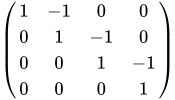 is a possible Seifert matrix, or because of its Conway polynomial, which is
 ,
,
and its Jones polynomial is

These are the same as the Alexander, Conway, and Jones polynomials of the knot 10132. However, the Kauffman polynomial can be used to distinguish between these two knots.
History
The name “cinquefoil” comes from the five-petaled flowers of plants in the genus Potentilla.
See also
- Pentagram
- Trefoil knot
- 7₁ knot
- Skein relation
References
- ↑ Weisstein, Eric W. “Solomon’s Seal Knot”. MathWorld.
Further reading
- A Pentafoil Knot at the Wayback Machine (archived June 4, 2004)
This article is adapted from “Cinquefoil knot” on Wikipedia, written by its contributors, and used under CC BY-SA 4.0. Text on this page is available under the same licence. Source snapshot: Wikipedia via Kiwix, 2026-07-20.