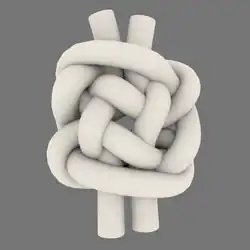
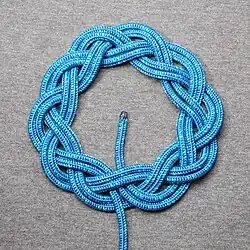
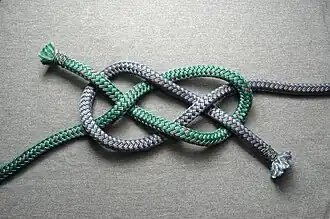
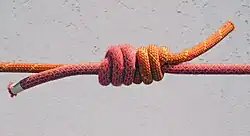
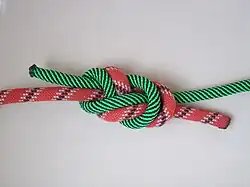
The Plafond knot,[7] with its spiral-like center and rectangular border, was inspired by the decorations found on the dome-like central sections of ceilings in Chinese temples and palaces. The ceilings, which are divided into nine rectangular sections, three across and three deep, each have a domed apex composed of a circular design filled with auspicious motifs surrounded by a complementary motif which radiates out to the rectangular border. This effect is echoed in the plafond knot, which is made by hooking up and tightening a number of flat knots.[7]
↑Kim Sang Lan. L’art du meadup noeuds coréens Bijoux & accessoires — ISBN978-2215078166
↑The Ashley Book of Knots — Ashley, Clifford W.. — Published by Faber and Faber, 1993 — ISBN9780571096596
↑The Art of Chinese and Western Knotting — ISBN962-15-0234-9
12Lydia Chen. The complete book of Chinese knotting — p. 102 — ISBN978-0 8048-3679-1
↑Lydia Chen. Chinese Knotting (1981) — ISBN0-8048-1389-2
↑Lindsey Phylpott.The ultimate book of decorative knots — p 363 — ISBN978-1-4081-5726-8
This article is adapted from “Plafond knot” on Wikipedia, written by its contributors, and used under CC BY-SA 4.0. Text on this page is available under the same licence. Source snapshot: Wikipedia via Kiwix, 2026-07-20.
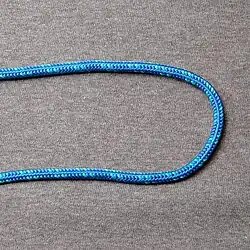
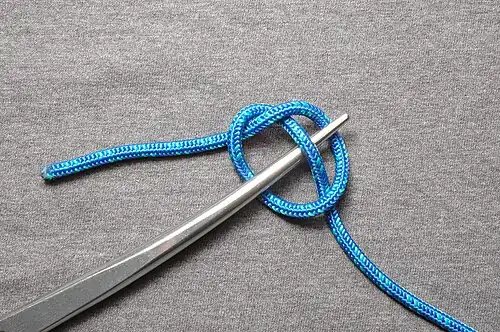
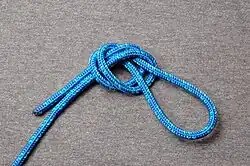
An open loop of rope. Sources differ on whether this is a bight.
In knot tying, a bight is a curved section or slack part between the two ends of a rope, string, or yarn.[1] A knot that can be tied using only the bight of a rope, without access to the ends, is described as in the bight. The term “bight” is also used in a more specific way when describing Turk’s head knots, indicating how many repetitions of braiding are made in the circuit of a given knot.[2]
Bight vs. open loop
Sources differ on whether an open loop or U-shaped curve in a rope qualifies as a bight. Ashley (1944) treats bights and loops as distinct, stating that a curve “no narrower than a semicircle” is a bight,[3] while an open loop is a curve “narrower than a bight but with separated ends”.[4] However, The Illustrated Encyclopedia of Knots (2002) states: “Any section of line that is bent into a U-shape is a bight.”[5]
Slipped knot
In order to make a slipped knot (also slipped loop and quick release knot), a bight must be passed, rather than the end. This slipped form of the knot is more easily untied. The traditional bow knot used for tying shoelaces is simply a reef knot with the final overhand knot made with two bights instead of the ends. Similarly, a slippery hitch is a slipped variation of the single hitch that spills instantly
when the end of the rope is pulled.[6]
In the bight
The phrase in the bight (or on a bight) means a bight of line is itself being used to make a knot. Specifically this means that the knot can be formed without access to the ends of the rope.[7] This can be an important property for knots to be used in situations where the ends of the rope are inaccessible, such as forming a fixed loop in the middle of a long climbing rope.[8]
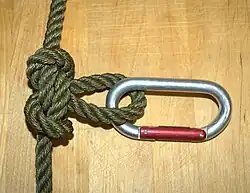
Many knots normally tied with an end also have a form which is tied in the bight (for example, the bowline and the bowline on a bight). In other cases, a knot being tied in the bight is a matter of the method of tying rather than a difference in the completed form of the knot. For example, the clove hitch can be made “in the bight” if it is being slipped over the end of a post or into an open carabiner but not if being cast onto a closed ring, which requires access to an end of the rope.
Examples
Bight examples
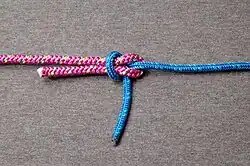
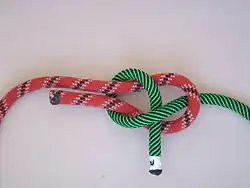
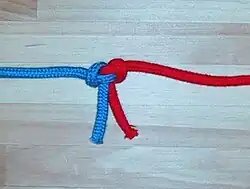
The blue rope (right) is half-hitched through and around a bight of the red rope (left) in this sheet bend.
The final tuck of this slipped buntline hitch is made with a bight rather than the end, making it easier to release after tightening.
In the tying of a marlinespike hitch, a bight of the standing part is snagged through the loop.
The bights, in the case of this 3-lead 10-bight Turk’s head knot, are the scallops along the perimeter of the knot.
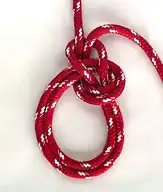
The alpine butterfly knot is a climbing knot which is tied inthebight and forms a reliable fixed loop.
Ashley, Clifford W. (1944). The Ashley Book of Knots. New York: Doubleday. ISBN9780385040259.{{cite book}}: ISBN / Date incompatibility (help)
Budworth, Geoffrey (2002). The Illustrated Encyclopedia of Knots. ISBN9781585746262.
External links
This article is adapted from “Bight (knot)” on Wikipedia, written by its contributors, and used under CC BY-SA 4.0. Text on this page is available under the same licence. Source snapshot: Wikipedia via Kiwix, 2026-07-20.
In the mathematical theory of knots, a Berge knot (named after mathematician John Berge) or doubly primitive knot is any member of a particular family of knots in the 3-sphere. A Berge knot K is defined by the conditions:
K lies on a genus two Heegaard surface S
in each handlebody bound by S, K meets some meridian disc exactly once.
John Berge constructed these knots as a way of creating knots with lens space surgeries and classified all the Berge knots. Cameron Gordon conjectured these were the only knots admitting lens space surgeries. This is now known as the Berge conjecture.
Berge conjecture
The Berge conjecture states that the only knots in the 3-sphere which admit lens space surgeries are Berge knots. The conjecture (and family of Berge knots) is named after John Berge.
Progress on the conjecture has been slow. Recently Yi Ni proved that if a knot admits a lens space surgery, then it is fibered. Subsequently, Joshua Greene showed that the lens spaces which are realized by surgery on a knot in the 3-sphere are precisely the lens spaces arising from surgery along the Berge knots.
Further reading
Knots
Baker, Kenneth L. (2008), “Surgery descriptions and volumes of Berge knots. I. Large volume Berge knots”, Journal of Knot Theory and its Ramifications, 17 (9): 1077–1097, arXiv:math/0509054, doi:10.1142/S0218216508006518, MR2457837.
Baker, Kenneth L. (2008), “Surgery descriptions and volumes of Berge knots. II. Descriptions on the minimally twisted five chain link”, Journal of Knot Theory and its Ramifications, 17 (9): 1099–1120, arXiv:math/0509055, doi:10.1142/S021821650800652X, MR2457838.
Yamada, Yuichi (2005), “Berge’s knots in the fiber surfaces of genus one, lens space and framed links”, Journal of Knot Theory and its Ramifications, 14 (2): 177–188, doi:10.1142/S0218216505003774, MR2128509.
This article is adapted from “Berge knot” on Wikipedia, written by its contributors, and used under CC BY-SA 4.0. Text on this page is available under the same licence. Source snapshot: Wikipedia via Kiwix, 2026-07-20.
A pipe hitch is a hitch-type knot used to secure smooth cylindrical objects,[2] such as pipes, poles, beams, or spars. According to The Ashley Book of Knots, a pipe hitch is “used to lower a pipe or hoist one”[1] and as “another method of tying to a rectangular timber.”[3]
Information
The pipe hitch will not slip when tied correctly to a pipe or pole. This knot is a variation of the Round turn and two half-hitches.[4][5] This knot can be used with a rope to pull a pipe or spar out of the ground,[6] or to hoist a pipe or beam.
Instructions
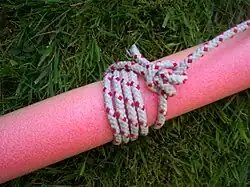
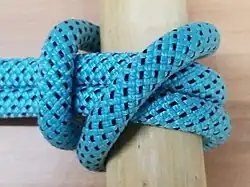
The pipe hitch is started by wrapping four or more coils around a pipe or pole. It is finished by tying the working end around the standing part with a clove hitch,[1] and less commonly with a cow hitch or a buntline hitch.
This article is adapted from “Pipe hitch” on Wikipedia, written by its contributors, and used under CC BY-SA 4.0. Text on this page is available under the same licence. Source snapshot: Wikipedia via Kiwix, 2026-07-20.
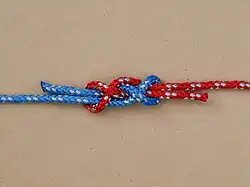
A bend is a type of knot used to unite two lengths of rope, or two parts of the same rope. Bends are used in a variety of situations, including climbing, sailing, and securing loads. They are classified based on their ability to be tightened or released, their resistance to slipping, and their strength. Some common types include the sheet bend, the double fisherman’s knot, and the double figure-eight bend. Bends allow the combined ropes to support weight or transmit force.[1]
Misuse of reef knot as a bend
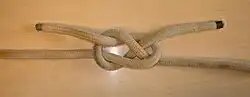
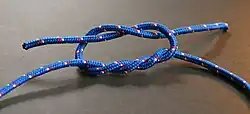
The common reef knot (square knot) is sometimes mistakenly tied as a bend. When used as a bend rather than a binding knot, the reef knot will capsize under sufficient tension.[2] For this reason, the reef knot is insecure as a bend and as such is not listed as one.
Employed as a binding knot, to reef and furl sails or to tie up parcels, [the reef knot] is invaluable. But employed as a bend […], the reef knot is probably responsible for more deaths and injuries than have been caused by the failure of all other knots combined.
A low-profile bend most usefully employed for joining sections of monofilament nylon line while maintaining a high portion of the line’s inherent strength.
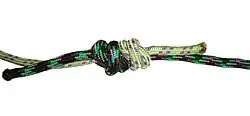
A bend consisting of interlocking overhand knots. It is similar to the hunter’s bend but offers advantages in that it is jam resistant and easy to untie.
This article is adapted from “Bend (knot)” on Wikipedia, written by its contributors, and used under CC BY-SA 4.0. Text on this page is available under the same licence. Source snapshot: Wikipedia via Kiwix, 2026-07-20.
The pile hitch is a kind of hitch, which is a knot used for attaching rope to a pole or other structure. The pile hitch is very easy to tie and can be tied in the bight, without access to either end of the rope, making it a valuable tool.
A pile hitch may be easily and quickly tied either in the end or bight of a heavy line. It is remarkably secure and is easy to cast off when the left bight has been loosened by a single well-aimed kick. Recommended for medium and heavy lines.
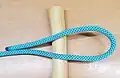
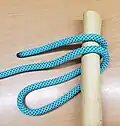
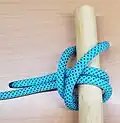
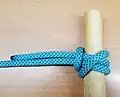
To tie, form a loop in the bight, and wrap both strands of this loop around the pole near the pole’s end. Pull the loop around and under the rope, then finish by putting the loop itself around the end of the pole.
This article is adapted from “Pile hitch” on Wikipedia, written by its contributors, and used under CC BY-SA 4.0. Text on this page is available under the same licence. Source snapshot: Wikipedia via Kiwix, 2026-07-20.
Difficult to visually assess the length of the free end inside webbing
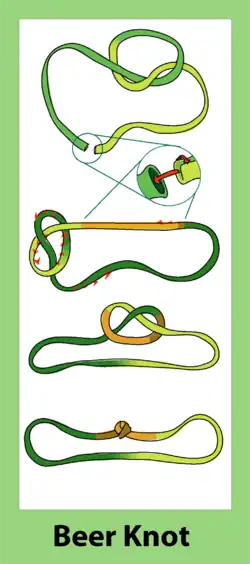
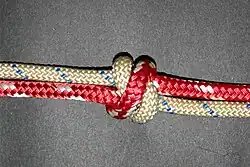
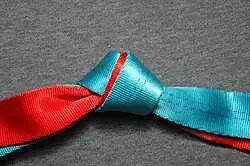
A beer knot is a bend used to join tubular webbing. Its most common application is in constructing slings used in rock climbing. Compared with the water knot, it has the advantages of a higher strength,[1] smaller profile, and a cleaner appearance due to the lack of free-hanging tails. However, the beer knot can be more difficult to tie than the water knot, and one of the tails is hidden from view, making safety checks for adequate tail length more difficult.
Testing by PMI in 1995 showed that the beer knot preserves about 80% of the strength of the webbing.[1]
The beer knot was introduced to the National Speleological Society in the 1980s by Peter Ludwig, from Austria.[1]
This article is adapted from “Beer knot” on Wikipedia, written by its contributors, and used under CC BY-SA 4.0. Text on this page is available under the same licence. Source snapshot: Wikipedia via Kiwix, 2026-07-20.
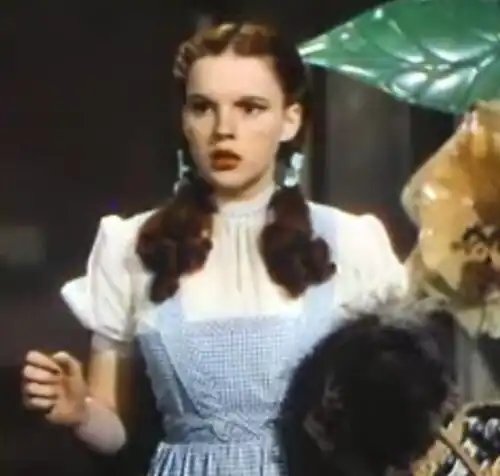
Judy Garland appears in The Wizard of Oz trailer with pigtails, 1939 Karen Nyberg appears with her hair in pigtails in the Unity node aboard the International Space Station, 2013
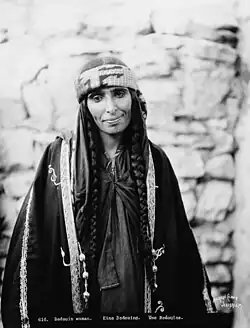
Pigtails (or twin tail or twintail) are a hairstyle of twin ponytails or braids on opposite sides of the head. Sometimes unbraided pigtails are called doggie ears or bunches, and usage of the term “pigtails” varies.[1]
Word origin and usage
Bedouin woman with braided pigtails, between 1898 and 1914.
The term pigtail appears in English in the American colonies in the 17th century to describe a twist of chewing tobacco. One of the steps in processing the tobacco was to twist a handful of leaves together to form a compact bunch that would then be cured (dried, either with or without smoking). The term “pigtail” was applied to the bunch based on its resemblance to a twisted pig’s tail.
From the later 17th century through the 19th century, the term came to be applied to any braided (“plaited”, in British parlance) hairstyle. The British army also adopted a single pigtail or “queue” as its standard dress for long hair. British barristers continue to wear a wig with pigtails as a way to hide the hairline in an attempt to provide basic anonymity.
Robert Louis Stevenson mentions “pigtail” referring to hair and then to “pigtail tobacco” in the first and fourth chapters of Treasure Island, respectively.[2]
Most modern dictionaries still define “pigtail” as a single tight braid. However, many speakers use the term to describe two symmetrical bunches of hair on either side of the head, braided or not.[1]
Styles
There are numerous styles of pigtails in which a person may wear their hair. They may be braided, straightened, beaded, ribboned, in buns, fishtailed, and even French braided. Pigtails can be placed on different parts of a person’s head: high, low, or to the side.
In some regions of China, traditional culture related the wearing of pigtails to a girl’s marital status. A young, unmarried, Chinese girl would often wear two buns, or bundles of hair on either side of the head to display her availability to prospective husbands. This style of pigtails is sometimes referred to as “ox horns.” However, when this girl would marry, the two pigtails, or buns, would be replaced with just one, thus indicating her marriage.
The Manchu and later Qing dynasty men’s coiffe called the “queue” is sometimes described incorrectly as a pigtail.
Notable pigtails in pop culture include Baby Spice of the Spice Girls and Britney Spears in the … Baby One More Time music video. Fictional characters known for pigtails include Harley Quinn, Angelica Pickles in Rugrats, Sailor Moon, Louise Lasser as Mary Hartman in Mary Hartman, Mary Hartman, and Boo from Monsters Inc..[3][4]
Bunches
Sometimes the portrayed hairstyle is referred to as “pigtails” in general, while “bunches” is more specific as they are unplaited.
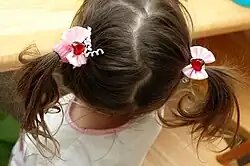
Bunches (also called pigtails, bunchies, twintails or angel wings) are a hairstyle in which the hair is parted down the middle and gathered into two symmetrical bundles, like ponytails, secured near the scalp. Sometimes this hairstyle is referred to as “pigtails”, but in other cases the term “pigtails” applies only if the hair is braided.[1]
In Japan
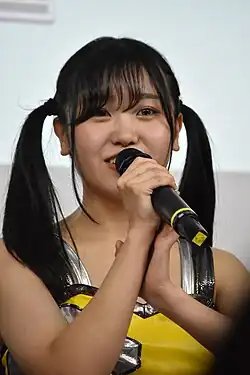
Suzume
Unbraided pigtails are extremely popular in Japan, especially in anime and manga fandom and Japanese otaku culture.[5] Traditionally a hairstyle worn by young girls, it has come to represent innocence, and is also known as the “twintail” or futatsu-yui (二つ結い). Anime and manga characters sporting twintails have been prevalent since the 1960s, and the hairstyle has since entered mainstream culture, in part due to Vocaloid Hatsune Miku embracing the look.[5] This includes the creation of a “Japan Twintail Association” to promote and celebrate the hairstyle, as well as running photo spreads of models sporting the dual tails.[5] “Twin Tail Day” is officially recognized by the Japan Anniversary Association and falls on February 2, when women post images of themselves with the hairstyle onto Twitter.[6]
In Japan, hair bunches are called ‘twin tails’ (ツインテール, tsuin teeru). A popular variation is the odango hairstyle, in which each ponytail is partially coiled around its base to form a small bun from which the remaining length hangs free.
The dictionary definition of pigtail at Wiktionary
This article is adapted from “Pigtail” on Wikipedia, written by its contributors, and used under CC BY-SA 4.0. Text on this page is available under the same licence. Source snapshot: Wikipedia via Kiwix, 2026-07-20.
Physical knot theory is the study of mathematical models of knotting phenomena, often motivated by considerations from biology, chemistry, and physics (Kauffman 1991). Physical knot theory is used to study how geometric and topological characteristics of filamentary structures, such as magnetic flux tubes, vortex filaments, polymers, DNAs, influence their physical properties and functions. It has applications in various fields of science, including topological fluid dynamics, structural complexity analysis and DNA biology (Kauffman 1991, Ricca 1998).
Traditional knot theory models a knot as a simple closed loop in three-dimensional space. Such a knot has no thickness or physical properties such as tension or friction. Physical knot theory incorporates more realistic models. The traditional model is also studied but with an eye toward properties of specific embeddings (“conformations”) of the circle. Such properties include ropelength and various knot energies (O’Hara 2003).
Most of the work discussed in this article and in the references below is not concerned with knots tied in physical pieces of rope. For the more specific physics of such knots, see Knot: Physical theory of friction knots.
References
Kauffman, L.H. (1991) Knots and Physics. Series on Knots and Everything 1, World Scientific.
Kauffman, L.H., Editor (1991) Knots and Applications. Series on Knots and Everything 6, World Scientific.
O’Hara, J. (2003) Energy of Knots and Conformal Geometry. Series on Knots and Everything 33, World Scientific.
Ricca, R.L. (1998) Applications of knot theory in fluid mechanics. In Knot Theory (ed. V.F.R. Jones et al.), pp. 321–346. Banach Center Publs. 42, Polish Academy of Sciences, Warsaw.
This article is adapted from “Physical knot theory” on Wikipedia, written by its contributors, and used under CC BY-SA 4.0. Text on this page is available under the same licence. Source snapshot: Wikipedia via Kiwix, 2026-07-20.
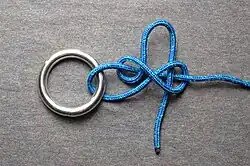
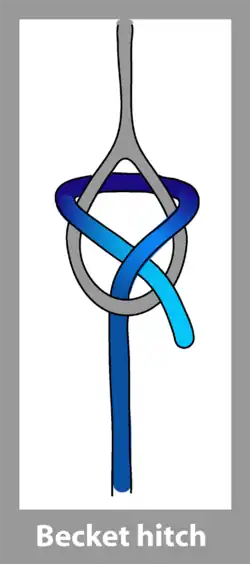
A becket hitch, including the double becket or figure-of-eight becket hitch, is any hitch that is made on an eye loop, i.e. on a becket.[1][2] A becket hitch has the same structure as the sheet bend, which joins, or “bends”, the ends of two ropes together. The becket hitch, in contrast, fixes a rope to a closed eye or hook.[3] In this instance, a becket means the eye or hook of a pulley block, an eye in the end of a rope, or a rope handle on a sailor’s sea chest.
Tying
For greater security, an additional round turn may be taken above the first before the line’s working end is brought back under itself, creating a double becket or figure-of-eight becket. In the figure-of-eight becket hitch, the working end of the line is also passed through the becket loop, wrapped around the becket then under itself, but then the line is wrapped in the opposite direction over the incoming line, but tucked under and inside the first wrap to align with the length of the becket. The figure-of-eight becket hitch contains 2 bends: one bend around under the becket, and the other bend under and over the incoming line, then tucked under inside the first bend.[2]
12Budworth, Geoffrey (September 2002). “Becket hitch”. The Illustrated Encyclopedia of Knots. see image on page 59, showing 2 bends in figure-of-eight line. ISBN9781585746262.
↑Ashley, Clifford W. (1944), The Ashley Book of Knots, New York: Doubleday, p.18
This article is adapted from “Becket hitch” on Wikipedia, written by its contributors, and used under CC BY-SA 4.0. Text on this page is available under the same licence. Source snapshot: Wikipedia via Kiwix, 2026-07-20.