Category: Knots

  • Petal projection

    Petal projection
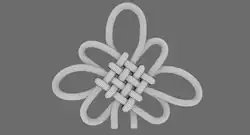
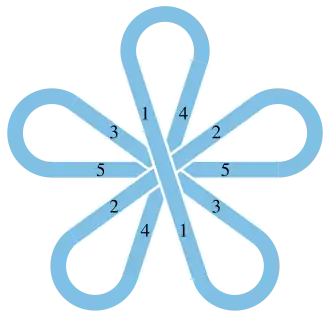
    Petal projection of a trefoil knot, the unique nontrivial knot with petal number five[1]

    In knot theory, a petal projection of a knot is a knot diagram with a single crossing, at which an odd number of non-nested arcs (“petals”) all meet. Because the above-below relation between the branches of a knot at this crossing point is not apparent from the appearance of the diagram, it must be specified separately, as a permutation describing the top-to-bottom ordering of the branches.

    Every knot or link has a petal projection; the minimum number of petals in such a projection defines a knot invariant, the petal number of the knot. Petal projections can be used to define the Petaluma model, a family of probability distributions on knots with a given number of petals, defined by choosing a random permutation for the branches of a petal diagram.

    Petal projection

    A petal projection is a description of a knot as a special kind of knot diagram, a two-dimensional self-crossing curve formed by projecting the knot from three dimensions down to a plane. In a petal projection, this diagram has only one crossing point, forming a topological rose. Every two branches of the curve that pass through this point cross each other there; branches that meet tangentially without crossing are not allowed. The “petals” formed by arcs of the curve that leave and then return to this crossing point are all non-nested, bounding closed disks that are disjoint except for their common intersection at the crossing point.[1]

    Beyond this topological description, the precise shape of the curve is unimportant. For instance, curves of this type could be realized algebraically as certain rose curves. However, it is common instead to draw a petal projection using straight line segments across the crossing point, connected at their endpoints by smooth curves to form the petals.[1]

    In order to specify the above-below relation of the branches of the curve at the crossing point, each branch is labeled with an integer, from 1 to the number of branches, giving its position in the top-down ordering of the branches as would be seen from a three-dimensional viewpoint above the projected diagram. The cyclic permutation of these integers, in the radial ordering of the branches around the crossing point, can be used as a purely combinatorial description of the petal projection.[1]

    In order to form a single knot, rather than a link, a petal projection must have an odd number of branches at its crossing point. Every knot can be represented as a petal projection, for diagrams with a sufficiently large number of petals. The minimum possible number of petals in a petal projection of a given knot defines a knot invariant called its petal number.[1][2]

    Petaluma model

    The Petaluma model is a random distribution on knots, parameterized by an odd number 2 n + 1 {\displaystyle 2n+1} {\displaystyle 2n+1} of petals in a petal diagram, and defined by constructing a petal diagram with this number of petals using a uniformly random permutation on its branches.[3]

    Generalization to links

    Petal projections, and the petaluma model, can be generalized from knots to links. However, for this generalization, it is no longer possible to guarantee that all petals are non-nested. Instead, the generalized petal projections for links have a different type of standard diagram allowing some nesting of the petals.[3]

    References

    1. 1 2 3 4 5 Adams, Colin; Crawford, Thomas; DeMeo, Benjamin; Landry, Michael; Lin, Alex Tong; Montee, MurphyKate; Park, Seojung; Venkatesh, Saraswathi; Yhee, Farrah (2015), “Knot projections with a single multi-crossing”, Journal of Knot Theory and Its Ramifications, 24 (3): 1550011, 30, arXiv:1208.5742, doi:10.1142/S021821651550011X, MR 3342136
    2. Adams, Colin; Capovilla-Searle, Orsola; Freeman, Jesse; Irvine, Daniel; Petti, Samantha; Vitek, Daniel; Weber, Ashley; Zhang, Sicong (2015), “Bounds on übercrossing and petal numbers for knots”, Journal of Knot Theory and Its Ramifications, 24 (2): 1550012, 16, arXiv:1311.0526, doi:10.1142/S0218216515500121, MR 3334663
    3. 1 2 Even-Zohar, Chaim; Hass, Joel; Linial, Nati; Nowik, Tahl (2016), “Invariants of random knots and links”, Discrete & Computational Geometry, 56 (2): 274–314, arXiv:1411.3308, doi:10.1007/s00454-016-9798-y, MR 3530968

    This article is adapted from “Petal projection” on Wikipedia, written by its contributors, and used under CC BY-SA 4.0. Text on this page is available under the same licence. Source snapshot: Wikipedia via Kiwix, 2026-07-20.

  • Basket weave knot

    Basket weave knot
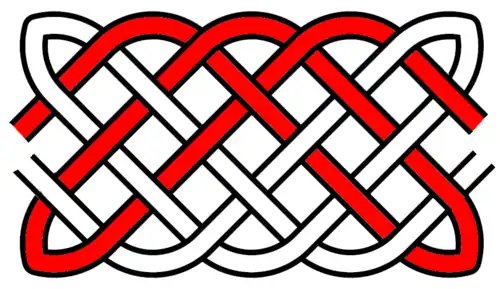
    A diagram of a basket weave knot on a 3×5 rectangular grid

    The basket weave knots are a family of bend and lanyard knots with a regular pattern of over–one, under–one. All of these knots are rectangular and lie in a plane.[1] They are named after plait-woven baskets, which have a similar appearance.

    Construction

    Basket weave knot
    A diagram of a long basket weave knot on a 2×5 grid

    A basket weave knot is made up of two sets of parallel lines drawn inside a rectangle such that the lines meet at the edges of the rectangle. For a true basket weave knot that can be tied with two strands, the number of intersections in each direction cannot have a common divisor. Within this constraint, there is no theoretical upper limit to the size of a basket weave knot.[1] Thus, a knot that has two intersections in one direction can be lengthened with any odd number in the perpendicular direction. If the dimension n in the smaller direction is odd, it is always possible to construct a knot with n + 2 intersections in the other dimension. However, large basket weave knots have a tendency to twist and curl because they are completely flat.[1]

    A basket weave knot can be tied from a single strand by first forming a bight in the middle of the line. The ends near the bight become the standing ends. This method will keep the knot in one plane only for knots in which the standing ends enter the same side; these knots are called bosun’s knots because they can be tied in a lanyard.[1] For knots in which the standing ends enter from different sides of the rectangle, the bight will wrap across one side of the knot after it is set.

    Any basket weave knot that can be tied from two strands can be drawn as an endless knot by connecting the standing ends together and the working ends together. An example of this can be seen in the carrick mat.

    Basket weave knot
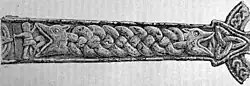
    A decorative use on the Gosforth Cross, from the 10th century AD

    If a basket weave knot is tied with a flat line such as ribbon instead of a round line such as rope or cord, the method of turning the line at the edges affects the final appearance. Deflecting the line will form a series of bights or scallops along the edge, while folding it over will leave the edge flat.[2]

    Examples

    Basket weave knot
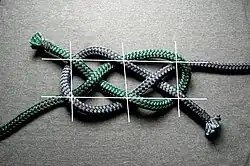
    A carrick bend knot with a 2×3 rectangular grid superimposed upon it

    The simplest basket weave knots consist of a two–by–three rectangle of intersections and include the following:

    In the granny knot, the standing ends enter the short side, while in the double coin knot, the standing ends enter the long side. Therefore, any of these knots could be used for a lanyard. In the carrick bend, which is otherwise similar to the double coin knot, the standing ends enter opposite long sides.

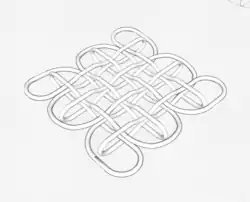
    The next smallest possible basket weave knot is made up of a three–by–four rectangle, and may be called a boatswain’s lanyard, whistle lanyard, Napoleon knot, or Chinese knot,[2] although the art of Chinese knotting includes many more knots besides this one.

    References

    1. 1 2 3 4 Ashley, Clifford W. (1993) [1944]. The Ashley Book of Knots. New York: Doubleday. pp. 139–140. ISBN 0-385-04025-3.
    2. 1 2 Ashley, pp. 148-149

    This article is adapted from “Basket weave knot” on Wikipedia, written by its contributors, and used under CC BY-SA 4.0. Text on this page is available under the same licence. Source snapshot: Wikipedia via Kiwix, 2026-07-20.
  • Perko pair

    Perko pair
    Arf invariant 1
    Braid length 10
    Braid no. 3
    Bridge no. 3
    Crosscap no. 2
    Crossing no. 10
    Genus 3
    Hyperbolic volume 5.63877
    Unknotting no. 3
    Conway notation [3:-20:-20]
    A–B notation 10161/10162
    Dowker notation 4, 12, -16, 14, -18, 2, 8, -20, -10, -6
    Last / Next 10160 / 10162
    Other
    hyperbolic, fibered, prime, reversible

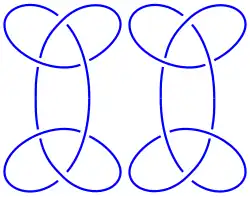
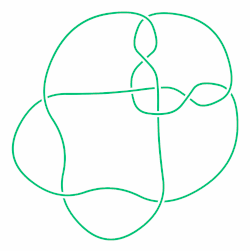
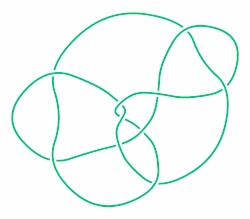
    In the mathematical theory of knots, the Perko pair, named after Kenneth Perko, is a pair of entries in classical knot tables that actually represent the same knot. In Dale Rolfsen‘s knot table, this supposed pair of distinct knots is labeled 10161 and 10162. In 1973, while working to complete the classification by knot type of the TaitLittle knot tables of knots up to 10 crossings (dating from the late 19th century),[1] Perko found the duplication in Charles Newton Little’s table.[2] This duplication had been missed by John Horton Conway several years before in his knot table and subsequently found its way into Rolfsen’s table.[3] The Perko pair gives a counterexample to a “theorem” claimed by Little in 1900 that the writhe of a reduced diagram of a knot is an invariant (see Tait conjectures), as the two diagrams for the pair have different writhes.

    In some later knot tables, the knots have been renumbered slightly (knots 10163 to 10166 are renumbered as 10162 to 10165) so that knots 10161 and 10162 are different. Some authors have mistaken these two renumbered knots for the Perko pair and claimed incorrectly that they are the same.[4]

    • The Perko pair
    • 10161
      10161
    • 10162 (in Rolfsen's original numbering)
      10162 (in Rolfsen’s original numbering)

    The Perko pair was correctly illustrated and explained on the first page of the Science section of the July 8, 1986 New York Times.

    The Perko pair is one of five knots with 10 crossings where the topological and smooth 4-genus are different; the former is equal to 2, while the latter is 3.[5]

    References

    1. Charles Newton Little, Non-alternating +/- knots, Trans. Roy. Soc. Edinburgh 39 (1900), page 774.
    2. Kenneth A. Perko Jr.(b.1943), On the classification of knots. Proc. Amer. Math. Soc. 45 (1974), 262—266.
    3. Dale Rolfsen, Knots and Links (see Appendix C for the knot table), 1976, ISBN 0-914098-16-0.
    4. The Revenge of the Perko Pair“, RichardElwes.co.uk. Accessed February 2016. Richard Elwes points out a common mistake in describing the Perko pair.
    5. P. Feller, D. McCoy: On 2-bridge knots with differing smooth and topological slice genera, Proc. Amer. Math. Soc. 144, p. 5435–5442, 2016.

    External links

    • 10_161“, The Knot Atlas.
    • Pictures of the equivalence between the two knots, as given by Perko: “The Perko pair“, WebArchive archive of page hosted by Brian Sanderson. Accessed April 2025.
    • Pictures of a different equivalence between the two knots: “Perko pair knots“, KnotPlot. Accessed February 2016.

    This article is adapted from “Perko pair” on Wikipedia, written by its contributors, and used under CC BY-SA 4.0. Text on this page is available under the same licence. Source snapshot: Wikipedia via Kiwix, 2026-07-20.
  • Barrel hitch

    Barrel hitch
    Barrel hitch
    Names Barrel hitch, Barrel Sling
    Category Hitch
    Related Overhand knot, bowline
    ABoK #459, #2176 and #2177

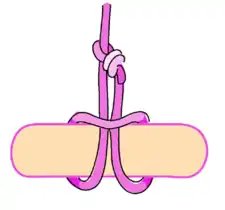
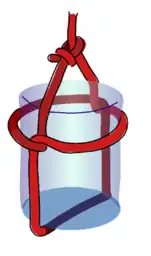
    The “barrel hitch” and “barrel sling“, named for their use in hoisting cargo aboard ships, are two simple yet effective ways to suspend an object. The barrel sling lays the barrel on its side, while the barrel hitch keeps it vertical. They work by forming a “sling” around the object, which supports it from either side and underneath.

    The barrel sling (not pictured) is made with a strop. The barrel is laid on its side, both sides of the strop are spread out and passed underneath, the ends of the strop are raised together, one end is tucked through the other and hooked to an eyehook. The tightened knot looks like a cow hitch. A cow hitch and bowline can achieve the same effect and are called a “cow hitch hoist”. The barrel hitch for lifting bales of hay is called a “bale sling hitch”.

    Tying

    Barrel hitch
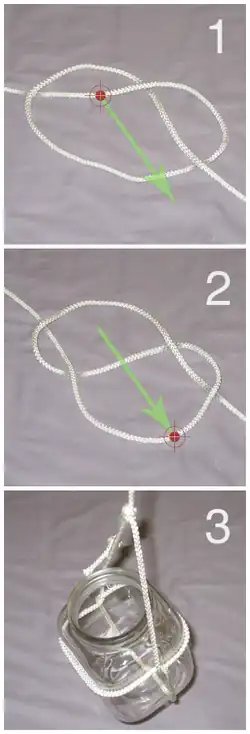
    How to tie a barrel hitch
    • The barrel hitch is made by tying an overhand knot, leaving plenty of free rope at the working end. Where the rope crosses itself in the middle of the knot (near the target), grab the strand of rope on top and bring it towards you, then lay it back down. The result should resemble stage 2: note where the target is.
    • Place your object on top of the diagonal strand of rope in the centre of the knot.
    • Carefully draw the rope up at the working and fixed ends, forming the “sling” around the object. Tie the working end off using a bowline, making sure the sling is tight around the object.

    See also

    References


    This article is adapted from “Barrel hitch” on Wikipedia, written by its contributors, and used under CC BY-SA 4.0. Text on this page is available under the same licence. Source snapshot: Wikipedia via Kiwix, 2026-07-20.
  • Peripheral subgroup

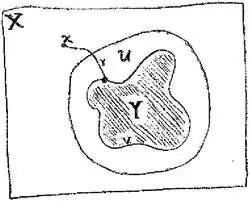
    In algebraic topology, a peripheral subgroup for a space-subspace pair X  Y is a certain subgroup of the fundamental group of the complementary space, π1(X  Y). Its conjugacy class is an invariant of the pair (X,Y). That is, any homeomorphism (X, Y)  (X′, Y′) induces an isomorphism π1(X  Y)  π1(X  Y′) taking peripheral subgroups to peripheral subgroups.

    A peripheral subgroup consists of loops in X  Y which are peripheral to Y, that is, which stay “close to” Y (except when passing to and from the basepoint). When an ordered set of generators for a peripheral subgroup is specified, the subgroup and generators are collectively called a peripheral system for the pair (X, Y).

    Peripheral systems are used in knot theory as a complete algebraic invariant of knots. There is a systematic way to choose generators for a peripheral subgroup of a knot in 3-space, such that distinct knot types always have algebraically distinct peripheral systems. The generators in this situation are called a longitude and a meridian of the knot complement.

    Full definition

    Peripheral subgroup
    Peripheral loops live in U  γ

    Let Y be a subspace of the path-connected topological space X, whose complement X  Y is path-connected. Fix a basepoint x  X  Y. For each path component Vi of X  YY, choose a path γi from x to a point in Vi. An element [α]  π1(X  Y, x) is called peripheral with respect to this choice if it is represented by a loop in U    iγi for every neighborhood U of Y. The set of all peripheral elements with respect to a given choice forms a subgroup of π1(X  Y, x), called a peripheral subgroup.

    In the diagram, a peripheral loop would start at the basepoint x and travel down the path γ until it’s inside the neighborhood U of the subspace Y. Then it would move around through U however it likes (avoiding Y). Finally it would return to the basepoint x via γ. Since U can be a very tight envelope around Y, the loop has to stay close to Y.

    Any two peripheral subgroups of π1(X  Y, x), resulting from different choices of paths γi, are conjugate in π1(X  Y, x). Also, every conjugate of a peripheral subgroup is itself peripheral with respect to some choice of paths γi. Thus the peripheral subgroup’s conjugacy class is an invariant of the pair (X, Y).

    A peripheral subgroup, together with an ordered set of generators, is called a peripheral system for the pair (X, Y). If a systematic method is specified for selecting these generators, the peripheral system is, in general, a stronger invariant than the peripheral subgroup alone. In fact, it is a complete invariant for knots.

    In knot theory

    Peripheral subgroup
    Peripheral loops live in γ union the tube.

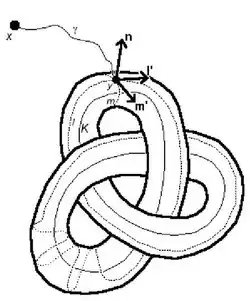
    The peripheral subgroups for a tame knot K in R3 are isomorphic to Z  Z if the knot is nontrivial, Z if it is the unknot. They are generated by two elements, called a longitude [l] and a meridian [m]. (If K is the unknot, then [l] is a power of [m], and a peripheral subgroup is generated by [m] alone.) A longitude is a loop that runs from the basepoint x along a path γ to a point y on the boundary of a tubular neighborhood of K, then follows along the tube, making one full lap to return to y, then returns to x via γ. A meridian is a loop that runs from x to y, then circles around the tube, returns to y, then returns to x. (The property of being a longitude or meridian is well-defined because the tubular neighborhoods of a tame knot are all ambiently isotopic.) Note that every knot group has a longitude and meridian; if [l] and [m] are a longitude and meridian in a given peripheral subgroup, then so are [l]·[m]n and [m]1, respectively (n  Z). In fact, these are the only longitudes and meridians in the subgroup, and any pair will generate the subgroup.

    A peripheral system for a knot can be selected by choosing generators [l] and [m] such that the longitude l has linking number 0 with K, and the ordered triple (m′,l′,n) is a positively oriented basis for R3, where m′ is the tangent vector of m based at y, l′ is the tangent vector of l based at y, and n is an outward-pointing normal to the tube at y. (Assume that representatives l and m are chosen to be smooth on the tube and cross only at y.) If so chosen, the peripheral system is a complete invariant for knots, as proven in [Waldhausen 1968].

    Peripheral subgroup
    A square knot (left) and a granny knot (right).

    Example: Square knot versus granny knot

    The square knot and the granny knot are distinct knots, and have non-homeomorphic complements. However, their knot groups are isomorphic. Nonetheless, it was shown in [Fox 1961] that no isomorphism of their knot groups carries a peripheral subgroup of one to a peripheral subgroup of the other. Thus the peripheral subgroup is sufficient to distinguish these knots.

    Peripheral subgroup
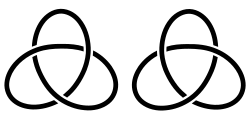
    A trefoil and a mirror trefoil.

    Example: Trefoil versus mirror trefoil

    The trefoil and its mirror image are distinct knots, and consequently there is no orientation-preserving homeomorphism between their complements. However, there is an orientation-reversing self-homeomorphism of R3 that carries the trefoil to its mirror image. This homeomorphism induces an isomorphism of the knot groups, carrying a peripheral subgroup to a peripheral subgroup, a longitude to a longitude, and a meridian to a meridian. Thus the peripheral subgroup is not sufficient to distinguish these knots. Nonetheless, it was shown in [Dehn 1914] that no isomorphism of these knot groups preserves the peripheral system selected as described above. An isomorphism will, at best, carry one generator to a generator going the “wrong way”. Thus the peripheral system can distinguish these knots.

    Wirtinger presentation

    It is possible to express longitudes and meridians of a knot as words in the Wirtinger presentation of the knot group, without reference to the knot itself.

    References


    This article is adapted from “Peripheral subgroup” on Wikipedia, written by its contributors, and used under CC BY-SA 4.0. Text on this page is available under the same licence. Source snapshot: Wikipedia via Kiwix, 2026-07-20.
  • Band sum

    In geometric topology, a band sum of two n-dimensional knots K1 and K2 along an (n + 1)-dimensional 1-handle h called a band is an n-dimensional knot K such that:

    • There is an (n + 1)-dimensional 1-handle h connected to (K1, K2) embedded in Sn+2.
    • There are points p 1 K 1 {\displaystyle p_{1}\in K_{1}} {\displaystyle p_{1}\in K_{1}} and p 2 K 2 {\displaystyle p_{2}\in K_{2}} {\displaystyle p_{2}\in K_{2}} such that h {\displaystyle h} {\displaystyle h} is attached to K 1 K 2 {\displaystyle K_{1}\sqcup K_{2}} {\displaystyle K_{1}\sqcup K_{2}} along p 1 p 2 {\displaystyle p_{1}\sqcup p_{2}} {\displaystyle p_{1}\sqcup p_{2}}.

    K is the n-dimensional knot obtained by this surgery.

    A band sum is thus a generalization of the usual connected sum of knots.

    See also

    • Manifold decomposition

    References

    • Cromwell, Peter R. (2004), Knots and Links, Cambridge University Press, p. 90, ISBN 9780521548311.
    • Kawauchi, Akio (1996), Survey on Knot Theory, Springer, p. 31, ISBN 9783764351243.

    This article is adapted from “Band sum” on Wikipedia, written by its contributors, and used under CC BY-SA 4.0. Text on this page is available under the same licence. Source snapshot: Wikipedia via Kiwix, 2026-07-20.
  • Pasha (Hinduism)

    Pasha (Hinduism)
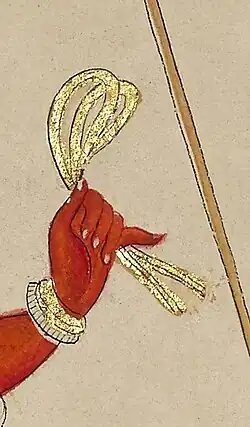
    Pasha as a noose in the hands of Ganesha

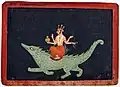
    A pasha (Sanskrit: पाश, romanized: pāśa, lit.noose, lasso) is a supernatural weapon depicted in Hindu iconography. Hindu deities such as Ganesha, Yama, Shyamala devi, and Varuna are depicted with the pasha in their hands.

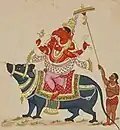
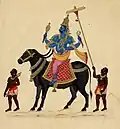
    Pasha is a common attribute of Ganesha,[1] the Lord of removing obstacles; a pasha represents his power to bind and free obstacles. Yama, the god of death, uses the Pasha to extract a soul from a being’s body at the time of death.[2] In sculpture, it is depicted as two or three bound into one or a double loop.[3]

    The Sanskrit word “pasha” originally meant “knot” or “loop”.[4] In general usage, the pasha is used to bind a foe’s arms and legs or for hunting animals.[4][3] Pasha represents worldly attachment as well as power of a deity to capture and bind evil and ignorance.[1] Ananda Coomaraswamy explores the connection of pasha to worldly bonds.[4]

    In the Shaiva Siddhanta school of Hinduism, pasha is part of the trinity Pati-pashu-pasha, meaning “Master, animal, tether”, symbolizing God, man and world. Pati is God as Shiva, the patron god of the sect. Pashu is the soul or man. Pasha is the power by which Shiva leads souls to the Truth or the power of his maya (illusion) by which he entices “unenlightened” beings.[2][5]

    Illustrations

    • Ganesha
      Ganesha
    • Yama
      Yama
    • Varuna holding a pasha in the form of a snake
      Varuna holding a pasha in the form of a snake

    References

    1. 1 2 Eva Rudy Jansen (1993). The Book of Hindu Imagery: Gods, Manifestations and Their Meaning. Binkey Kok Publications. ISBN 978-90-74597-07-4.
    2. 1 2 James G. Lochtefeld (2002). “Pasha”. The Illustrated Encyclopedia of Hinduism: N–Z. The Rosen Publishing Group. p. 505. ISBN 978-0-8239-3180-4.
    3. 1 2 Rao, T. A. Gopinatha (1914). Elements of Hindu iconography. Vol. 1: Part I. Madras: Law Printing House. p. 8.
    4. 1 2 3 René Guénon (2004). Symbols of Sacred Science. Sophia Perennis. pp. 328–330. ISBN 978-0-900588-77-8.
    5. Subramuniya; Subramuniya (Master.) (2000). Loving Ganeśa: Hinduism’s Endearing Elephant-faced God. Himalayan Academy Publications. p. 508. ISBN 978-1-934145-17-3.

    This article is adapted from “Pasha (Hinduism)” on Wikipedia, written by its contributors, and used under CC BY-SA 4.0. Text on this page is available under the same licence. Source snapshot: Wikipedia via Kiwix, 2026-07-20.
  • Pan Chang knot

    Pan chang[1][2]
    Pan Chang knot
    Names Pan chang[3][2], P’anch’ang pattern,[4] 盤長結, chinese butterfly knot,[5] Mystic knot,[2] Мистический узел[6]
    Category Decorative
    ABoK 2460

    The Pan Chang Knot is one of the eight symbols of Buddhism. It communicates that religion’s belief in a cycle of life with no beginning and no end. It was illustrated in a painting of the Emperor Xiaozhong (the second ruling member of the southern Song dynasty, which existed from AD 960 to 1279) that is now in the Palace Museum in Beijing. The knot is also known as the Mystic Knot, and is believed to impart good fortune to those who wear and observe it. It is an intricate knot that forces the tyer to think in three dimensions.[2]

    Pan Chang knot
    3d structure of Panchang knot

    See also

    References

    1. The Complete Book of Chinese Knotting (2014) by Lydia Chen — ISBN 978-0 8048-3679-1
    2. 1 2 3 4 The Ultimate Book of Decorative Knots by Lindsey Philpott (2010) — ISBN 978-1-4081-5726-8
    3. The Complete Book of Chinese Knotting (2014) by Lydia Chen — ISBN 978-0 8048-3679-1
    4. HISTORY AND SCIENCE OF KNOTS (Series on Knots & Everything) — ISBN 978-9810224691
    5. Ashley, Clifford W.. The Ashley Book of Knots. Published by Faber and Faber, 1993, ISBN 057109659X, 978-0571096596
    6. Демус Валерий Анатольевич, Большая книга узлов. Рыбацкие, охотничьи, морские, туристские, альпинистские, бытовые: Издательство «Клуб Семейного Досуга»; 2014; ISBN 978-966-14-8264-6 — p.127


    This article is adapted from “Pan Chang knot” on Wikipedia, written by its contributors, and used under CC BY-SA 4.0. Text on this page is available under the same licence. Source snapshot: Wikipedia via Kiwix, 2026-07-20.
  • Bale sling hitch

    Bale sling hitch, Bale sling, Barrel sling, Strap hitch
    Bale sling hitch

    Tied with a loop knot at the end of a rope
    Category Hitch
    Related Cow hitch
    Releasing Non-jamming
    Typical use Hoisting or lowering objects
    ABoK #1694, #2163, #2168

    The bale sling hitch (or strap hitch) is a knot which traditionally uses a continuous loop of strap to form a cow hitch around an object in order to hoist or lower it. In practice, a similar arrangement can also be formed using a fixed loop at the end of a rope. This loop could be formed at the end of a line with a knot, such as the bowline, or a large eye splice.[1]

    See also

    References

    1. Ashley, Clifford W. (1944), The Ashley Book of Knots, New York: Doubleday, pp. 348–9


    This article is adapted from “Bale sling hitch” on Wikipedia, written by its contributors, and used under CC BY-SA 4.0. Text on this page is available under the same licence. Source snapshot: Wikipedia via Kiwix, 2026-07-20.
  • Bachmann knot

    Bachmann knot
    Bachmann knot
    Names Bachmann knot, Bachman knot
    Category Hitch
    Related Prusik knot, Klemheist knot, Blake’s hitch
    Typical use Mountaineering

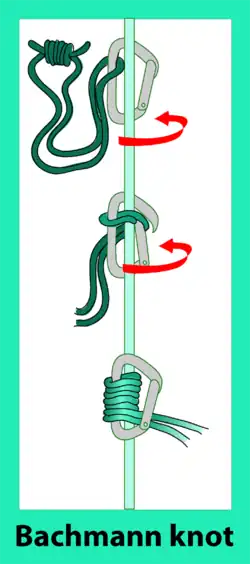
    The Bachmann hitch (sometimes misspelled ‘Bachman’) is a friction hitch, named after the Austrian alpinist Franz Bachmann.[1] It is useful when the friction hitch needs to be reset quickly or often or made to be self-tending as in crevasse and self-rescue. (See Prusik knot)

    The Bachmann hitch requires the use of a carabiner. It does not matter if the carabiner is locking or not. Most importantly, the carabiner must be of round cross section for friction. Grabbing hold of the carabiner will release the friction and allow the hitch to slide freely and thus be moved appropriately. To remove the Bachmann hitch, just unclip the top loop, hold on to the carabiner and pull the cord free.

    This knot is frequently tied using a sling made from 1″ tubular webbing. In this case wrap the webbing 3 times around the rope (this means the carabiner gate must be opened 3 times in the tying of the knot) for normal (dry) applications. There are a limited number of applications that involve repeated shock loads to the knot and in these 4 wraps are usually sufficient.

    However, with a non-locking carabiner it is safer to use the knot with the carabiner gate opening facing down (opposite to what is shown in the picture). This decreases the risk of self-unclipping: at maximum, one twist goes off. Otherwise, the whole knot may fail.

    It is important for safety reasons to mention that the rope used for the friction hitch should be smaller in diameter than the tension rope. This allows for movement when resetting the hitch position but when a large load is applied to the friction hitch, the hitch locks on to the tension rope. If two ropes of the same diameter are used for the friction hitch and tension rope, the hitch may move freely like a slip knot (lasso or noose) and not lock into place. When encircling any cylindrical object, most ropes can only be tightened to a diameter slightly greater than the ropes own diameter(USMC Assault Climber Course).

    References

    1. Luebben, Craig (2011). Knots for Climbers. Rowman & Littlefield. ISBN 978-0-7627-6858-5.

    See also

    External links


    This article is adapted from “Bachmann knot” on Wikipedia, written by its contributors, and used under CC BY-SA 4.0. Text on this page is available under the same licence. Source snapshot: Wikipedia via Kiwix, 2026-07-20.