| Plafond | |
|---|---|
 |
|
| Names | Plafond, Chinese Lanyard Knot,[1] Китайский мусинг,[2][3] lunette noeud,[4] two-strand Chinese lanyard knot,[5] Caisson Ceiling Knot[6] |
| Category | Decorative |
| ABoK | 807 |
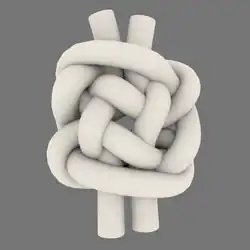
The Plafond knot,[7] with its spiral-like center and rectangular border, was inspired by the decorations found on the dome-like central sections of ceilings in Chinese temples and palaces. The ceilings, which are divided into nine rectangular sections, three across and three deep, each have a domed apex composed of a circular design filled with auspicious motifs surrounded by a complementary motif which radiates out to the rectangular border. This effect is echoed in the plafond knot, which is made by hooking up and tightening a number of flat knots.[7]
The knot is also known by other names:
| name | source |
|---|---|
| 藻井結, (simplified: 藻井结) | Chen 1.[8] |
| 藻井結 | Ruri-Ishikawa |
| Spectacles Knot (안경매듭) | tUBoDk[9] |
See also
External links
References
- ↑ The Complete Book of Decorative Knots — Geoffrey Budworth — ISBN 1-55821-791-6
- ↑ Шпаковский М. М. Большая энциклопедия узлов. — ACT, 2016. — С. 142. — 256 с. — ISBN 978-5-17-093501-7
- ↑ Джеффри Будворт. Узлы. Полная энциклопедия. (2014) — 140 с. — ISBN 978-5-699-68816-6
- ↑ Kim Sang Lan. L’art du meadup noeuds coréens Bijoux & accessoires — ISBN 978-2215078166
- ↑ The Ashley Book of Knots — Ashley, Clifford W.. — Published by Faber and Faber, 1993 — ISBN 9780571096596
- ↑ The Art of Chinese and Western Knotting — ISBN 962-15-0234-9
- 1 2 Lydia Chen. The complete book of Chinese knotting — p. 102 — ISBN 978-0 8048-3679-1
- ↑ Lydia Chen. Chinese Knotting (1981) — ISBN 0-8048-1389-2
- ↑ Lindsey Phylpott.The ultimate book of decorative knots — p 363 — ISBN 978-1-4081-5726-8
This article is adapted from “Plafond knot” on Wikipedia, written by its contributors, and used under CC BY-SA 4.0. Text on this page is available under the same licence. Source snapshot: Wikipedia via Kiwix, 2026-07-20.