| Round turn and two half-hitches | |
|---|---|
 |
|
| Names | Round turn and two half-hitches, Round turn and a half-hitch, Two round turns and two half-hitches, etc. |
| Category | Hitch |
| Related | Two half-hitches, Clove hitch, Buntline hitch, capstan equation |
| Typical use | Secure the end of a rope to a fixed object. |
| ABoK | #1720, #1721, #1784, #1834, #1835, #1836, #1883, #1884, #1910 |
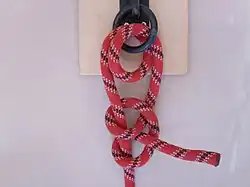
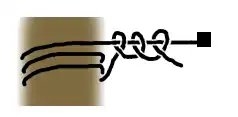
The round turn and two half hitches is a hitch used to secure the end of a rope to a fixed object. The name refers to the components used to form the knot: a round turn wraps the rope around the object (completely encircling it) and the two half hitches secure the end around the standing part. Variations of this hitch can be made with differing numbers of turns and half-hitches; an example is illustrated below. With additional turns, it becomes a pipe hitch.
The Round Turn and Two Half Hitches is named by Steel in 1794. If a spar is small, a round turn is preferable to a single turn. It makes a stronger knot and dissipates the wear.
— Clifford W Ashley, Ashley Book of Knots, [1]
References
- ↑ Ashley, Clifford W. (1944). The Ashley Book of Knots.
This article is adapted from “Round turn and two half-hitches” on Wikipedia, written by its contributors, and used under CC BY-SA 4.0. Text on this page is available under the same licence. Source snapshot: Wikipedia via Kiwix, 2026-07-20.