This article is adapted from “7 2 knot” on Wikipedia, written by its contributors, and used under CC BY-SA 4.0. Text on this page is available under the same licence. Source snapshot: Wikipedia via Kiwix, 2026-07-20.
A marudai (丸台, lit.‘round stand‘) is the most common of the traditional frames used for making kumihimo, a type of Japanese braid.[1]
Etymology
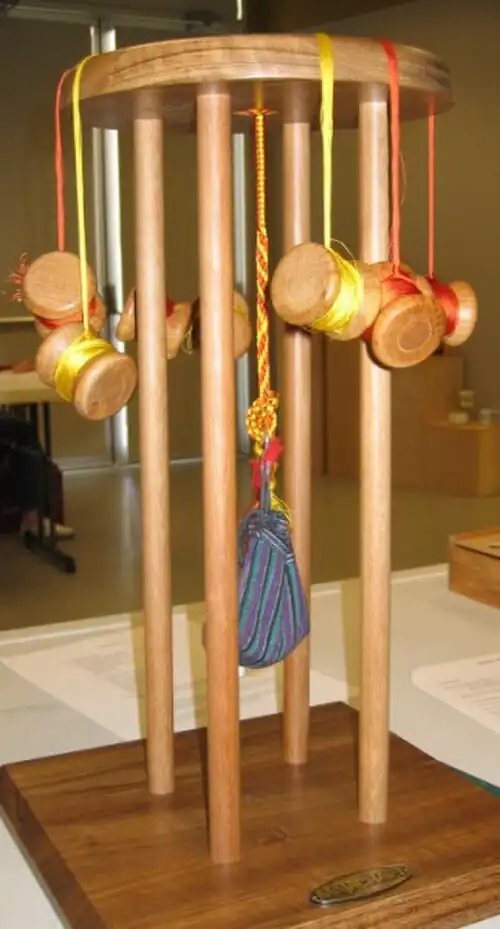
The marudai is generally made of a close-grained wood and consists of a round disk (kagami or “mirror”)[1] with a hole in the center, supported by four legs set in a base. The Japanese style marudai is often about 16in (41cm) high and is used while kneeling or when placed on a table. The Western style 26in (66cm)marudai allows the braider to sit in a chair to braid.
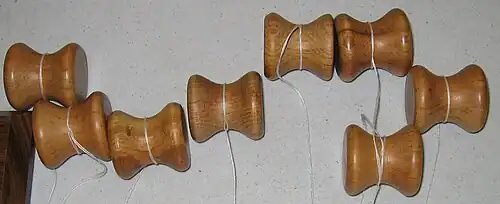
The warp threads that form the braid are wound around weighted bobbins called tama (lit.‘egg‘).[1]Tama were once made of clay, but now are most commonly wood filled with lead. The weight of the tama maintains even tension on the warp threads, and is balanced by a bag of counterweights called omori[1] that is attached to the base of the braid.
Modern braiders often replace the marudai with a foam disk with numbered slots that tightly grip the warp threads to maintain warp tension, so that weighted bobbins are not needed; instead, flexible plastic bobbins are used to prevent tangling of the threads. Unlike kumihimo disks, marudai have no indication of where the thread should be placed; it is done freehand.
Related terms
Kagami – “Mirror”, the polished wooden top disk of the marudai.[1]
Kongō Gumi – a class of patterns for round cord all involving eight threads folded in half for a total of sixteen strands. In clockwise order, each bobbins is moved to the opposite side. When different combinations of thread color are used, many interesting patterns emerge, including diagonal stripes, diamonds on a background, triangles resembling hearts, and tiny six-petalled flowers. Kongō Gumi is named for the venerable Kongō Gumi company of Japan, the oldest known company in the world.
Kumihimo or kumi himo – Japanese for “gathered threads”.
Obi – the broad cloth sash worn with kimono; kumihimo braids are often used as obijime, worn on top of the obi.
Obijime – the cord used to fasten the obi securely in some obi styles. Usually one string of kumihimo is tied around the obi securely, and an accessory called the obidome is often added in front for decoration.
Omori – Counterweights used in kumihimo braiding.[1]
Takadai – a rectangular or square frame for kumihimo.
Tama – little spools. The thread is kept from unwinding by passing the thread under itself, forming a loop around the tama.
True silk – a hollow fiber with a rough surface that resists slipping past the loop unless gently pulled. For synthetic fibers, a flexible plastic “clamshell” bobbin may be preferable.
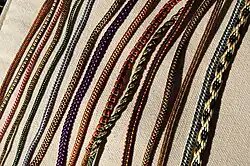
A number of tama in use.Example kumihimo of several different styles.
Tada, Makiko. (1996) Andesu No Kumihimo: Kādo to Marudai. [Andean sling braids]. (Kumihimo sōran series, 2) Hino: Tekusuto. 2nd ed., (in Japanese) with some English. ISBN4925252127, 9784925252126, OCLC977659717 .
Carey, Jacqui. (1997) The Craft of Kumihimo. New York: Midpoint Trade Books, In. ISBN9780855328283, 0855328282, OCLC903504434.
Carey, Jacqui. (1997) Beginner’s Guide to Braiding, the Craft of Kumihimo. Tunbridge Wells: Search Press. ISBN0855328282, 9780855328283, OCLC472775122
Tada, Makiko (2008). Tada Makiko Kumihimo-ten: dento no bi to sentan gijutsu [Makiko Tada kumihimo show: traditional beauty and the latest technics]. Naruse Memorial Hall (ed). Tokyo: Japan Women’s College (Tsukuru series 5). NCIDBB19346894. (in Japanese)
Sakai, Aiko; Tada, Makiko. E o mite wakaru kumihimo: Tanoshiku dekiru marudai kakudai ayadake-dai [Visual guide to kumihimo: practice on marudai, kakudai, and ayadake-dai with fun], Japan Vogue, OCLC676423318. (in Japanese)
Tada, Makiko. (April 2014) Marudai braids 120.(Comprehensive treatise of braids 1), 3rd ed., Hino : Tekusuto. (in Japanese) with some English. OCLC676423383
Chottikampon K.; Mathurosemontri S.; Marui H.; Sirisuwan P.; Inoda M., et al. (2015) Comparison of braiding skills between expert and non-experts by eye’s movement measurement. Lecture Notes in Computer Science (including subseries Lecture Notes in Artificial Intelligence and Lecture Notes in Bioinformatics) 9184 (2015): 14-23 ISSN0302-9743, OCLC5932476964
Tada, Makiko. (2017). Utsukushii kumihimo to komono no reshipi: marudai de tsukuru honkakuteki na kumihimo o mijika na dōgu de yasashiku kawaiku. [Beautiful kumihimo recipes for marudai you braid with everyday tools, fun and pretty] Tōkyō: Nihon Bungeisha. ISBN9784537214901, 4537214902, OCLC995846156. (in Japanese)
Footnotes
References
123456Owen, Rodrick (1931-) (2004). Braids: 250 patterns from Japan, Peru & beyond. Berkeley, California: Lacis. ISBN1893063089. OCLC79431006.{{cite book}}: CS1 maint: numeric names: authors list (link)
This article is adapted from “Marudai” on Wikipedia, written by its contributors, and used under CC BY-SA 4.0. Text on this page is available under the same licence. Source snapshot: Wikipedia via Kiwix, 2026-07-20.
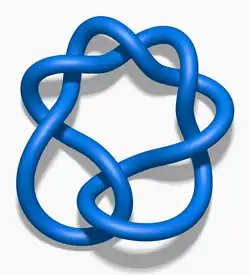
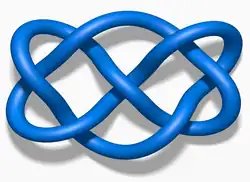
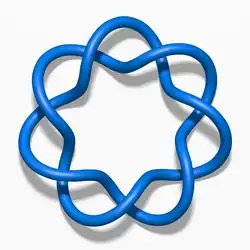
In mathematical knot theory, 74 is the name of a 7-crossing knot which can be visually depicted in a highly-symmetric form, and so appears in the symbolism and/or artistic ornamentation of various cultures.
Visual representations
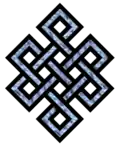
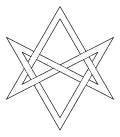
The interlaced version of the simplest form of the Endless knot symbol of Buddhism is topologically equivalent to the 74 knot (though it appears to have nine crossings), as is the interlaced version of the unicursal hexagram of occultism.[1] (However, the endless knot symbol has more complex forms not equivalent to 74, and both the endless knot and unicursal hexagram can appear in non-interlaced versions, in which case they are not knots at all.)
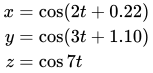
The 74 knot is a Lissajous knot, representable for example by the parametric equation[2]
↑Lamm, C. (1997). “There are infinitely many Lissajous knots”. Manuscripta Mathematica. 93: 29–37. doi:10.1007/BF02677455. S2CID123288245.
↑Celtic Art: The Methods of Construction by George Bain, p. 27 (ISBN0-486-22923-8)
This article is adapted from “74 knot” on Wikipedia, written by its contributors, and used under CC BY-SA 4.0. Text on this page is available under the same licence. Source snapshot: Wikipedia via Kiwix, 2026-07-20.
The marlinespike hitch is a temporary knot used to attach a rod to a rope in order to form a handle.[1] This allows more tension than could be produced comfortably by gripping the rope with the hands alone. It is useful when tightening knots and for other purposes in ropework.
As the name suggests, the type of rod traditionally used with this hitch is a marlinespike. The advantages of this hitch over others which might serve the purpose are its quickness of tying and ease of releasing. Topologically it is a form of the noose, but in practice this hitch is not allowed to collapse into that shape. When it does capsize into a traditional noose, it can jam against the rod, making it much more difficult to release.[2]
The hitch is frequently used by hammock campers to attach adjustable rope slings (“whoopie slings”) to the webbing straps that are used to attach hammocks to trees.
By passing the working end through the marlinespike hitch, this knot can be used as an alternative method of tying the Bowline knot. Passing through in the opposite direction will give you the Cowboy bowline (also known as the left-hand bowline, Dutch marine bowline or winter bowline).
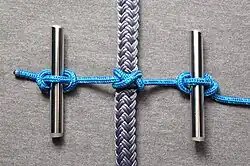
A constrictor knot prepared for tightening using two rods and marlinespike hitches
Tying
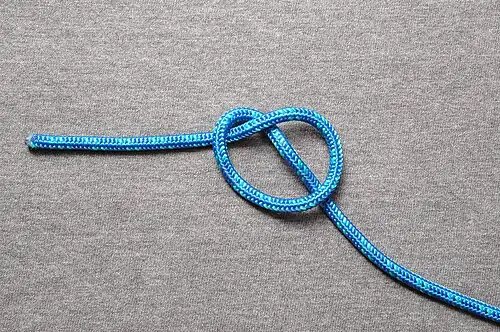
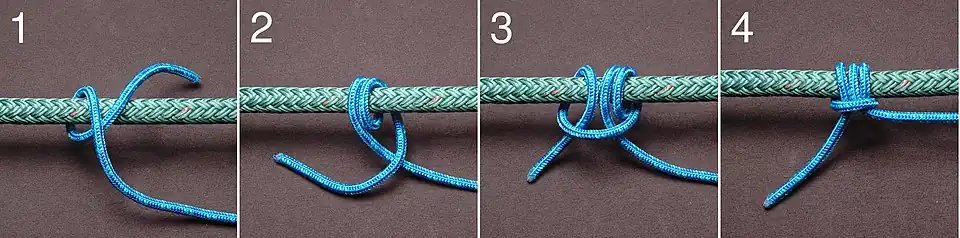
Below is a basic method of tying. The knot can also be made by using the rod itself to form the loop, but the tying method does not affect the performance of the resulting hitch.
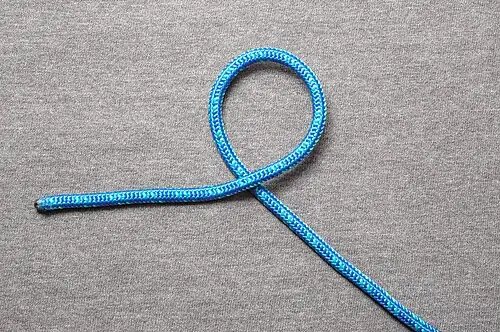
Begin with an overhand loop, that is, a loop in which the working part passes over the standing part:
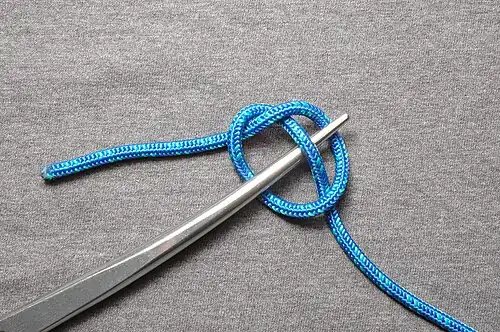
Fold the loop over the working part, towards the standing part such that the standing part is visible through the center of the loop:
In stiffer material the first two steps can be accomplished in a single motion by twisting the working part with the fingers until a loop forms and flops over the standing part.
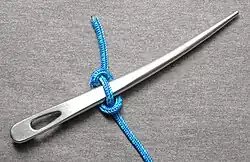
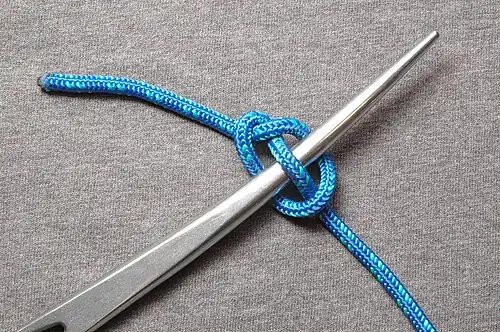
Use the rod to snag a bight of the standing part through the loop, that is, pass the rod over the near side of the loop, under the standing part and then over the far side of the loop:
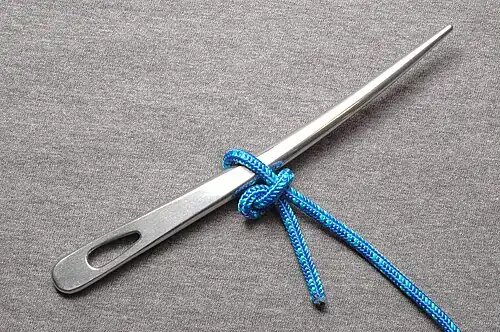
Before tensioning, excess slack can be removed by pulling simultaneously on both the working and standing parts:
In actual use the hitch should be loaded only from the standing side.
Undesirable capsized form
If the working end is loaded rather than the standing part, the knot will capsize into an overhand noose:
While this form may still hold when the standing part is subsequently loaded, it can jam badly against the rod. This is especially troublesome if the rod is not tapered.
See also
Marlinespike seamanship
References
↑Clifford W. Ashley, The Ashley Book of Knots (New York: Doubleday, 1944), 330.
This article is adapted from “Marlinespike hitch” on Wikipedia, written by its contributors, and used under CC BY-SA 4.0. Text on this page is available under the same licence. Source snapshot: Wikipedia via Kiwix, 2026-07-20.
This article is adapted from “71 knot” on Wikipedia, written by its contributors, and used under CC BY-SA 4.0. Text on this page is available under the same licence. Source snapshot: Wikipedia via Kiwix, 2026-07-20.
Like the figure-eight knot, the 63 knot is fully amphichiral. This means that the 63 knot is amphichiral,[2] meaning that it is indistinguishable from its own mirror image. In addition, it is also invertible, meaning that orienting the curve in either direction yields the same oriented knot.
This article is adapted from “63 knot” on Wikipedia, written by its contributors, and used under CC BY-SA 4.0. Text on this page is available under the same licence. Source snapshot: Wikipedia via Kiwix, 2026-07-20.
In mathematics the Markov theorem gives necessary and sufficient conditions for two braids to have closures that are equivalent knots or links. The conditions are stated in terms of the group structures on braids.
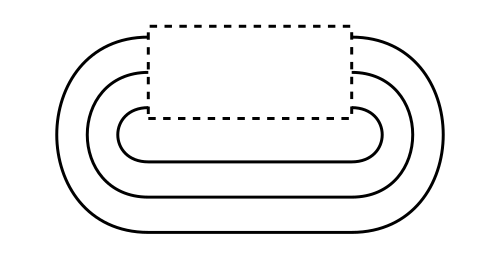
Braids are algebraic objects described by diagrams; the relation to topology is given by Alexander’s theorem which states that every knot or link in three-dimensional Euclidean space is the closure of a braid. The Markov theorem, proved by Russian mathematician Andrei Andreevich Markov Jr.[1] describes the elementary moves generating the equivalence relation on braids given by the equivalence of their closures.
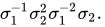
More precisely Markov’s theorem can be stated as follows:[2][3] given two braids represented by elements in the braid groups , their closures are equivalent links if and only if can be obtained from applying to a sequence of the following operations:
conjugating in ;
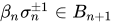
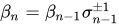
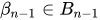
replacing by (here are the standard generators of the braid groups; geometrically this amounts to adding a strand to the right of the braid diagram and twisting it once with the (previously) last strand);
the inverse of the previous operation (if with replace with ).
In 1974 American mathematician Joan Birman published a monograph, Braids, Links, and Mapping Class Groups, based on a graduate course she taught as a visiting professor at Princeton University in 1971–72; this book contains the first complete proof of the Markov theorem.[4]
↑Birman, Joan (1974). Braids, Links, and Mapping Class Groups. Annals of Mathematics Studies. Vol.82. Princeton University Press., Theorem 2.3 on p. 51
↑Kauffman, Louis (1991). Knots and Physics. World Scientific., p.95
This article is adapted from “Markov theorem” on Wikipedia, written by its contributors, and used under CC BY-SA 4.0. Text on this page is available under the same licence. Source snapshot: Wikipedia via Kiwix, 2026-07-20.
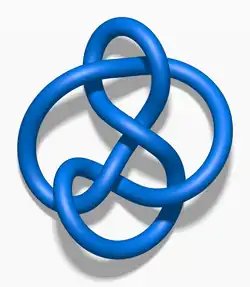
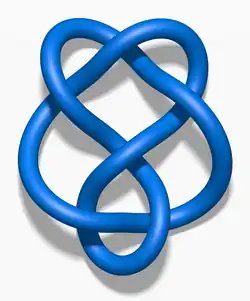
In knot theory, the 62 knot is one of three prime knots with crossing number six, the others being the stevedore knot and the 63 knot. This knot is sometimes referred to as the Miller Institute knot,[1] because it appears in the logo[2] of the Miller Institute for Basic Research in Science at the University of California, Berkeley.
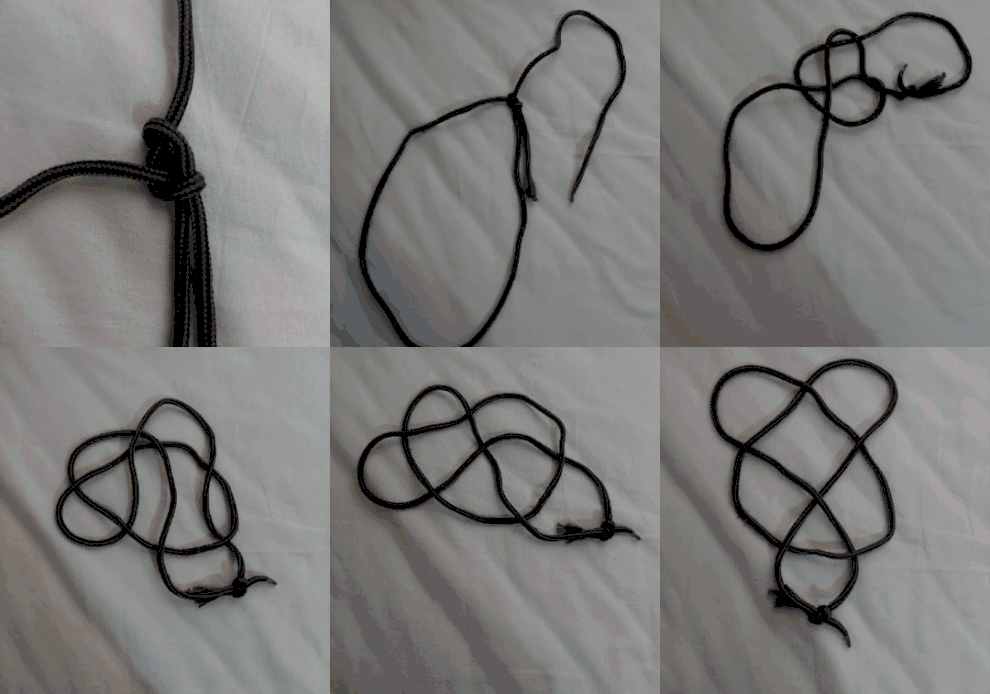
If a bowline is tied and the two free ends of the rope are brought together in the simplest way, the knot obtained is the 62 knot. The sequence of necessary moves are depicted here:
This article is adapted from “62 knot” on Wikipedia, written by its contributors, and used under CC BY-SA 4.0. Text on this page is available under the same licence. Source snapshot: Wikipedia via Kiwix, 2026-07-20.
The magnus hitch is a knot similar to a rolling hitch or clove hitch, used to tie a rope or line to a pole, spar, or another line. It is tied similarly to a rolling hitch but with the final hitch in the opposite direction. It can be more tricky to snug up, since both lines emerge from the same side of the hitch, but it has less tendency to twist under load.
Tying
To tie a magnus hitch:
Start with a turn around the object. Bring the working end towards the direction of pull and between the standing part and the object.
Make another wrap around the object, completing a round turn. The wraps of the round turn should progress towards the desired direction of pull. Bring the working end out over the standing part away from the direction of pull.
Complete with a half hitch, moving around the object in the opposite direction as the first turns, as for a cow hitch.
Dress by snugging the hitch around the object before applying load, away from the tail of the hitch.
Ashley, Clifford Warren (1944), “#1736. Magnus Hitch”, The Ashley Book of Knots, Mariners’ Museum Publications, vol.13, Random House, p.298, ISBN9780385040259{{citation}}: ISBN / Date incompatibility (help).
Blandford, Percy W. (2012), Practical Knots and Ropework, Courier Dover Publications, pp.150–151, ISBN9780486148656.
This article is adapted from “Magnus hitch” on Wikipedia, written by its contributors, and used under CC BY-SA 4.0. Text on this page is available under the same licence. Source snapshot: Wikipedia via Kiwix, 2026-07-20.
Lào zi (simplified Chinese:络子; traditional Chinese:絡子), also called Tāo zi (绦子), is an ancient name for knots in China.[1] In ancient Chinese literature, the Lào zi actually refers to what is now known as zhongguo jie (simplified Chinese:中国结; traditional Chinese:中國結; Hanyu Pinyin:zhōngguó jié; Tongyong Pinyin:li; lit.‘Chinese knots‘) in Chinese and Chinese knotting in English. The term Chinese knotting only became known in recent years when it was summarized by Lydia Chen in the 1980s.[2] It was a tradition to use the lào and/or tāo as a form of yaopei (“waist girdle ornament”) in Hanfu where it was tied to the waist by using silk or cotton ribbon.[1]
Etymology
The meaning of the two terms Lào zi and Tāo zi are quite similar.
The Chinese character for lào (络; 絡) refers to knotting, enmeshing, and wrapping.[3] The Chinese character for tāo (绦) refers to the lace or flat ribbon woven from silk thread which can used to decorate clothing.[4]
Usage
According to Dream of the Red Chamber, making Lào zi means making knots that can be used on waist as knotting belt; the Lào zi could also be as decorative knots with tassel hanging for small object or furnishing (similar to the norigae used in the hanbok). As a form of knot-craft, it could be used to knot a net sachet for containing small objects.[5]
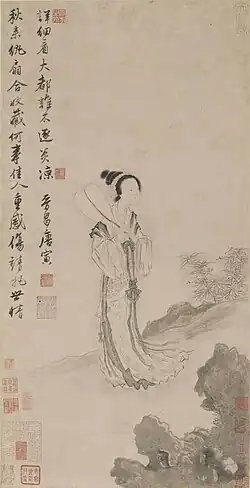
The knot at the waist by ribbon can be seen from many artworks especially in the beauty painting, and ancient literature description recorded that the tradition of knot ribbon can be traced back to the Spring and Autumn period (770 – 76 BCE); for example, in the chapter Zhaogong (昭公) of the Zuo Zhuan (左傳), the tradition of tying ribbon as knots to the belt is recorded.[6]
↑紅樓夢/第035回[Dream of the Red Chamber·Chapter 35]. Wikisource. Retrieved 2020-07-14.
↑春秋左传·昭公[Zuo Zhuan·Zhao Gong]. Wikisource. Retrieved 14 July 2020.
This article is adapted from “Lào zi” on Wikipedia, written by its contributors, and used under CC BY-SA 4.0. Text on this page is available under the same licence. Source snapshot: Wikipedia via Kiwix, 2026-07-20.