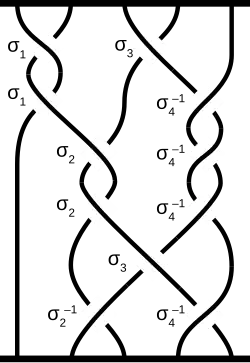
In mathematics Alexander’s theorem states that every knot or link can be represented as a closed braid; that is, a braid in which the corresponding ends of the strings are connected in pairs. The theorem is named after James Waddell Alexander II, who published a proof in 1923.[1]
Braids were first considered as a tool of knot theory by Alexander. His theorem gives a positive answer to the question Is it always possible to transform a given knot into a closed braid? A good construction example is found in Colin Adams’s book.[2]
However, the correspondence between knots and braids is clearly not one-to-one: a knot may have many braid representations. For example, conjugate braids yield equivalent knots. This leads to a second fundamental question: Which closed braids represent the same knot type?
This question is addressed in Markov’s theorem, which gives ‘moves’ relating any two closed braids that represent the same knot.
References
- ↑ Alexander, James (1923). “A lemma on a system of knotted curves”. Proceedings of the National Academy of Sciences of the United States of America. 9 (3): 93–95. Bibcode:1923PNAS….9…93A. doi:10.1073/pnas.9.3.93. PMC 1085274. PMID 16576674.
- ↑ Adams, Colin C. (2004). The Knot Book. Revised reprint of the 1994 original. Providence, RI: American Mathematical Society. p. 130. ISBN 0-8218-3678-1. MR 2079925.
- Sossinsky, Alexei B. (2002). Knots: Mathematics with a Twist. Cambridge, MA: Harvard University Press. p. 17. ISBN 9780674009448. MR 1941191.
This article is adapted from “Alexander's theorem” on Wikipedia, written by its contributors, and used under CC BY-SA 4.0. Text on this page is available under the same licence. Source snapshot: Wikipedia via Kiwix, 2026-07-20.