Lissajous knot

Written by

in

In knot theory, a Lissajous knot is a knot defined by parametric equations of the form

x = cos ( n x t + ϕ x ) , y = cos ( n y t + ϕ y ) , z = cos ( n z t + ϕ z ) , {\displaystyle x=\cos(n_{x}t+\phi _{x}),\qquad y=\cos(n_{y}t+\phi _{y}),\qquad z=\cos(n_{z}t+\phi _{z}),} {\displaystyle x=\cos(n_{x}t+\phi _{x}),\qquad y=\cos(n_{y}t+\phi _{y}),\qquad z=\cos(n_{z}t+\phi _{z}),}
Lissajous knot
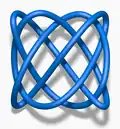
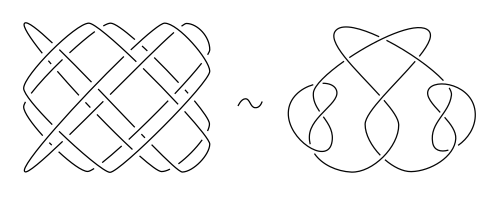
A Lissajous 821 knot

where n x {\displaystyle n_{x}} {\displaystyle n_{x}}, n y {\displaystyle n_{y}} {\displaystyle n_{y}}, and n z {\displaystyle n_{z}} {\displaystyle n_{z}} are integers and the phase shifts ϕ x {\displaystyle \phi _{x}} {\displaystyle \phi _{x}}, ϕ y {\displaystyle \phi _{y}} {\displaystyle \phi _{y}}, and ϕ z {\displaystyle \phi _{z}} {\displaystyle \phi _{z}} may be any real numbers.[1]

The projection of a Lissajous knot onto any of the three coordinate planes is a Lissajous curve, and many of the properties of these knots are closely related to properties of Lissajous curves.

Replacing the cosine function in the parametrization by a triangle wave transforms every Lissajous
knot isotopically into a billiard curve inside a cube, the simplest case of so-called billiard knots.
Billiard knots can also be studied in other domains, for instance in a cylinder[2] or in a (flat) solid torus (Lissajous-toric knot).

Form

Because a knot cannot be self-intersecting, the three integers n x , n y , n z {\displaystyle n_{x},n_{y},n_{z}} {\displaystyle n_{x},n_{y},n_{z}} must be pairwise relatively prime, and none of the quantities

n x ϕ y n y ϕ x , n y ϕ z n z ϕ y , n z ϕ x n x ϕ z {\displaystyle n_{x}\phi _{y}-n_{y}\phi _{x},\quad n_{y}\phi _{z}-n_{z}\phi _{y},\quad n_{z}\phi _{x}-n_{x}\phi _{z}} {\displaystyle n_{x}\phi _{y}-n_{y}\phi _{x},\quad n_{y}\phi _{z}-n_{z}\phi _{y},\quad n_{z}\phi _{x}-n_{x}\phi _{z}}

may be an integer multiple of pi. Moreover, by making a substitution of the form t = t + c {\displaystyle t’=t+c} {\displaystyle t'=t+c}, one may assume that any of the three phase shifts ϕ x {\displaystyle \phi _{x}} {\displaystyle \phi _{x}}, ϕ y {\displaystyle \phi _{y}} {\displaystyle \phi _{y}}, ϕ z {\displaystyle \phi _{z}} {\displaystyle \phi _{z}} is equal to zero.

Examples

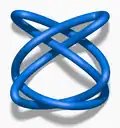
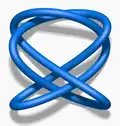
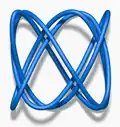
Here are some examples of Lissajous knots,[3] all of which have ϕ z = 0 {\displaystyle \phi _{z}=0} {\displaystyle \phi _{z}=0}:

  • Three-twist knot  


        (
        
          n
          
            x
          
        
        ,
        
          n
          
            y
          
        
        ,
        
          n
          
            z
          
        
        )
        =
        (
        3
        ,
        2
        ,
        7
        )
      
    
    {\displaystyle (n_{x},n_{y},n_{z})=(3,2,7)}


        (
        
          ϕ
          
            x
          
        
        ,
        
          ϕ
          
            y
          
        
        )
        =
        (
        0.7
        ,
        0.2
        )
      
    
    {\displaystyle (\phi _{x},\phi _{y})=(0.7,0.2)}
    Three-twist knot
    ( n x , n y , n z ) = ( 3 , 2 , 7 ) {\displaystyle (n_{x},n_{y},n_{z})=(3,2,7)} {\displaystyle (n_{x},n_{y},n_{z})=(3,2,7)}
    ( ϕ x , ϕ y ) = ( 0.7 , 0.2 ) {\displaystyle (\phi _{x},\phi _{y})=(0.7,0.2)} {\displaystyle (\phi _{x},\phi _{y})=(0.7,0.2)}
  • Stevedore knot  


        (
        
          n
          
            x
          
        
        ,
        
          n
          
            y
          
        
        ,
        
          n
          
            z
          
        
        )
        =
        (
        3
        ,
        2
        ,
        5
        )
      
    
    {\displaystyle (n_{x},n_{y},n_{z})=(3,2,5)}


        (
        
          ϕ
          
            x
          
        
        ,
        
          ϕ
          
            y
          
        
        )
        =
        (
        1.5
        ,
        0.2
        )
      
    
    {\displaystyle (\phi _{x},\phi _{y})=(1.5,0.2)}
    Stevedore knot
    ( n x , n y , n z ) = ( 3 , 2 , 5 ) {\displaystyle (n_{x},n_{y},n_{z})=(3,2,5)} {\displaystyle (n_{x},n_{y},n_{z})=(3,2,5)}
    ( ϕ x , ϕ y ) = ( 1.5 , 0.2 ) {\displaystyle (\phi _{x},\phi _{y})=(1.5,0.2)} {\displaystyle (\phi _{x},\phi _{y})=(1.5,0.2)}
  • Square knot  


        (
        
          n
          
            x
          
        
        ,
        
          n
          
            y
          
        
        ,
        
          n
          
            z
          
        
        )
        =
        (
        3
        ,
        5
        ,
        7
        )
      
    
    {\displaystyle (n_{x},n_{y},n_{z})=(3,5,7)}


        (
        
          ϕ
          
            x
          
        
        ,
        
          ϕ
          
            y
          
        
        )
        =
        (
        0.7
        ,
        1.0
        )
      
    
    {\displaystyle (\phi _{x},\phi _{y})=(0.7,1.0)}
    Square knot
    ( n x , n y , n z ) = ( 3 , 5 , 7 ) {\displaystyle (n_{x},n_{y},n_{z})=(3,5,7)} {\displaystyle (n_{x},n_{y},n_{z})=(3,5,7)}
    ( ϕ x , ϕ y ) = ( 0.7 , 1.0 ) {\displaystyle (\phi _{x},\phi _{y})=(0.7,1.0)} {\displaystyle (\phi _{x},\phi _{y})=(0.7,1.0)}
  • 821 knot  


        (
        
          n
          
            x
          
        
        ,
        
          n
          
            y
          
        
        ,
        
          n
          
            z
          
        
        )
        =
        (
        3
        ,
        4
        ,
        7
        )
      
    
    {\displaystyle (n_{x},n_{y},n_{z})=(3,4,7)}


        (
        
          ϕ
          
            x
          
        
        ,
        
          ϕ
          
            y
          
        
        )
        =
        (
        0.1
        ,
        0.7
        )
      
    
    {\displaystyle (\phi _{x},\phi _{y})=(0.1,0.7)}
    821 knot
    ( n x , n y , n z ) = ( 3 , 4 , 7 ) {\displaystyle (n_{x},n_{y},n_{z})=(3,4,7)} {\displaystyle (n_{x},n_{y},n_{z})=(3,4,7)}
    ( ϕ x , ϕ y ) = ( 0.1 , 0.7 ) {\displaystyle (\phi _{x},\phi _{y})=(0.1,0.7)} {\displaystyle (\phi _{x},\phi _{y})=(0.1,0.7)}

There are infinitely many different Lissajous knots,[4] and other examples with 10 or fewer crossings include the 74 knot, the 815 knot, the 101 knot, the 1035 knot, the 1058 knot, and the composite knot 52* # 52,[1] as well as the 916 knot, 1076 knot, the 1099 knot, the 10122 knot, the 10144 knot, the granny knot, and the composite knot 52 # 52.[5] In addition, it is known that every twist knot with Arf invariant zero is a Lissajous knot.[6]

Symmetry

Lissajous knots are highly symmetric, though the type of symmetry depends on whether or not the numbers n x {\displaystyle n_{x}} {\displaystyle n_{x}}, n y {\displaystyle n_{y}} {\displaystyle n_{y}}, and n z {\displaystyle n_{z}} {\displaystyle n_{z}} are all odd.

Odd case

If n x {\displaystyle n_{x}} {\displaystyle n_{x}}, n y {\displaystyle n_{y}} {\displaystyle n_{y}}, and n z {\displaystyle n_{z}} {\displaystyle n_{z}} are all odd, then the point reflection across the origin ( x , y , z ) ( x , y , z ) {\displaystyle (x,y,z)\mapsto (-x,-y,-z)} {\displaystyle (x,y,z)\mapsto (-x,-y,-z)} is a symmetry of the Lissajous knot which preserves the knot orientation.

In general, a knot that has an orientation-preserving point reflection symmetry is known as strongly positive amphicheiral.[7] This is a fairly rare property: only seven prime knots with twelve or fewer crossings are strongly positive amphicheiral (1099, 10123, 12a427, 12a1019, 12a1105, 12a1202, 12n706).[8] Since this is so rare, ′most′ prime Lissajous knots lie in the even case.

Even case

If one of the frequencies (say n x {\displaystyle n_{x}} {\displaystyle n_{x}}) is even, then the 180° rotation around the x-axis ( x , y , z ) ( x , y , z ) {\displaystyle (x,y,z)\mapsto (x,-y,-z)} {\displaystyle (x,y,z)\mapsto (x,-y,-z)} is a symmetry of the Lissajous knot. In general, a knot that has a symmetry of this type is called 2-periodic, so every even Lissajous knot must be 2-periodic.

Consequences
Lissajous knot
A Lissajous knot with three factors: ( n x , n y , n z ) = ( 4 , 5 , 41 ) {\displaystyle (n_{x},n_{y},n_{z})=(4,5,41)} {\displaystyle (n_{x},n_{y},n_{z})=(4,5,41)},
( ϕ x , ϕ y ) = ( 0.01 , 0.16 ) {\displaystyle (\phi _{x},\phi _{y})=(0.01,0.16)} {\displaystyle (\phi _{x},\phi _{y})=(0.01,0.16)}

The symmetry of a Lissajous knot puts severe constraints on the Alexander polynomial. In the odd case, the Alexander
polynomial of the Lissajous knot must be a perfect square.[9] In the even case, the Alexander polynomial must be a perfect square modulo 2.[10] In addition, the Arf invariant of a Lissajous knot must be zero. It follows that:

References

  1. 1 2 Bogle, M. G. V.; Hearst, J. E.; Jones, V. F. R.; Stoilov, L. (1994). “Lissajous knots”. Journal of Knot Theory and Its Ramifications. 3 (2): 121–140. doi:10.1142/S0218216594000095.
  2. Lamm, Christoph; Obermeyer, Daniel (1999). “Billiard knots in a cylinder”. Journal of Knot Theory and Its Ramifications. 8 (3): 353–366. arXiv:math/9811006. Bibcode:1998math…..11006L. doi:10.1142/S0218216599000225. S2CID 17489206.
  3. Cromwell, Peter R. (2004). Knots and links. Cambridge, UK: Cambridge University Press. p. 13. ISBN 978-0-521-54831-1.
  4. Lamm, C. (1997). “There are infinitely many Lissajous knots”. Manuscripta Mathematica. 93: 29–37. doi:10.1007/BF02677455. S2CID 123288245.
  5. Boocher, Adam; Daigle, Jay; Hoste, Jim; Zheng, Wenjing (2007). “Sampling Lissajous and Fourier knots”. arXiv:0707.4210 [math.GT].
  6. Hoste, Jim; Zirbel, Laura (2006). “Lissajous knots and knots with Lissajous projections”. arXiv:math.GT/0605632.
  7. Przytycki, Jozef H. (2004). “Symmetric knots and billiard knots”. In Stasiak, A.; Katrich, V.; Kauffman, L. (eds.). Ideal Knots. Series on Knots and Everything. Vol. 19. World Scientific. pp. 374–414. arXiv:math/0405151. Bibcode:2004math……5151P.
  8. See Lamm, Christoph (2023). “Strongly positive amphicheiral knots with doubly symmetric diagrams”. arXiv:2310.05106 [math.GT]. This article contains a complete list of prime strongly positive amphicheiral knots up to 16 crossings.
  9. Hartley, R.; Kawauchi, A (1979). “Polynomials of amphicheiral knots”. Mathematische Annalen. 243: 63–70. doi:10.1007/bf01420207. S2CID 120648664.
  10. Murasugi, K. (1971). “On periodic knots”. Commentarii Mathematici Helvetici. 46: 162–174. doi:10.1007/bf02566836. S2CID 120483606.


This article is adapted from “Lissajous knot” on Wikipedia, written by its contributors, and used under CC BY-SA 4.0. Text on this page is available under the same licence. Source snapshot: Wikipedia via Kiwix, 2026-07-20.