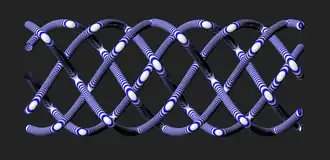
In knot theory, a Lissajous-toric knot is a knot defined by parametric equations of the form:

where  ,
,  , and
, and  are integers, the phase shift
  is a real number
and the parameter  varies between 0 and
  .[1]
.[1]
For  the knot is a torus knot.
Braid and billiard knot definitions
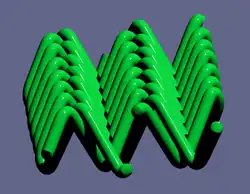
In braid form these knots can be defined in a square solid torus (i.e. the cube ![{\displaystyle [-1,1]^{3}}](/wp-content/uploads/wiki-images/98ff687f83fe9fc6244d40b9cb2f905a70b669a0-a7d03650.svg) with identified top and bottom) as
with identified top and bottom) as
![{\displaystyle x(t)=\sin 2\pi qt,\qquad y(t)=\cos 2\pi p(t+\phi ),\qquad z(t)=2(Nt-\lfloor Nt\rfloor )-1,\qquad t\in [0,1]}](/wp-content/uploads/wiki-images/2c54fe71777efccf873b68da4df8b1fcc5194fa9-e4c96a4c.svg) .
.
The projection of this Lissajous-toric knot onto the x-y-plane is a Lissajous curve.
Replacing the sine and cosine functions in the parametrization by a triangle wave transforms a Lissajous-toric
knot isotopically into a billiard curve inside the solid torus. Because of this property Lissajous-toric knots are also called billiard knots in a solid torus.[2]
Lissajous-toric knots were first studied as billiard knots and they share many properties with billiard knots in a cylinder.[3]
They also occur in the analysis of singularities of minimal surfaces with branch points[4] and in the study of
the Three-body problem.[5]
The knots in the subfamily with  , with an integer
  , are known as ′Lemniscate knots′.[6] Lemniscate knots have period and are fibred. The knot shown on the right is of this type (with
  ).
).
Properties
Lissajous-toric knots are denoted by 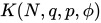 . To ensure that the knot is traversed only once in the parametrization
the conditions  are needed. In addition, singular values for the phase, leading to self-intersections, have to be excluded.
The isotopy class of Lissajous-toric knots surprisingly does not depend on the phase (up to mirroring).
If the distinction between a knot and its mirror image is not important, the notation  can be used.
The properties of Lissajous-toric knots depend on whether and are coprime or  . The main properties are:
- Interchanging and :
 (up to mirroring).
- Ribbon property:
- If and are coprime, is a symmetric union and therefore a ribbon knot.
- Periodicity:
- If , the Lissajous-toric knot has period
 and the factor knot is a ribbon knot.
- Strongly positive amphicheirality:
- If and have different parity, then is strongly positive amphicheiral.
- Period 2:
- If and are both odd, then has period 2 (for even ) or is freely 2-periodic (for odd ).
Example
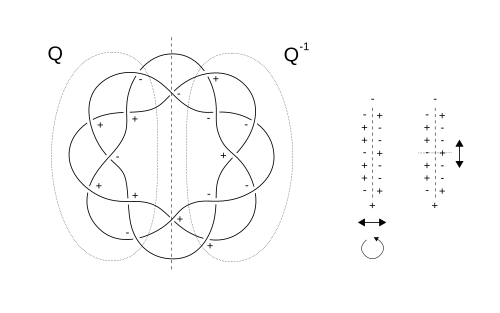
The knot T(3,8,7), shown in the graphics, is a symmetric union and a ribbon knot (in fact, it is the composite knot  ).
).
It is strongly positive amphicheiral: a rotation by  maps the knot to its mirror image, keeping its orientation.
An additional horizontal symmetry occurs as a combination of the vertical symmetry and the rotation (′double palindromicity′ in Kin/Nakamura/Ogawa).
′Classification′ of billiard rooms
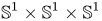
In the following table a systematic overview of the possibilities to build billiard rooms from the interval and the circle (interval with identified boundaries) is given:
| Billiard room | Billiard knots |
|---|---|
|
Lissajous knots |
![{\displaystyle [-1,1]^{2}\times \mathbb {S} ^{1}}](/wp-content/uploads/wiki-images/347fb1274b11bc218afba8c30a88583d116fd76b-1fe59a64.svg) |
Lissajous-toric knots |
![{\displaystyle [-1,1]\times \mathbb {S} ^{1}\times \mathbb {S} ^{1}}](/wp-content/uploads/wiki-images/8591b9ef82b90649d00841d8dcb4f69925d1aa4e-710e1a9a.svg) |
Torus knots |
 |
(room not embeddable into  ) ) |
In the case of Lissajous knots reflections at the boundaries occur in all of the three cube’s dimensions.
In the second case reflections occur in two dimensions and we have a uniform movement in the third dimension.
The third case is nearly equal to the usual movement on a torus, with an additional triangle wave movement in the first dimension.
References
- ↑ See M. Soret and M. Ville: Lissajous-toric knots,
J. Knot Theory Ramifications 29, 2050003 (2020). - ↑ See C. Lamm:
Deformation of cylinder knots, 4th chapter of Ph.D. thesis, ‘Zylinder-Knoten und symmetrische Vereinigungen‘, Bonner Mathematische Schriften 321 (1999), available since 2012 as arXiv:1210.6639. - ↑ See C. Lamm and
D. Obermeyer: Billiard knots in a cylinder, J. Knot Theory Ramifications 8, 353–-366 (1999). - ↑ See Soret/Ville.
- ↑ See E. Kin, H. Nakamura and H. Ogawa: Lissajous 3-braids, J. Math. Soc. Japan 75, 195–228 (2023) (or arXiv:2008.00585v4).
- ↑ See B. Bode, M.R. Dennis,
D. Foster and R.P. King: Knotted fields and explicit fibrations for lemniscate knots,
Proc. Royal Soc. A (2017).
This article is adapted from “Lissajous-toric knot” on Wikipedia, written by its contributors, and used under CC BY-SA 4.0. Text on this page is available under the same licence. Source snapshot: Wikipedia via Kiwix, 2026-07-20.