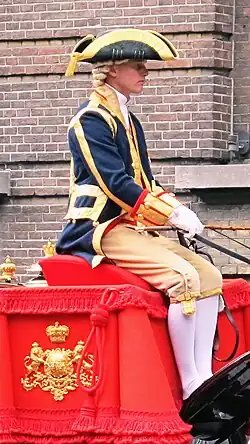
Gold galloon trim on the cuffs, pockets, seams and tricorn hat, as worn at the Dutch court
Type
Decorative woven trim
Material
Metallic gold or silver thread, lace, or embroidery
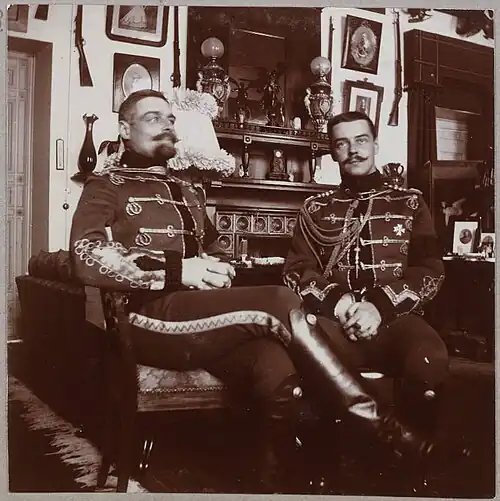
Galloon trim on the cuffs and chest of a c.1908 Russian court uniform
Galloon (sometimes spelled galon in British English)[1] is a heavily-decorated woven or braided trim, typically made of, or featuring, gold or silver thread, which may be woven or embroidered. Galloon trim is used in the trim of military and police uniforms, ecclesiastical dress, and as trim on textiles, drapery, and upholstery. Galloon trim may also come in the form of lace, and is typically wide.
In formal evening wear, a non-military usage, this decoration has evolved into satin stripes that conceal the outer seam of men’s dress trousers.
The distinction between galloon trim or braid, ribbon, and belting has not always been clear, and a great deal of overlap has occasionally caused problems in classification.[2]
Etymology
The term galloon stems from the French galon, in turn itself from the verb galloner, “to braid”.[3]
Abbott, James Archer. Jansen Furniture. Acanathus Press: 2007. ISBN978-0-926494-45-9.
Pegler, Martin. The Dictionary of Interior Design. Fairchild Publications: 1983. ASIN B0006ECV48.
This article is adapted from “Galloon” on Wikipedia, written by its contributors, and used under CC BY-SA 4.0. Text on this page is available under the same licence. Source snapshot: Wikipedia via Kiwix, 2026-07-20.
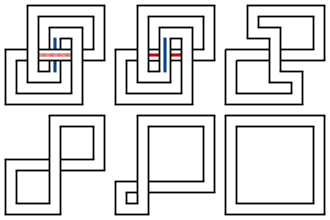
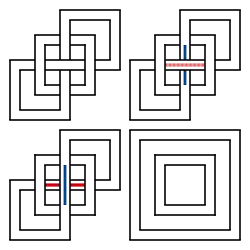
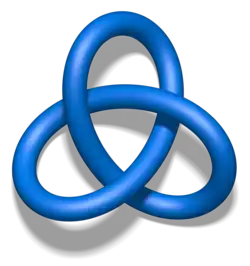
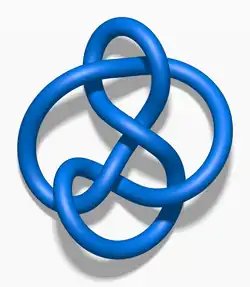
Trefoil knot without 3-fold symmetry being unknotted by one crossing switch.Whitehead link being unknotted by undoing one crossing
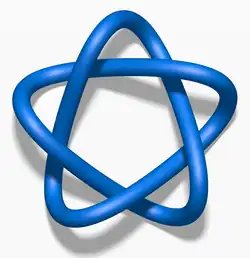
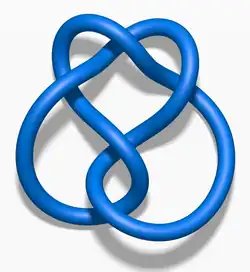
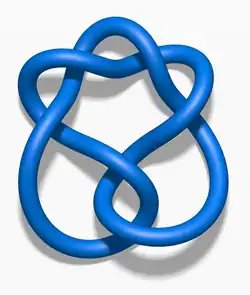
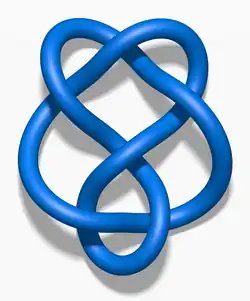
In the mathematical area of knot theory, the unknotting number of a knot is the minimum number of times the knot must be passed through itself (crossing switch) to untie it. If a knot has unknotting number , then there exists a diagram of the knot which can be changed to unknot by switching crossings.[1] The unknotting number of a knot is always less than half of its crossing number.[2] This invariant was first defined by Hilmar Wendt in 1936.[3]
Any composite knot has unknotting number at least two, and therefore every knot with unknotting number one is a prime knot. The unknotting number is not additive under connected sum,[4] although that possibility, implicit in [Wendt,1937[3]] and explicitly asked by Gordon in 1977[5] and many others, was not resolved until 2025. A counterexample showed that the unknotting number of the connected sum of 71 and its mirror image was at most 5, one less than the sum of the numbers from its components.[6]
The following table show the unknotting numbers for the first few knots:
In general, it is relatively difficult to determine the unknotting number of a given knot. Known cases include:
The unknotting number of a nontrivial twist knot is always equal to one.
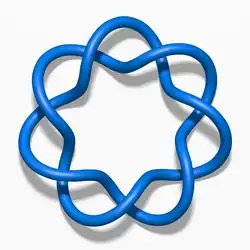
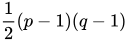
The unknotting number of a –torus knot is equal to .[7]
The unknotting numbers of prime knots with nine or fewer crossings have all been determined.[8] (The unknotting number of the 1011 prime knot is unknown.)
↑Adams, Colin Conrad (2004). The knot book: an elementary introduction to the mathematical theory of knots. Providence, Rhode Island: American Mathematical Society. p.56. ISBN0-8218-3678-1.
↑Taniyama, Kouki (2009), “Unknotting numbers of diagrams of a given nontrivial knot are unbounded”, Journal of Knot Theory and Its Ramifications, 18 (8): 1049–1063, arXiv:0805.3174, doi:10.1142/S0218216509007361, MR2554334.
↑Brittenham, Mark; Hermiller, Susan (2025). “Unknotting number is not additive under connected sum”. arXiv:2506.24088 [math.GT].
↑Gordon, C. M. (1978). “Some aspects of classical knot theory”. In Hausmann, Jean-Claude (ed.). Knot Theory. Vol.685. Berlin, Heidelberg: Springer Berlin Heidelberg. p.1–60. doi:10.1007/bfb0062968. ISBN978-3-540-08952-0. MR0521730. Retrieved 2025-09-14.This volume is dedicated to the memory of Christos Demetriou Papakyriakopoulos, 1914–1976.
This article is adapted from “Unknotting number” on Wikipedia, written by its contributors, and used under CC BY-SA 4.0. Text on this page is available under the same licence. Source snapshot: Wikipedia via Kiwix, 2026-07-20.
In the mathematical theory of knots, the Fáry–Milnor theorem, named after István Fáry and John Milnor, states that three-dimensional smooth curves with small total curvature must be unknotted. The theorem was proved independently by Fáry in 1949 and Milnor in 1950. It was later shown to follow from the existence of quadrisecants(Denne 2004).
Statement
If K is any closed curve in Euclidean space that is sufficiently smooth to define the curvature κ at each of its points, and if the total absolute curvature is less than or equal to 4π, then K is an unknot, i.e.:
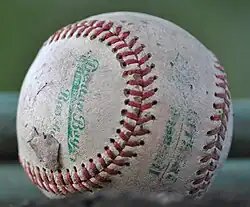
The seam of a baseball follows an unknotted curve with total curvature roughly 4π. By making the curve more convoluted, unknots can be made to have arbitrarily large curvature.
The contrapositive tells us that if K is not an unknot, i.e. K is not isotopic to the circle, then the total curvature will be strictly greater than 4π. Notice that having the total curvature less than or equal to 4π is merely a sufficient condition for K to be an unknot; it is not a necessary condition. In other words, although all knots with total curvature less than or equal to 4π are the unknot, there exist unknots with curvature strictly greater than 4π.
Generalizations to non-smooth curves
For closed polygonal chains the same result holds with the integral of curvature replaced by the sum of angles between adjacent segments of the chain. By approximating arbitrary curves by polygonal chains, one may extend the definition of total curvature to larger classes of curves, within which the Fáry–Milnor theorem also holds (Milnor 1950, Sullivan 2008).
References
Denne, Elizabeth Jane (2004), Alternating quadrisecants of knots, Ph.D. thesis, University of Illinois at Urbana-Champaign, arXiv:math/0510561, Bibcode:2005math…..10561D.
Milnor, J. W. (1950), “On the total curvature of knots”, Annals of Mathematics, 52 (2): 248–257, doi:10.2307/1969467.
Sullivan, John M. (2008), “Curves of finite total curvature”, Discrete differential geometry, Oberwolfach Semin., vol.38, Birkhäuser, Basel, pp.137–161, arXiv:math/0606007, doi:10.1007/978-3-7643-8621-4_7, MR2405664.
External links
Fenner, Stephen A. (1990), The total curvature of a knot (long). Fenner describes a geometric proof of the theorem, and of the related theorem that any smooth closed curve has total curvature at least 2π.
This article is adapted from “Fáry–Milnor theorem” on Wikipedia, written by its contributors, and used under CC BY-SA 4.0. Text on this page is available under the same licence. Source snapshot: Wikipedia via Kiwix, 2026-07-20.
Fulani braids (also known as Fulani style, Fulani hairstyle) are a hair-braiding style originating from the Fulani people, a nomadic ethnic group who inhabit West Africa.
In Fulani culture, braiding is traditionally used to express identity, heritage, and social status. Fulani braids are often adorned with beads, cowrie shells, and other decorative elements, which symbolize beauty, wealth, and cultural pride.
Fulani braids are found in Nigeria, Senegal, Guinea, Mali, Niger, Cameroon, Burkina Faso, Mauritania, Gambia, Chad, Guinea-Bissau, Sierra Leone, Ivory Coast (Côte d’Ivoire), Togo, and Sudan.
Celebrities such as Bo Derek, Alicia Keys, and Cicely Tyson have worn Fulani braids.
Senegal
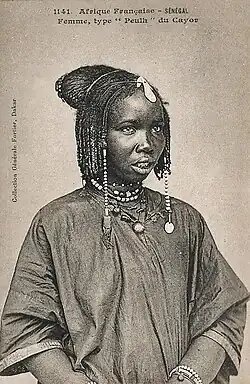
Sénégal-Femme Peulh du Cayor (AOF)
Hairstyling plays a significant role in Senegalese culture, symbolizing origins, social status, and marital status. In Senegalese society, Fulani women decorated their styled hair with beads and other accessories.[1]
Fulani braids can be distinguished from other Senegalese hairstyles by the presence of two or more long strands on each side.
References
↑Les mots du patrimoine: le Sénégal. Moussa Daff, Geneviève N’Diaye-Correard, Equipe du projet IFA. Paris: Éditions de archives contemporaines. 2006. ISBN2-914610-33-5. OCLC71887592.{{cite book}}: CS1 maint: others (link)
This article is adapted from “Fulani braids” on Wikipedia, written by its contributors, and used under CC BY-SA 4.0. Text on this page is available under the same licence. Source snapshot: Wikipedia via Kiwix, 2026-07-20.
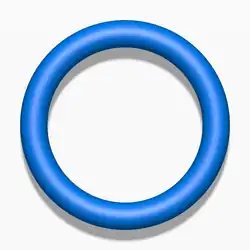
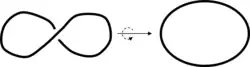
In the mathematical theory of knots, the unknot, not knot, or trivial knot, is the least knotted of all knots.[1] Intuitively, the unknot is a closed loop of rope without a knot tied into it, unknotted. To a knot theorist, an unknot is any embedded topological circle in the 3-sphere that is ambient isotopic (that is, deformable) to a geometrically round circle, the standard unknot.
The unknot is the only knot that is the boundary of an embedded disk, which gives the characterization that only unknots have Seifert genus 0. Similarly, the unknot is the identity element with respect to the knot sum operation.
Background
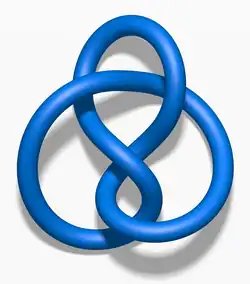
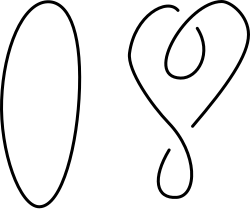
An easy unknot, reduced to a trivial diagram by a type I Reidemeister move.
An unknot is a closed loop in three dimensions that does not contain knots and can, in principle, be stretched out into a circle without any part of the loop passing through another part. A diagram of an unknot is a projection of its three dimensional shape onto two dimensions, where the loop can appear to cross over itself. At each crossing where two parts of the curve intersect, the diagram will show which part of the curve passes over or under the other. To demonstrate whether any given diagram is an unknot, a sequence of Reidemeister moves must be applied to the diagram to eliminate all the crossings until the diagram is a circle, known as simplifying the diagram. This typically involve passing parts of the diagram over each other (Reidemeister types II and III), or untwisting loops (type I). While an individual diagram may be simplified in a small number of Reidemeister moves, it is very difficult to know how many moves this will take for an arbitrary diagram.
Unknotting problem
Deciding if a particular knot is the unknot was a major driving force behind knot invariants, since it was thought this approach would possibly give an efficient algorithm to recognize the unknot from some presentation such as a knot diagram. Unknot recognition is known to be in both NP and co-NP.
It is known that knot Floer homology and Khovanov homology detect the unknot, but these are not known to be efficiently computable for this purpose. It is not known whether the Jones polynomial or finite type invariants can detect the unknot.
Examples
It can be difficult to find a way to untangle string even though the fact it started out untangled proves the task is possible. Thistlethwaite and Ochiai provided many examples of diagrams of unknots that have no obvious way to simplify them, requiring one to temporarily increase the diagram’s crossing number. Such cases are known as hard unknots.
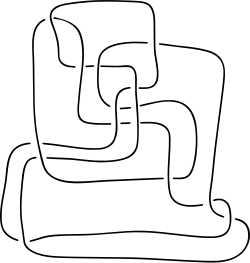
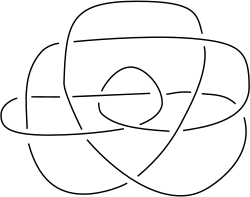
Thistlethwaite unknot
One of Ochiai’s unknots
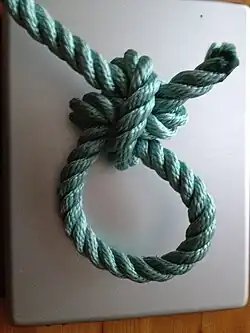
While rope is generally not in the form of a closed loop, sometimes there is a canonical way to imagine the ends being joined together. From this point of view, many useful practical knots are actually the unknot, including those that can be tied in a bight.[2]
Every tame knot can be represented as a linkage, which is a collection of rigid line segments connected by universal joints at their endpoints. The stick number is the minimal number of segments needed to represent a knot as a linkage, and a stuck unknot is a particular unknotted linkage that cannot be reconfigured into a flat convex polygon.[3] Like crossing number, a linkage might need to be made more complex by subdividing its segments before it can be simplified.
Hard unknot
A hard unknot is a diagram of the unknot for which proving that it is unknotted is difficult. Hard unknot diagrams typically have at least ten crossings, and the difficulty arises both from the human perception of knottedness as well as from the number of Reidemeister moves required to reduce the diagram to that of a circle. Typically, a hard unknot diagram requires additional crossings to be introduced before the number of crossings can be reduced to zero. These diagrams are of importance to the field of knot theory because they can serve as cases for which conjectures about unknotting algorithms can be tested.[4]
Examples
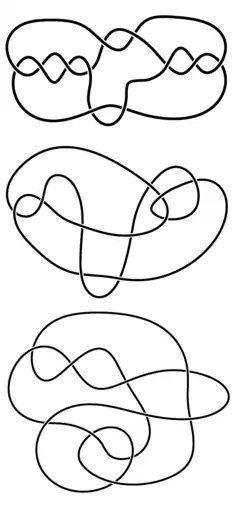
From top to bottom, the Goeritz, Culprit, and Monster unknots
Early examples of hard unknot diagrams were created by Lebrecht Goeritz in 1934. A diagram known as the Goeritz unknot contains 11 crossings but requires an additional crossing to be created in order to simplify it.[5] Another early diagram is known as “the Culprit” and was created by Ken Millett in 1988.[6] It contains 10 crossings. At least two additional crossings must be introduced, making the diagram reach at least 12 crossings, before the knot can be untied using planar Reidemeister moves. (Note, however, only one new crossing needs to be introduced when working with spherical Reidemeister moves.) Many other examples exist such as “the Monster” created by Rob Scharein, who used a physics engine to show that hard unknots could be simplified.[7] A 2025 computational study found 2.6 million cases of hard unknot diagrams that could not be simplified by available algorithms, but were determined to be unknotted through the calculation of knot invariants.[8]
No other knot with 10 or fewer crossings has trivial Alexander polynomial, but the Kinoshita–Terasaka knot and Conway knot (both of which have 11 crossings) have the same Alexander and Conway polynomials as the unknot. It is an open problem whether any non-trivial knot has the same Jones polynomial as the unknot.
The unknot is the only knot whose knot group is an infinite cyclic group, and its knot complement is homeomorphic to a solid torus.
Unknotting on a sphere
If a diagram lies on the surface of a sphere rather than a plane, unknotting can be simpler as part of the diagram may (for example) slide over the North Pole, pass over the equator, and be brought up from the South Pole. In the case of both the Goeritz unknot and the Culprit, only one extra crossing (rather than two) is required on a sphere, and the Monster no longer requires additional crossings. In 2021, it was demonstrated that no previously published example of a hard unknot requires more than one additional crossing on a sphere.[9] Computational methods were used to create new hard unknot diagrams that require at least three additional crossings, on either a sphere or a plane, currently the hardest known unknots.
Applebaum, Taylor; Blackwell, Sam; Davies, Alex; Edlich, Thomas; Juhász, András; Lackenby, Marc; Tomašev, Nenad; Zheng, Daniel (2025). “The unknotting number, hard unknot diagrams, and reinforcement learning”. Experimental Mathematics: 1–19. doi:10.1080/10586458.2025.2542174.
Burton, Benjamin A.; Chang, Hsien-Chih; Löffler, Maarten; Maria, Clément; de Mesmay, Arnaud; Schleimer, Saul; Sedgwick, Eric; Spreer, Jonathan (2024). “Hard diagrams of the unknot”. Experimental Mathematics. 33 (3): 482–500. doi:10.1080/10586458.2022.2161676.
Goeritz, Lebrecht (1934). “Bemerkungen zur knotentheorie”. Abhandlungen aus dem Mathematischen Seminar der Universität Hamburg (in German). 10: 201–210. doi:10.1007/BF02940674.
Henrich, Allison; Kauffman, Louis H. (2024). “Unknotting unknots”. American Mathematical Monthly. 121 (5): 379–390. doi:10.4169/amer.math.monthly.121.05.379.
Kauffman, Louis H.; Lambropoulou, Sofia (2011). “Hard unknots and collapsing triangles”. Introductory Lectures on Knot Theory. Series on Knots and Everything. Vol.46. World Scientific Publishing. pp.187–247. doi:10.1142/9789814313001_0009.
Scharein, Robert Glenn (2009). Interactive topological drawing. University of British Columbia (Thesis). doi:10.14288/1.0051670.
This article is adapted from “Unknot” on Wikipedia, written by its contributors, and used under CC BY-SA 4.0. Text on this page is available under the same licence. Source snapshot: Wikipedia via Kiwix, 2026-07-20.
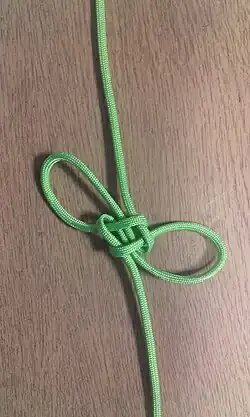
Friendship knot loop is a knot to tie a secure and stable loop at the end of a rope.
The slipped version where the last move is done with a bight of the end, rather than with the end itself, is one that can be tightened flat, slid, locked (like a belt buckle), and then untied quickly (like when nature calls) with an exploding pop. If not tightened flat, this Slipped friendship knot loop collapses into a cube and will neither slide nor pop.[1]
Tying
Like tying a friendship knot, except that it is tied to the ropes own end, coming back from forming the loop.
This article is adapted from “Friendship knot loop” on Wikipedia, written by its contributors, and used under CC BY-SA 4.0. Text on this page is available under the same licence. Source snapshot: Wikipedia via Kiwix, 2026-07-20.
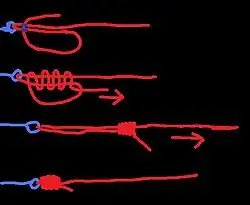
The uni knot is a multi-purpose fishing knot used in angling that can be used for attaching the fishing line to the spool of a reel, for joining main line to leader/backing lines, and for attaching lures, swivels and snaps. When tied correctly, the Uni Knot retains 80% of the line’s breaking strength when used to attach hooks or lures, and about 70% when joining lines.[1]
History
The knot, shown with three passes, was published in 1944 under the name gallows knot (#1121) in The Ashley Book of Knots. Ashley notes that it is actually an alternate arrangement of the multiple overhand noose. His diagram shows how the knot can be manipulated into the more familiar form.[2]
This knot is also called the Duncan loop, after Norman Duncan who developed it independently as a fishing knot in the early 1960s.[3] The knot was popularized as the uni knot by Vic Dunaway, an editor at the Miami Herald, in a 1970 fishing book.[4][5]
Currently, in American English the knot is known as the uni knot referring to its ability to work with mono-filament or fluorocarbon fishing lines. However, in British English it is commonly known as the Grinner knot.[6]
The uni knot is used by popular television host Jeremy Wade, on the Animal Planet TV series River Monsters.[7]
Use
The uni knot is widely used for attaching hooks, rings and swivels to the end of the line[8] and it is also used for joining two fishing lines together.[9] The bend form of the uni knot (for joining two lines) is not a noose; rather it is akin to a multiplefisherman’sknot with the two opposing knotted parts arranged in the manner of uni knots.[10]
The uni knot retains much of the fishing line breaking strength and the uni knot works well with monofilament, fluorocarbon[11] and braided[12] fishing lines.
This article is adapted from “Uni knot” on Wikipedia, written by its contributors, and used under CC BY-SA 4.0. Text on this page is available under the same licence. Source snapshot: Wikipedia via Kiwix, 2026-07-20.
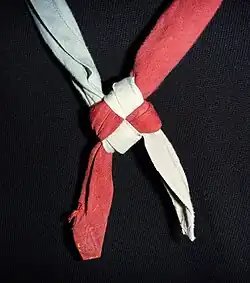
A two-coloured Scout neckerchief tied with a friendship knot.
History and use
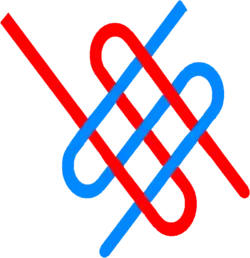
This is one of the eleven basic knots of traditional Chinese knotting,[1] a craft which began in the Tang and Song dynasty (960–1279 AD) in China. The Chinese and Japanese names for this knot are based on the shape of the ideogram for the number ten, which is in the shape of a cross that appears on one face (and a square on the other face).[2]The Ashley Book of Knots, first published in 1944, says: “A decorative Chinese Loop. This is commonly employed as a Lanyard Knot. It is handsome and secure.”[3] In recent years, it has become popular with members of the Scout and Guide movements for tying their neckerchieves instead of using a woggle.[4]
A winged cross knot.
A more complicated version of this knot with a loop on either side is called a winged cross knot in Chinese knotting and macramé.[5]
This article is adapted from “Friendship knot” on Wikipedia, written by its contributors, and used under CC BY-SA 4.0. Text on this page is available under the same licence. Source snapshot: Wikipedia via Kiwix, 2026-07-20.
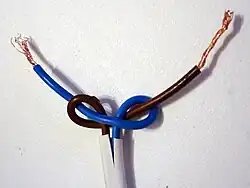
Note that the colors in this depiction do not match current practises in either the UK or the US, nor is this cable in keeping with current safety standards for electrical installations
The underwriter’s knot is used in electrical wiring as strain relief to prevent a cable from being pulled from electrical terminals when the cable is pulled.[1]
History
Clifford Ashley listed it as an electrician’s knot in 1944. He suggested it be used “where rough treatment is expected” and described it as a two-strand wall knot.[2]
The name may come from its use by fire underwriters, who understood its importance in the prevention of both electrocution and fire.[3]
Function
The knot is typically used as a stopper knot where a lamp or appliance cord passes through a hole or slot of a plug or socket. Its purpose is to “reduce strain on the screw terminal connections—where the metal parts of the wires connect to the socket or plug—and prevent the wires from pulling free.”[4]
This article is adapted from “Underwriter's knot” on Wikipedia, written by its contributors, and used under CC BY-SA 4.0. Text on this page is available under the same licence. Source snapshot: Wikipedia via Kiwix, 2026-07-20.
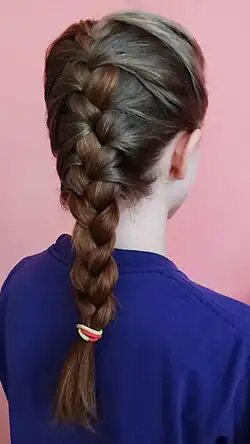
A French braid, also called a French plait, is a type of braided hairstyle. The three-strand gathered plait includes three sections of hair that are braided together from the crown of the head to the nape of the neck.
Description
In the simplest form of three-strand braid, all the hair is initially divided into three sections, which are then simultaneously gathered together near the scalp. In contrast, a French braid starts with three small sections of hair near the crown of the head, which are then braided together toward the nape of the neck, gradually adding more hair to each section as it crosses in from the side into the center of the braid structure. The final result incorporates all of the hair into a smoothly woven pattern over the scalp.
If the main mass of hair is initially parted into two or more sections along the scalp that are kept separate from one another, multiple French braids may be created, each in its own section. The length of hair plays a role in the ability to braid; shorter hair can be more of a challenge. Bobby pins can be useful when braiding shorter hair or hair with many different layers to keep all of the hair in the French braid in place. There are many different ways of French braiding that make it unique; for example, a person can braid at a slant, braid into a bun, or only braid the bangs (fringe).
Compared to the simplest form of hair braid, a French braid has several practical advantages: it can restrain hair from the top of the head that is too short to reach the nape of the neck, and it spreads the weight and tension of the braid across a larger portion of the scalp. Its sleek appearance is often regarded as being elegant and sophisticated. A French braid is more difficult to construct than a simple braid because of its greater complexity. When performed on one’s own hair, it also requires a more prolonged elevation of the hands above the back of the head, and leaves more tangled hair along the scalp when unbraiding.
In this style of braid, start on top of the head and braid it till the end of the hair. Braiding in this manner can be done with different braid types but the most popular are the classic braid and the fishtail braid.[1] A sister braid to the French braid is the Spanish braid. The Spanish braid is like a French braid but in the beginning, instead of grabbing three sections of hair, only two are used.
History
The phrase “French braid” appears in an 1871 issue of Arthur’s Home Magazine, used in a piece of short fiction (“Our New Congressman” by March Westland) that describes it as a new hairstyle (“do up your hair in that new French braid”).[2] However, no visual illustrations are provided for that context, making it impossible to tell whether it refers to the same hairstyle described above.
Variations
Variations on this hairstyle include:
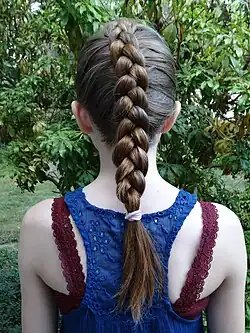
Dutch braid: A Dutch braid (also called an inverted French braid or reverse French braid or pineapple braid) is created when the three hair sections are crossed under each other, instead of over. It results in the look of a braid standing up from the rest of the hair, instead of being under the hair.
Fishtail braid: A fishtail braid resembles a French braid in its smoothly woven appearance, but divides the hair into only two sections instead of three. A small piece of each section is passed over to the other section over and over to form the braid. This style was called the “Grecian braid” in the 19th century.[3]
Variations of the French braid are also used to prepare horses’ tails for showing polo and polocrosse.[4]
A Dutch braid, otherwise known as an inverted French braid. The braid is above the hair instead of beneath it like normal French braids.
Various braids combined to look like a French and Dutch braid.
Media related to French braid at Wikimedia Commons
The dictionary definition of french braid at Wiktionary
This article is adapted from “French braid” on Wikipedia, written by its contributors, and used under CC BY-SA 4.0. Text on this page is available under the same licence. Source snapshot: Wikipedia via Kiwix, 2026-07-20.
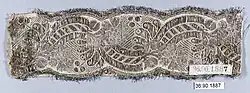 Metallic galloon lace in silk and metal thread
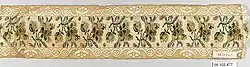 Woven floral galloon trim
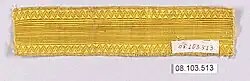 Golden silk and cotton galloon trim