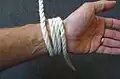
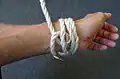
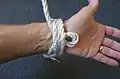
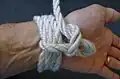
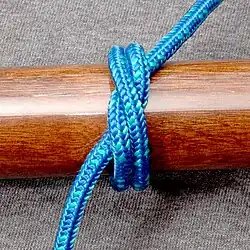
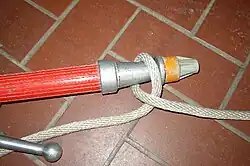
Two half-hitches is a type of knot, specifically a binding knot or hitch knot. One variety consists of an overhand knot tied around a post, followed by a half-hitch. This knot is less often referred to as a clove hitch over itself, double half-hitch, or full-hitch.
Two half hitches is the commonest of all hitches for mooring in particular and also for general utility. Steel gives the name in 1794. The difference between two half hitches and the clove hitch is that the former, after a single turn around a spar, is made fast around its own standing part, while the latter is tied directly around the spar.
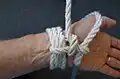
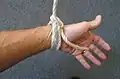
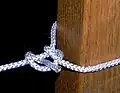
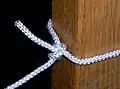
The following three-step process for tying the two half-hitches is also explained in the image gallery below. Click on the images for high-resolution versions.
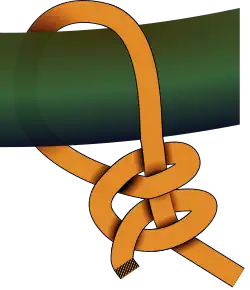
Begin by forming a clockwise loop around the pole, with the working end of the rope on top. Bring the working end through the loop. At this point, you have an overhand knot around the pole.
Bring the working end down and to the left. Loop it under the standing end. Pull the working end through the loop just formed, tighten, and slide the knot along the standing end up to the post.
A correctly tied two half-hitches resembles a clove hitch tied around the standing end of the line, not a cow hitch.
Step 1: Form a single half-hitch, or overhand knot
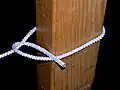
Step 2: Form a second half-hitch above the first
Step 3: Tighten
To release the knot, pry apart the two hitches with a bending motion. However, it can often be difficult to untie. To help avoid this problem, tie a slipped variation: in the second half-hitch, pass through a bight, as when tying your shoe, rather than the entire free end.
The buntline hitch, when bent to a yard, makes a more secure knot than two half hitches, but is more liable to jam. It differs from two half hitches in that the second half hitch is inside instead of outside the first one.
This article is adapted from “Two half-hitches” on Wikipedia, written by its contributors, and used under CC BY-SA 4.0. Text on this page is available under the same licence. Source snapshot: Wikipedia via Kiwix, 2026-07-20.
Some consider that a French bowline is the same as a Portuguese bowline, i.e. a bowline with two loops that can be used as a bosun’s chair.
A different knot is however also known as a French bowline.
This form of bowline is similar to a standard bowline but there are several loops so that there is less likelihood of damage to a delicate object secured by the bowline. As with a standard bowline, the knot cannot tighten. Pressure is distributed over a wider area than in the case of a standard bowline.
The main advantage of this method is that the knot can be tied with one hand.
A convenient way to tie a French bowline can be:
1. Wind the running end several times round the object to be tied, leaving enough running end for one further turn.
3. Pass this behind the winds in the running end until it projects beyond these.
4. Form a bight in the standing end and push this through the loop.
5. Bring the running end behind and through the bight.
6. Pull on the standing end to pull the bight back through the loop and form the knot.
This article is adapted from “French bowline” on Wikipedia, written by its contributors, and used under CC BY-SA 4.0. Text on this page is available under the same licence. Source snapshot: Wikipedia via Kiwix, 2026-07-20.
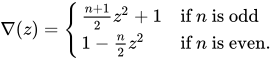
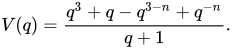
In knot theory, a branch of mathematics, a twist knot is a knot obtained by repeatedly twisting a closed loop and then linking the ends together. (That is, a twist knot is any Whitehead double of an unknot.) The twist knots are an infinite family of knots, and are considered the simplest type of knots after the torus knots.
Construction
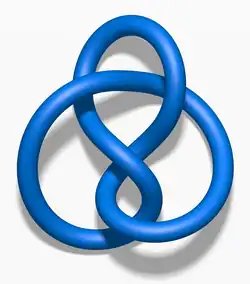
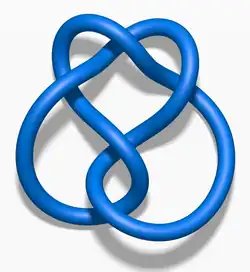
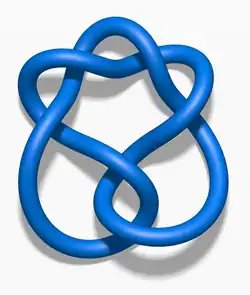
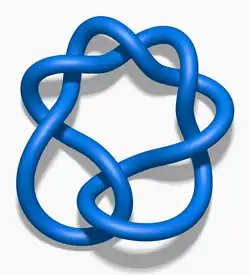
A twist knot is obtained by linking together the two ends of a twisted loop. Any number of half-twists may be introduced into the loop before linking, resulting in an infinite family of possibilities. The following figures show the first few twist knots:
This article is adapted from “Twist knot” on Wikipedia, written by its contributors, and used under CC BY-SA 4.0. Text on this page is available under the same licence. Source snapshot: Wikipedia via Kiwix, 2026-07-20.
In the mathematical field of topology, a free loop is a variant of the notion of a loop. Whereas a loop has a distinguished point on it, called its basepoint, a free loop lacks such a distinguished point. Formally, let be a topological space. Then a free loop in is an equivalence class of continuous functions from the circle to . Two loops are equivalent if they differ by a reparameterization of the circle. That is, if there exists a homeomorphism such that
Thus, a free loop, as opposed to a based loop used in the definition of the fundamental group, is a map from the circle to the space without the basepoint-preserving restriction. Assuming the space is path-connected, free homotopy classes of free loops correspond to conjugacy classes in the fundamental group.
Recently, interest in the space of all free loops has grown with the advent of string topology, i.e. the study of new algebraic structures on the homology of the free loop space.
See also
Loop space
Loop (topology)
Quasigroup
Further reading
Brylinski, Jean-Luc: Loop spaces, characteristic classes and geometric quantization. Reprint of the 1993 edition. Modern Birkhäuser Classics. Birkhäuser Boston, Inc., Boston, MA, 2008.
This article is adapted from “Free loop” on Wikipedia, written by its contributors, and used under CC BY-SA 4.0. Text on this page is available under the same licence. Source snapshot: Wikipedia via Kiwix, 2026-07-20.
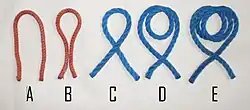
A: An open loop.[1] B: A closed loop[2] C: Turn or single turn[3] D: Round turn[4] E: Two round turns[5]
A turn is one round of rope on a pin or cleat, or one round of a coil.[6] Turns can be made around various objects, through rings, or around the standing part of the rope itself or another rope. A turn also denotes a component of a knot.
When the legs of a loop are brought together and crossed, the rope has taken a turn.[7] One distinguishes between single turn, round turn, and two round turns depending on the number of revolutions around an object. The benefit of round turns is best understood from the capstan equation.
Riding turn
The riding turn of this strangle knot passes from the upper left to lower right
A riding turn is a section of rope that passes on top of another section of rope, often parallel or at only a slight angle to the section below. Examples of riding turns can be seen in both the constrictor knot and the strangle knot. The second course of wrappings in some seizing knots can be referred to as riding turns. The formation of an unintentional riding turn on a sailing winch can cause it to jam.
↑Clifford W. Ashley, The Ashley Book of Knots (New York: Doubleday, 1944), fig. 49
This article is adapted from “Turn (knot)” on Wikipedia, written by its contributors, and used under CC BY-SA 4.0. Text on this page is available under the same licence. Source snapshot: Wikipedia via Kiwix, 2026-07-20.
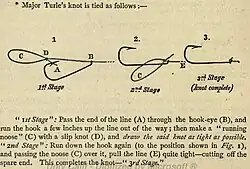
A turle knot is a knot used while fishing for tying a hook or fly to a leader. It is named after Major William Greer Turle, a 19th-century English angler who popularized the knot but did not claim to have invented it. Turle was a contemporary of Frederic M. Halford and fished the chalkstreams of Hampshire with Halford in the late 19th century and was an early pioneer in the use of eyed hooks for fly fishing.[1] It has sometimes, wrongly, been referred to as the turtle knot.[2]
H. Cholmondeley-Pennell is his 1886 edition of Modern Improvements in Fishing Tackle and Fish Hooks described the Turle Knot thus:
For attachment to a bare hook I have been hitherto in the habit of using a very ingenious knot invented by Major Turle, and known under his name.* Attached to the turn-down eyed hook it answers excellently well, as I can testify from experience, having used nothing else for many weeks in sea and river fishing, when the catch amounted to some thousands of whiting, mackerel, gurnets, flat-fish, &c., and also in legering and float-fishing on the Thames and Norfolk Broads for bream, roach, barbel, chub, perch, and gudgeon.[3]
↑Hayter, Tony (2002). F.M. Halford and the Dry-Fly Revolution. London: Rober Hale. ISBN0-7090-6773-9.
↑Budworth, Geoffrey (1999). The Complete Book of Fishing Knots. New York: The Lyons Press. pp.108–111. ISBN1-55821-907-2.
↑Cholmondeley-Pennell, H. (1886). Modern Improvements in Fishing Tackle and Fish Hooks. London. p.20.{{cite book}}: CS1 maint: location missing publisher (link)
This article is adapted from “Turle knot” on Wikipedia, written by its contributors, and used under CC BY-SA 4.0. Text on this page is available under the same licence. Source snapshot: Wikipedia via Kiwix, 2026-07-20.
In the mathematical field of knot theory, Fox n-coloring is a method of specifying a representation of a knot group or a group of a link (not to be confused with a link group) onto the dihedral group of order n where n is an odd integer by coloring arcs in a link diagram (the representation itself is also often called a Fox n-coloring). Ralph Fox discovered this method (and the special case of tricolorability) “in an effort to make the subject accessible to everyone” when he was explaining knot theory to undergraduate students at Haverford College in 1956. Fox n-coloring is an example of a conjugation quandle.
Definition
Let L be a link, and let be the fundamental group of its complement. A representation of onto the dihedral group of order 2n is called a Fox n-coloring (or simply an n-coloring) of L. A link L which admits such a representation is said to be n-colorable, and is called an n-coloring of L. Such representations of groups of links had been considered in the context of covering spaces since Reidemeister in 1929. [Actually, Reidemeister fully explained all this in 1926, on page 18 of “Knoten und Gruppen” in Hamburger Abhandlungen 5. The name “Fox coloring” was given to it much later by mathematicians who probably couldn’t read German.] Fox’s preferred term for so-called “Fox 3-coloring” was “property L”; see Exercise 6 on page 92 of his book “Introduction to Knot Theory” (1963).
The group of a link is generated by paths from a basepoint in to the boundary of a tubular neighbourhood of the link, around a meridian of the tubular neighbourhood, and back to the basepoint. By surjectivity of the representation these generators must map to reflections of a regular n-gon. Such reflections correspond to elements of the dihedral group, where t is a reflection and s is a generating () rotation of the n-gon. The generators of the group of a link given above are in bijective correspondence with arcs of a link diagram, and if a generator maps to we color the corresponding arc . This is called a Fox n-coloring of the link diagram, and it satisfies the following properties:
At least two colors are used (by surjectivity of ).
Around a crossing, the average of the colors of the undercrossing arcs equals the color of the overcrossing arc (because is a representation of the group of the link).
A n-colored link yields a 3-manifold M by taking the (irregular) dihedral covering of the 3-sphere branched over L with monodromy given by . By a theorem of Montesinos and Hilden, any closed oriented 3-manifold may be obtained this way for some knot K and some tricoloring of K. This is no longer true when n is greater than three.
Number of colorings
The number of distinct Fox n-colorings of a link L, denoted
is an invariant of the link, which is easy to calculate by hand on any link diagram by coloring arcs according to the coloring rules. When counting colorings, by convention we also consider the case where all arcs are given the same color, and call such a coloring trivial.
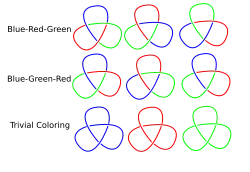
All possible tricolorings of the trefoil knot.
For example, the standard minimal crossing diagram of the Trefoil knot has 9 distinct tricolorings as seen in the figure:
3 “trivial” colorings (every arc blue, red, or green)
3 colorings with the ordering Blue→Green→Red
3 colorings with the ordering Blue→Red→Green
The set of Fox ‘n’-colorings of a link forms an abelian group , where the sum of two n-colorings is the n-coloring obtained by strandwise addition. This group splits as a direct sum
,
where the first summand corresponds to the n trivial (constant) colors, and nonzero elements of summand correspond to nontrivial n-colorings (modulo translations obtained by adding a constant to each strand).
If is the connected sum operator and and are links, then
Generalization to G-coloring
Let L be a link, and let π be the fundamental group of its complement, and let G be a group. A homomorphism of π to G is called a G-coloring of L.
A G-coloring of a knot diagram is an induced assigning an element of G to the strands of L such that, at each crossing, if c is the element of G assigned to the overcrossing strand and if a and b are the elements of G assigned to the two undercrossing strands, then a = c−1 b c or b = c−1 a c, depending on the orientation of the overcrossing strand. If the group G is dihedral of order 2n, this diagrammatic representation of a G-coloring reduces to a Fox n-coloring. The torus knot T(3,5) has only constant n-colorings, but for the group G equal to the alternating group A5, T(3,5) has non-constant G-colorings.
Further reading
Richard H. Crowell, Ralph H. Fox, “An Introduction to Knot Theory”, Ginn and Co., Boston, 1963. MR0146828
Ralph H. Fox, A quick trip through knot theory, in: M. K. Fort (Ed.), “Topology of 3-Manifolds and Related Topics”, Prentice-Hall, NJ, 1961, pp.120–167. MR0140099
Ralph H. Fox, Metacyclic invariants of knots and links, Canadian Journal of Mathematics 22 (1970) 193–201. MR0261584
Kurt Reidemeister, Knoten und Verkettungen, Math. Z. 29 (1929), 713-729. MR1545033
This article is adapted from “Fox n-coloring” on Wikipedia, written by its contributors, and used under CC BY-SA 4.0. Text on this page is available under the same licence. Source snapshot: Wikipedia via Kiwix, 2026-07-20.
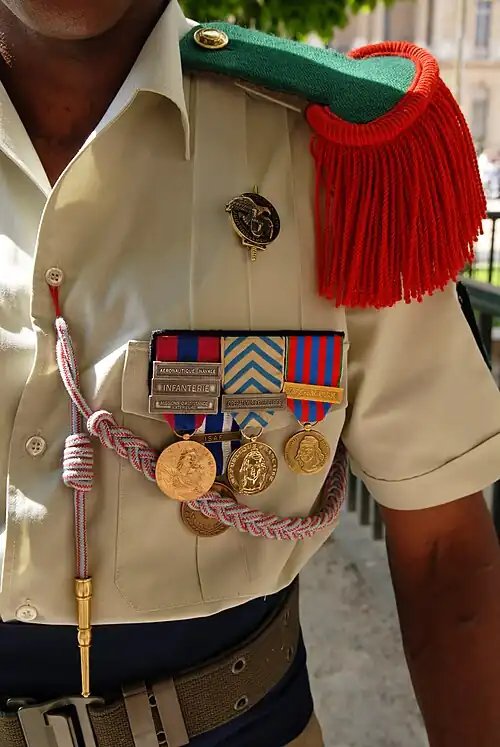
Blue and red fourragère of the Croix de Guerre TOE worn by a soldier of the 2nd Foreign Infantry Regiment (2e REI). The fourragère is the braided cord passing under the medals and around the soldier’s side.The fourragère of the Order of the Legion of Honor
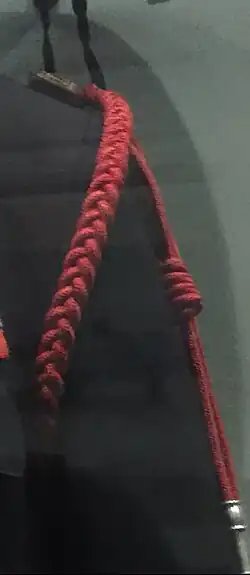
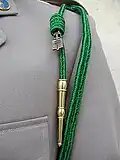
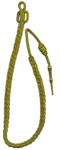
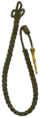
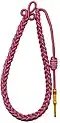
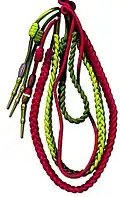
The fourragère (French:[fuʁaʒɛʁ], from fourrage, “fodder”) is a military award, distinguishing military units as a whole, in the form of a braided cord. The award was first adopted by France, followed by other nations such as the Netherlands, Belgium, Portugal, and Luxembourg. Fourragères have been awarded to units of both national and foreign militaries, except for that of Luxembourg, which has not been awarded to any foreign units.
The origin of the award is not entirely certain, but at least two conjectural stories have been posited. The first involves Flemish soldiers serving under the Duke of Alva who were reported as having been cowardly in battle. The Duke threatened them all with hanging if they did not perform better in future engagements, and the soldiers, so insulted by the insinuation, took to wearing cords tied to large nails around their shoulders, as if to say “Hang me by this cord and nail if you see me run from battle.” Following this, the unit’s members performed so well that the rope and nail became a badge of honor.[1]
The other is that to the extent that an aiguillette is a form of fourragère, the wearing of armor by European knights required the use of ropes with metal tabs and a squire to cinch the armor into place—the squire would carry these cords over his shoulder, hence the association with aides de camp.[1]
France
History
As a regimental distinction the fourragère should not be confused with the aiguillette (distinctive insignia of the aide-de-camp) which was introduced by Napoleon I and which it closely resembles (the aiguillette is merely a golden fourragère).
The modern fourragère of the French Army is awarded to all members of military units which have been awarded a mention in despatches. It should not be confused with unit awards of particular decorations, where the medal itself is hung on the flag of the unit. For example, there are many units wearing the fourragère of the médaille militaire, whereas only six units wore the medal on their flags.
It was introduced during the First World War, when the French Ministry of War first awarded the fourragère to units which had been recorded as distinguishing themselves more than once in the Orders of the Army. There were then six fourragères, depending on the numbers of Mentions in dispatches awarded to the unit:
Numbers of mentions
First and Second World Wars
Overseas Wars
Operations since 1952
9,10 or 11
Double, red (color of the légion d’honneur) and green with red stripes (colors of the croix de guerre 14-18)
not awarded
not awarded
6, 7 or 8
Simple, red (color of the légion d’honneur)
Simple, red, with an olive red and blue (colors of the croix de guerre Overseas)
not awarded
4 or 5
Simple, yellow with green stripes (colors of the médaille militaire)
Simple, yellow with green stripes, with an olive red and blue
not awarded
2 or 3
Simple, green with red stripes (colors of the croix de guerre 14-18)
Simple, red and blue
Simple, red and white (colors of the croix de la Valeur Militaire)
If a unit received this distinction in both the First and Second World Wars, its fourragère bears two olives, one for each conflict it earned mentions. These olives are different:
numbers of mentions
First World War
Second World War
9, 10 or 11
half-red and half-green with red stripes, the two halves separated by a white ring
not awarded
6, 7 or 8
half-red and half-green with red stripes
not awarded
4 or 5
half-yellow with green stripes and half-green with red stripes
half-yellow with green stripes and half-red with green stripes
2 or 3
green with red stripes
red with green stripes
During the Second World War, the medal of the Ordre de la Libération was awarded to the flags of 17 military units, whose members now wear a fourragère since June 18, 1996. This fourragère is considered the top unit award in the French military, as the ordre de la Libération award is seen to be more important than any mention in dispatches.
Certain French military units wear combinations of fourragères, if they were mentioned in orders in both one of the World War and an overseas (colonial) war. For example, the famous Foreign Legion regiment the 3rd Foreign Infantry wears a double fourragère red and green with red stripes (9 mentions during World War I), with an olive red with green stripes (3 mentions during World War II) and a fourragère yellow with green stripes, with an olive red and blue (5 mentions during Overseas Wars).
Fourragères used by the French Foreign Legion are:
2e REI (2nd Foreign Legion Infantry) – croix de guerre des TOE
2e REP (2nd Foreign Legion Paratroops) – Légion d’honneur
1er REC (1st Foreign Legion Cavalry) – Croix de Guerre (World War II); croix de guerre des TOE
3e REI (3rd Foreign Legion Infantry) – Légion d’honneur, Médaille militaire, Croix de Guerre
13e DBLE (13th Foreign Legion Demi-Brigade) – Ordre de la Libération
Personal wear of the fourragère
The fourragère is normally worn by members of a unit awarded the decoration. When they leave the unit, they have to relinquish the fourragère. However members who took part personally in the actions leading to the award of the fourragère can continue to wear the fourragère, even after leaving the unit. They can only wear a fourragère corresponding to the number of actions they actually took part in. Thus, if a member of a 5-mentions regiment leaves but took part in only two mentioned actions, he can only wear the croix de guerre fourragère and not the médaille militaire fourragère.
Pictures
Fourragère aux couleurs du ruban de l’Ordre de la Libération
Fourragère aux couleurs de la Légion d’honneur
Fourragère aux couleurs de la Médaille militaire
Fourragère aux couleurs de la croix de guerre 1914-1918
Fourragère aux couleurs de la croix de guerre des TOE
The most impressive set of fourragères: double fourragère of Légion d’honneur and Croix de Guerre with olives of both World War I (9 mentions) and World War II (3 mentions) and fourragère of Médaille militaire with olive of TOE (4 mentions). Worn by members of 3 REI.
American Units awarded the fourragère
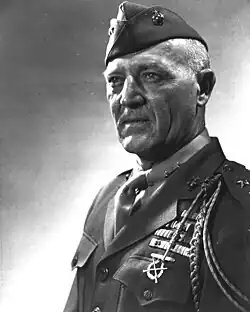
Gen Graves B. Erskine wearing the fourragère with the cords hanging over the sleeve, a mark of being in the military unit when the award was made
1LT Alexander Woody, with the 82nd Airborne Division, wearing the fourragère that was awarded to the division for its performance at the Battle of Normandy in 1944; note the lack of outside cords
The 5th Marine Regiment, the 6th Marine Regiment, and the 5th Machine Gun Battalion of the United States Marine Corps were awarded the fourragère for having earned the Croix de Guerre with palm leaf three times during World War I.
The 9th Infantry Regiment, 23rd Infantry Regiment, 12th Field Artillery Regiment, 15th Field Artillery Regiment, 17th Field Artillery Regiment, 2nd Engineer Battalion, 1st Field Signal Battalion, 2nd Trench Artillery, 2nd Sanitary Train, 2nd Division, A.E.F., was awarded the French Croix de Guerre with Palm three times, and awarded the French fourragère for service during World War I campaigns at Chateau Thierry, Aisne-Marne, and Meuse-Argonne. In addition, because several U.S. soldiers were present in front-line action during each battle for which all the unit within the 2nd Division was awarded the Croix de Guerre, the French Government and U.S. Army Adjutant General allowed these soldiers to wear the fourragère as an individual decoration regardless of future unit assignment—a very rare honor. In total, 30,000 A.E.F. officers and men were certified to wear the French fourragère as an individual decoration, per the Final Report of the Secretary of War, 1922.
During World War I, the 5th S.S.U. and 646th S.S.U. was awarded the fourragère aux couleurs du ruban de la médaille militaire.
During World War II, the 16th, 18th, and 26th Infantry Regiments, the 5th and 7th Field Artillery Battalions, the 1st Engineer Battalion and the 1st Signal Company were awarded the fourragère aux couleurs du ruban de la médaille militaire.
17 French military units wear the fourragère of the Ordre de la Libération
82nd Airborne Division during the Battle of Normandy in June 1944.
The 3rd Division (Marne Division) was awarded the Fourragère aux couleurs de la Croix de Guerre for service to France in WW II.
The 79th Infantry Division was awarded the Fourragère aux couleurs de la Croix de Guerre for its actions in helping liberate Paris from June 1944 through 27 August 1944 and helping liberate Baccarat, Phalsbourg and Saverne from 21–24 November 1944.[3]
The 12th Field Artillery Regiment was awarded the French fourragère in World War I and the Belgian fourragère in World War II.
The 102nd Cavalry Regiment was awarded the French and Belgian Croix de Guuerre in World War II.
The 104th Infantry Regiment, 26th Infantry Division was awarded the French Croix de Guerre in World War I and World War II.
The 121st Cavalry Squadron of the 106th Cavalry Group, XV Corps, was awarded the French Croix de Guerre and French fourragère for actions during World War II.
The 143rd Infantry Regiment, 36th Division, Texas Army National Guard, was awarded the French Croix de Guerre in connection with its action fought at Meuse-Argonne during World War I.
The 4th Infantry Division, consisting of the 8th, 12th (both cited twice) and the 22nd Infantry Regiments were awarded the Belgian fourragère for action in the Battle of the Bulge. The 8th Infantry was awarded the Presidential Unit Citation for the Beaches of Normandy, the 12th Infantry for Luxembourg (Battle of the Bulge) and the 22nd Infantry received three Presidential Unit Citations for Carentan (France), St. Gillis_Marigny (France), and the Hurtgen Forest (Battle of the Bulge).
The 2nd Infantry Division, 9th Infantry Division, 30th Infantry Division, 101st Airborne Division, 2nd Armored Division, 3rd Armored Division and 7th Armored Division was awarded the Belgian fourragère on July 13th, 1950 for their action in the Battle of the Bulge.
World War I
Unit
Service
Year awarded
Campaign or battle
Other notes
5th Marines 6th Marines 5th Machine Gun Battalion
US Marines
1918
Battle of Belleau Wood, Western Front
Awarded the Fourragère aux couleurs de la Croix de guerre with palm leaf three times
9th Infantry Regiment, 2nd Division
US Army
1919
Chateau Thierry, Aisne-Marne, and Meuse-Argonne
French fourragère in the colors of the Croix de Guerre, under General Order No. 156 F, August 29, 1919, GHQ, French Armies of the East.
23rd Infantry Regiment, 2nd Division
US Army
1918
Chateau Thierry, Aisne-Marne, and Meuse-Argonne
434 officers and men were certified to wear the French fourragère as an individual decoration, per the Final Report of the Secretary of War, 1922
2nd Division and its subordinates
US Army
1919
Chateau Thierry, Aisne-Marne, and Meuse-Argonne
Awarded the Fourragère aux couleurs de la Croix de guerre with palm leaf three times
Awarded the Fourragère aux couleurs du ruban de la médaille militaire
16th Infantry, 18th Infantry 26th Infantry, 5th Field Artillery, 7th Field Artillery Battalion, 1st Engineer Battalion, 1st Signal Company, all of the 1st Infantry Division
U.S. Army
1944
Normandy
Awarded the Fourragère aux couleurs du ruban de la médaille militaire
Division and 1st Brigade, 82nd Airborne Division
U.S. Army
1944
Normandy
Also awarded the Order of William by the Kingdom of the Netherlands for gallantry during Operation Market Garden in 1944
3rd Infantry Division
U.S. Army
1945
Colmar
Awarded the Fourragère aux couleurs de la Croix de guerre
26th Infantry Division
U.S. Army
1944
Lorraine
awarded the Fourragère aux couleurs de la Croix de guerre
79th Infantry Division
U.S. Army
1944
Operation Overlord
Awarded the Fourragère aux couleurs de la Croix de guerre
4th Armored Division
U.S. Army
1944
Normandy
Awarded the Fourragère aux couleurs de la Croix de guerre
478th Amphibious Truck Company Non Divisional
U.S. Army
1944
Operation Overlord
Awarded the Fourragère aux couleurs de la Croix de guerre
The Cabinet of the Netherlands granted the right to wear an Orange Lanyard to individual members of 3 United States Army units who actually participated in the ground operations of Operation Market Garden in 1944: The U.S. 82nd Airborne Division by ministerial decree of 8 October 1945, the U.S. 101st Airborne Division on 20 September 1946 and on 20 April 1982 to glider pilots of the IXth U.S. Air Force Troop Carrier Command who were ‘forgotten’ in 1945 and 1946. (The Orange Lanyard was not awarded to the 1st Airborne Division (United Kingdom) because the British soldiers were not authorized to wear foreign lanyards).
The Orange Lanyard has nothing to do with the Military Order of William. This persistent misconception among many militaria collectors, primarily in the United States, arises from the fact that the orange fourragere was awarded to individual members of the U.S. 82nd Airborne Division by Ministerial Decree of October 8, 1945,the very same daythat the Military Order of William 4th Class (RMWO4) was awarded by Royal Decree (RD) No. 30 to the unit colours of the U.S. 82nd Airborne Division.[16]
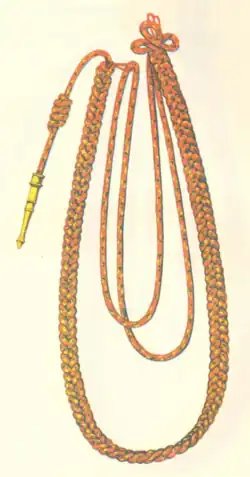
The Belgian fourragère of 1940 was created by Prince Charles of Belgium, Regent of the Kingdom to honor certain military formations that distinguished themselves during the Second World War. It consists of three cords terminated by a knot and a metal tag, and is braided in red and green; the colors of the Belgian Croix de guerre of 1940. The fourragère is in cotton for non-commissioned officers and soldiers and in silk for officers.
Luxembourg fourragère
The Luxembourg Army currently awards an orange and blue fourragère.[17]
Portuguese fourragères
Portugal has three fourragères: the War Cross (red and green), the Military Valor Medal (blue and white) and the Order of the Tower and Sword (solid blue).
South Vietnamese fourragère
Vietnam fourragère (Mixed colors of Gallantry Cross, Military Merit Medal, and National Order)
The Vietnam Gallantry Cross is the equivalent of the French Croix de Guerre. It was created by Decree No 74-b/Qt dated 15 August 1950 and Decree No 96/DQT/HC dated 2 May 1952. Both individuals (denoted by a star) and formations (denoted by a palm) cited for gallantry were awarded the decoration. Formations that were awarded the Gallantry Cross for two or more occasions were initially authorized to wear a fourragère.[18]
The Vietnam Civil Action is another of the South Vietnamese fourragères. In appearance it resembled the Republic of Vietnam Cross of Gallantry, but rather than yellow and red, it was green and red. Formations that were awarded the medal or emblem for two or more occasions are authorized to wear a fourragère. Many units and individuals were awarded one award, but few were presented with a second award.[19]
Decorative fourragères
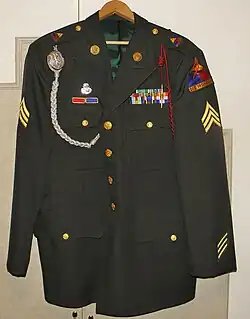
Fourragères are often worn as decorative items to liven up ceremonial uniforms in military, police, and cadet organisations. Members of the United States and Canadian 1st Special Service Force wore a red, white, and blue fourragère made out of parachute shroud lines without having earned them in any particular form of military engagement.[20]
This article is adapted from “Fourragère” on Wikipedia, written by its contributors, and used under CC BY-SA 4.0. Text on this page is available under the same licence. Source snapshot: Wikipedia via Kiwix, 2026-07-20.
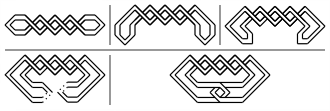
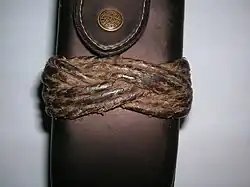
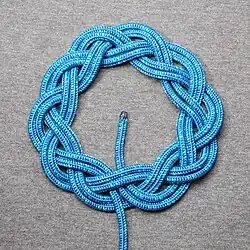
A Turk’s head knot, sometimes known as a sailor’s knot, is a decorative knot with a variable number of interwoven strands forming a closed loop. The name refers to a general family of knots, not an individual knot. While this knot is typically made around a cylinder, it can also be formed into a flat, mat-like shape. Some variants can be arranged into a roughly spherical shape, akin to a monkey’s fist knot.[1]
This knot is primarily used for tightening up underlying material to overlay as a tubular covering knot, prevent slipping, and add a decorative element. A notable practical use for the Turk’s head is to mark the “king spoke” of a ship’s wheel (the spoke that is upright when the rudder is in a central position). The knot takes its name from its resemblance to a turban (Turkish: sarık), though a turban is wound rather than interwoven.
Leads and bights
A 3-lead, 10-bight Turk’s head knot, doubled
Different types of Turk’s head knots are classified according to the number of leads and bights, as well as the method of construction. The number of bights is the number of crossings around the circumference of the cylinder. The number of leads refers to the number of strands around the circumference of the cylinder, before doubling, tripling, etc. Depending on the number of leads and bights, a Turk’s head may be tied using a single strand or multiple strands. Mathematically, the number of strands is the greatest common divisor of the number of leads and the number of bights. The knot may be tied with a single strand if and only if the two numbers are co-prime. For example, 3 lead × 5 bights (3×5), or 5 lead × 7 bights (5×7).
There are three general groupings of Turk’s head knots:
Narrow, where the number of leads is two or more less than the number of bights (3×5, or 3×7).
Long or wide, where the number of leads is two or more greater than the number of bights (5×3, or 16×7).
Square, where there is a difference of one between leads and bights (7×8 or 8×7).
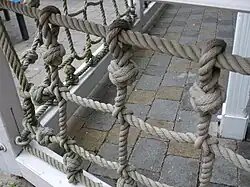
Turk’s head knots on netting
The number of bights determines the shape found at the center. Three bights create a triangular shape, while four create a square. A two lead, 3 bight Turk’s head is a double overhand knot.[2]
A two lead, three bight Turk’s head is also a trefoil knot if the ends are joined together. (2,n) alternatingtorus knots are (2,n) Turk’s head knots.[3] ((p,q) = q times around a circle in the interior of the torus, and p times around its axis of rotational symmetry.) Turk’s head knots are easy to edit though hard to tie.
Uses in culture
In the World Organization of the Scout Movement, the scarf rings called woggles to affix their neckerchiefs or scarfs are often variations of the Turk’s head knot. The Gilwell Woggle is worn by Scout Leaders who complete training courses to be awarded the Wood Badge insignia. It is an official part of the uniform.
↑Simpson, Thomas (June 2010), “Ashley’s Mauretania Knot & Early Sightings of a Monkey’s Fist”, Knotting Matters (107), London: International Guild of Knot Tyers: 28–31
↑Shaw, George Russell (MCMXXXIII). Knots: Useful & Ornamental, p.61. ISBN978-0-517-46000-9.
↑Bozhuyuk, M. E. (1993). Topics in Knot Theory, p.3. ISBN978-0-7923-2285-6.
This article is adapted from “Turk's head knot” on Wikipedia, written by its contributors, and used under CC BY-SA 4.0. Text on this page is available under the same licence. Source snapshot: Wikipedia via Kiwix, 2026-07-20.
In mathematics, the tunnel number of a knot, as first defined by Bradd Clark, is a knot invariant, given by the minimal number of arcs (called tunnels) that must be added to the knot so that the complement becomes a handlebody. The tunnel number can equally be defined for links. The boundary of a regular neighbourhood of the union of the link and its tunnels forms a Heegaard splitting of the link exterior.
The trefoil knot has tunnel number 1. In general, any nontrivial torus knot has tunnel number 1.[1]
Every link L has a tunnel number. This can be seen, for example, by adding a ‘vertical’ tunnel at every crossing in a diagram ofL. It follows from this construction that the tunnel number of a knot is always less than or equal to its crossing number.
References
↑Boileau, Michel; Rost, Markus; Zieschang, Heiner (1 January 1988). “On Heegaard decompositions of torus knot exteriors and related Seifert fibre spaces”. Mathematische Annalen. 279 (3): 553–581. doi:10.1007/BF01456287. ISSN1432-1807.
Clark, Bradd (1980), “The Heegaard Genus Of Manifolds Obtained By Surgery On Links And Knots”, International Journal of Mathematics and Mathematical Sciences, 3 (3): 583–589, doi:10.1155/S0161171280000440
Boileau, Michel; Lustig, Martin; Moriah, Yoav (1994), “Links with super-additive tunnel number”, Mathematical Proceedings of the Cambridge Philosophical Society, 115 (1): 85–95, Bibcode:1994MPCPS.115…85B, doi:10.1017/S0305004100071930, MR1253284.
Kobayashi, Tsuyoshi; Rieck, Yo’av (2006), “On the growth rate of the tunnel number of knots”, Journal für die reine und angewandte Mathematik, 2006 (592): 63–78, arXiv:math/0402025, doi:10.1515/CRELLE.2006.023, MR2222730.
Scharlemann, Martin (1984), “Tunnel number one knots satisfy the Poenaru conjecture”, Topology and Its Applications, 18 (2–3): 235–258, doi:10.1016/0166-8641(84)90013-0, MR0769294.
Scharlemann, Martin (2004), “There are no unexpected tunnel number one knots of genus one”, Transactions of the American Mathematical Society, 356 (4): 1385–1442, arXiv:math/0106017, doi:10.1090/S0002-9947-03-03182-9, MR2034312.
This article is adapted from “Tunnel number” on Wikipedia, written by its contributors, and used under CC BY-SA 4.0. Text on this page is available under the same licence. Source snapshot: Wikipedia via Kiwix, 2026-07-20.
 Step 1: Form a single half-hitch, or overhand knot
 Step 2: Form a second half-hitch above the first
 Step 3: Tighten