Category: Knots

  • Gripfid

    The gripfid is an invention of knotting expert Stuart Grainger.[1] It is a small knotter’s fid with an added “grip”, a hollow shaft that ends near the point with a vee that acts as a jamming cleat.

    A Gripfid.
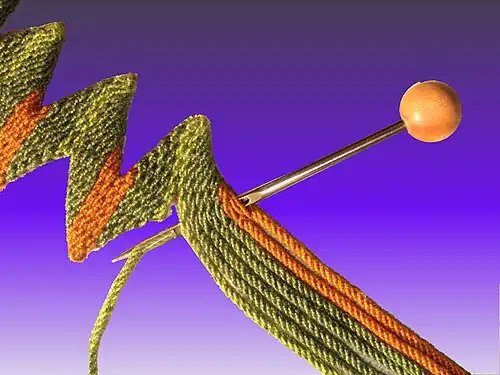
    A Gripfid tool being used to pull a cord in ply-split braiding.

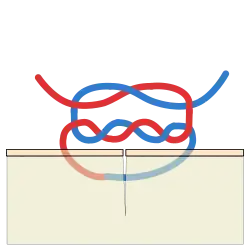
    For ply-split braiding the point separates plies, and another cord is tucked into the hollow shaft of the gripfid and pulled back through the split cord. Although a latchhook may be used instead of a gripfid, the latter is much preferred.[2][3][4][5][6]

    References

    1. Stuart Grainger, Knotted Fabrics (ISBN 0-9530398-0-3), pages 71–74
    2. Peter Collingwood, “The Techniques of Ply-split Braiding” (ISBN 0-9625586-9-9)
    3. “Tools for Ply-split Braiding”https://www.louisefrench.com/techniques/techniques.html
    4. “Making Gripfids” http://www.louisefrench.com/making_gripfids.htm
    5. “How to Make a Gripfid for Ply-Splitting” https://www.youtube.com/watch?v=8e9-t9aXa6M
    6. “Tools for Tablet Weaving and Ply-Splitting” http://www.lindahendrickson.com/tools.htm

    This article is adapted from “Gripfid” on Wikipedia, written by its contributors, and used under CC BY-SA 4.0. Text on this page is available under the same licence. Source snapshot: Wikipedia via Kiwix, 2026-07-20.
  • Water bowline

    Water bowline
    Water bowline
    Category Loop
    Related double bowline
    Releasing Non-jamming
    Typical use Wet conditions
    ABoK #1012

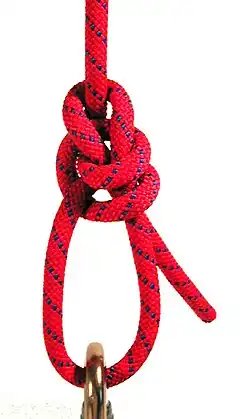
    The water bowline is a type of knot designed for use in wet conditions where other knots may slip or jam.

    Although similar in finished appearance to the double bowline, the water bowline is formed with a clove hitch as the loop in the standing part of the rope. This is similar to the double bowline, which puts the running end through a round turn. The additional friction from the clove hitch increases the security of this knot.

    • 1. Make a half hitch
      1. Make a half hitch
    • 2. Complete the clove hitch
      2. Complete the clove hitch
    • 3. Through the clove hitch
      3. Through the clove hitch
    • 4. Around standing end
      4. Around standing end
    • 5. Back through hitches
      5. Back through hitches

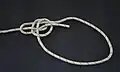
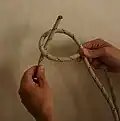
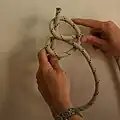
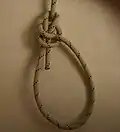
    The Water Bowline can be tied very quickly by throwing two half hitches over the working end and then running the working end around the standing line and back through both half hitches. This is illustrated in the three pictures below.

    • Throw the first hitch
      Throw the first hitch
    • Throw the second hitch
      Throw the second hitch
    • Complete the knot
      Complete the knot

    See also

    External links


    This article is adapted from “Water bowline” on Wikipedia, written by its contributors, and used under CC BY-SA 4.0. Text on this page is available under the same licence. Source snapshot: Wikipedia via Kiwix, 2026-07-20.
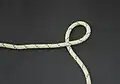
  • Grief knot

    Grief knot
    Grief knot
    Names Grief knot, What knot, Whatnot, Grass bend, Reeving-line bend
    Category Trick
    Category 2 Bend
    Related Reef knot, Thief knot, Granny knot
    Releasing Non-jamming
    Typical use Used for jokes and tricks. It unrolls itself under a light load.
    Caveat Highly insecure
    ABoK #1208, #1406, #1407, #1459, #1490, #2579, #259

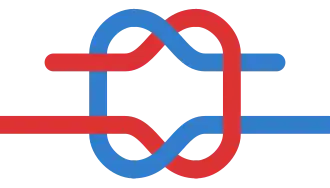
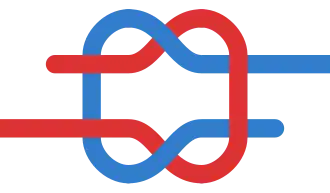
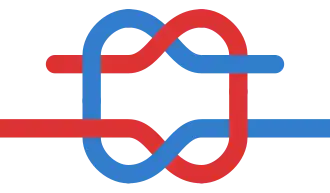
    A grief knot (also what knot) is a knot which combines the features of a granny knot and a thief knot, producing a result which is not generally useful for working purposes. The word grief does not carry its usual meaning but is a portmanteau of granny and thief.

    The grief knot resembles the granny knot, but tied so that the working ends come out diagonally from each other, whereas a granny knot’s ends both come out on the same side. It unravels rather elegantly: as tension is applied, the ropes rotate like little cogs, each one twisting to feed the rope through the knot.[1]

    The whatnot. This is the same knot formation as the granny knot, but the ends are diagonally opposite each other. It is hardly a practical knot. But with the ends seized it is called the reeving line bend, and it also serves as an interesting trick.

    Tying

    To tie the grief knot, tie a single “overhand knot” (nb: this isn’t the same as a single-strand “overhand knot” often used as a stopper or as a component of other knots, such as the fisherman’s knot or ring water knot), as if starting a reef knot. Then thrust the two free ends together down through the center of the just-tied overhand knot.[3] Twist the free ends to form half hitches to lock, twist the other way for the granny knot-like configuration that rolls apart when the standing parts are pulled. In short, if the standing parts (the “main lines” which bear force into the knot) nip/cross their own ends, the knot will lock; otherwise, it will probably slip.

    As a trick knot

    The starkly differing behavior of the knot, depending on how it is arranged, has been exploited as the basis of a parlor trick.[1] When pulling on the standing ends the knot starts slipping and the working ends become crossed. By twisting the working ends so that they uncross and then recross in reverse, the knot’s structure is changed so that it will no longer slip. The twisting motion has been paralleled to the turning of a key, “locking” and “unlocking” the knot.

    Security

    Because the grief knot is known to slip apart “with astonishing ease”,[3] it is considered one of the most insecure of knots.[4]

    However, in its locked opposing half-hitch arrangement, the grief knot has been used as a practical bend for tying together flat materials, such as straps, belts, blades of grass, and similar materials. This is because the flat shape helps to prevent the knot from accidentally “unlocking”. When used in this manner, the knot is known as a grass bend.[5]

    Related knots

    See also

    References

    1. 1 2 Ashley, Clifford W. (1944), The Ashley Book of Knots, New York: Doubleday, p. 415
    2. Ashley, Clifford W. (1944), The Ashley Book of Knots, New York: Doubleday, p. 220
    3. 1 2 Cyrus Lawrence Day (1986), The Art of Knotting and Splicing (4th ed.), Annapolis: Naval Institute Press, pp. 44–45
    4. Geoffrey Budworth (1999). The Ultimate Encyclopedia of Knots. London: Hermes House. p. 155.
    5. Ashley, p. 269

    External links


    This article is adapted from “Grief knot” on Wikipedia, written by its contributors, and used under CC BY-SA 4.0. Text on this page is available under the same licence. Source snapshot: Wikipedia via Kiwix, 2026-07-20.
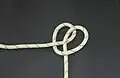
  • Warazan

    Warazan
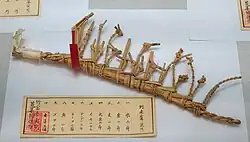
    Example of warazan at the Museum of Science, Tokyo University of Science
    Warazan
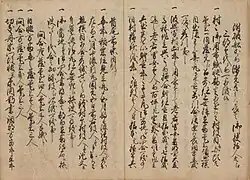
    Instruction to use warazan to record the level of tax assessed, in the Yaeyama-jima Kuramoto Kujichō (1873 copy of the 1857 original); the fourth to sixth characters in the fifth line from the right read「わら算」(University of the Ryukyus Library)[1][2]

    Warazan (藁算) was a system of record-keeping using knotted straw at the time of the Ryūkyū Kingdom.[3][4] In the Southern Ryukyuan languages of the Sakishima Islands it was known as barazan and on Okinawa Island as warazani or warazai.[5] Formerly used in particular in relation to the “head tax”, it is still to be found in connection with the annual Itoman Giant Tug-of-War (糸満大綱引), to record the amount of miki or sacred sake dedicated.[1]

    See also

    • Kaidā glyphs
    • Naha Tug-of-war
    • Quipu

    References

    1. 1 2 “The mathematics from Komonjo” (PDF). University of the Ryukyus Library. November 2017. Retrieved 31 August 2021.
    2. 八重山島蔵元公事帳 [Administrative Guidelines Of Yaeyama Kuramoto] (in Japanese). University of the Ryukyus Library. Retrieved 31 August 2021.
    3. “Native Writing Systems in the Okinawan Islands” 沖縄諸島の土着書記体系の研究 (in Japanese and English). University of Tokyo. 2015. Retrieved 31 August 2021.
    4. Sasaki Toshikazu. “A Study of Ryukyu Materials in the Collection of the National Museum of Ethnology”. National Museum of Ethnology. Retrieved 31 August 2021.
    5. Miyata Yoshimi 宮田義美 (27 December 2014). 古代中国における計算の起源 [The Origins of Reckoning in Ancient China] (PDF). Reports of Institute for Mathematics and Computer Science, Tsuda University (in Japanese). Tsuda University: 358.

    This article is adapted from “Warazan” on Wikipedia, written by its contributors, and used under CC BY-SA 4.0. Text on this page is available under the same licence. Source snapshot: Wikipedia via Kiwix, 2026-07-20.
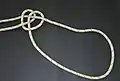
  • Grantchester knot

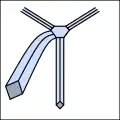
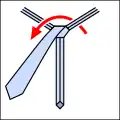
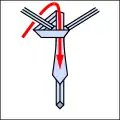
    The Grantchester knot is a self-releasing, asymmetric way of tying a necktie.
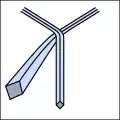
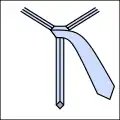
    Using the notation presented in The 85 Ways to Tie a Tie, it is a Lo Ri Lo Ri Co Li, finishing with Ro Li Co T.

    • Grantchester knot instructions
    • Lo beginning
      Lo beginning
    • Ri
      Ri
    • Lo
      Lo
    • Ri
      Ri
    • Co, Li
      Co, Li
    • Ro Li Co T end.
      Ro Li Co T end.

    References

    External links


    This article is adapted from “Grantchester knot” on Wikipedia, written by its contributors, and used under CC BY-SA 4.0. Text on this page is available under the same licence. Source snapshot: Wikipedia via Kiwix, 2026-07-20.
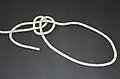
  • Wall and crown knot

    Wall and crown knot
    Wall and crown knot
    Names Wall and crown knot, Manrope knot
    Category Decorative
    Related Turk’s head knot, Underwriter’s knot
    ABoK #672, #847
    Instructions

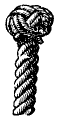
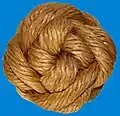
    A wall and crown knot is a decorative kind of rope button. The original use of the knot was to put at the end of the ropes on either side of a gangway leading onto a ship as stoppers.

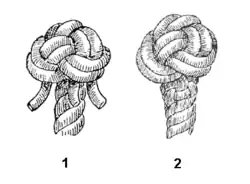
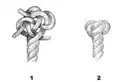
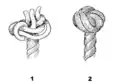
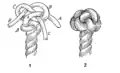
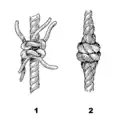
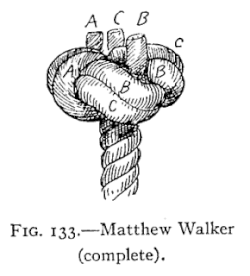
    The knot consists of a wall knot and a crown knot with doubled strands.[1] The strands of the wall knot go over, under twice, and over, while the strands of the crown knot go under, over twice, and under. In the wall and crown knot they are tied in opposite directions.

    This knot is often confused with a Turk’s head knot, as both knots have a basket weave pattern.

    A Manrope knot (double wall and crown, #847) is the same knot as wall and crown knot, but with little changes – crown strands doubled or tripled. In Verrill’s book it is made from three-strand and crown strands doubled, in Ashley’s book it is made from four-strand and crown strands tripled.

    Wall and crown knot
    Double wall and crown

    Crown knot

    Crown knot
    Wall and crown knot
    Names Crown knot, single crown,[2] three strand crown[3]
    Category Decorative
    ABoK 670

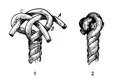
    A crown knot[3] is the simplest of the fancy knots.[2] It is created from three strands.

    670. “Crowning” is mentioned by Steel in 1794. The Vocabulary of Sea Phrases of 1799 gives both the crown and the double crown…To tie a three-strand crown: Hold the apparatus as in the right upper diagram, and tie the knot in a counterclockwise direction. Take one strand, and cross it over the next strand ahead. Take the second strand, cross it over the end of the first-moved strand and across the standing part of the next strand ahead. Take the third strand, and cross it over the end of the strand last moved, then tuck the end through the bight of the next strand ahead (which, in the Three-Strand Knot, is the first strand that was moved). Draw the knot up, and it will appear as in the last two diagrams.

    The Ashley Book of Knots[3]

    • Crown (top view)
      Crown (top view)
    • Crown tucked
      Crown tucked
    • Double crown
      Double crown

    Wall knot

    Wall knot
    Wall and crown knot
    Category Decorative
    ABoK 671

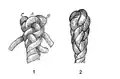
    A wall knot[2][3] is essentially a crown knot, but reversed.[2][4]

    671. The wall knot is the exact reverse of the crown knot. If either of these knots is turned upside down it becomes the other knot. But as the stem of a knot leads from the bottom, the knots ordinarily are different.

    John Smith mentions the “wall knot” in 1627, Manwayring the “wale knot” in 1644, Blanckley the “whale knott” in 1750, and Falconer the “Walnut” in 1769. Even in Falconer’s day standardized spelling and pronunciation had hardly been thought of…To tie a three-strand wall knot: Take one strand and bring it counterclockwise under the next strand. Take the next strand, and pass it under the end of the first-moved strand and under the standing part of the next. Take the third strand under the second end and up through the bight of the first-moved strand.

    The Ashley Book of Knots[3]

    • Double wall
      Double wall
    • Wall crowned(unfinished "wall and crown knot")
      Wall crowned
      (unfinished “wall and crown knot”)

    See also

    References

    1. Shaw, George Russell (MCMXXXIII) Knots: Useful & Ornamental, p.50-51. [ISBN unspecified].
    2. 1 2 3 4 Verrill, A. Hyatt (1917). Knots, Splices and Rope Work, p84.. at Project Gutenberg.
    3. 1 2 3 4 5 Ashley, Clifford W. (1944). The Ashley Book of Knots, p.116. Doubleday. ISBN 0-385-04025-3.
    4. Williams, Laura and Mann, Elise (2011). 75 Chinese, Celtic & Ornamental Knots, p.66. ISBN 978-0-312-67531-8.

    Knob knots

    External links


    This article is adapted from “Wall and crown knot” on Wikipedia, written by its contributors, and used under CC BY-SA 4.0. Text on this page is available under the same licence. Source snapshot: Wikipedia via Kiwix, 2026-07-20.
  • Granny knot

    Granny knot
    Granny knot
    Names Granny knot, false knot, lubber’s knot, calf knot, booby knot
    Category Binding
    Origin Ancient
    Related Reef knot, thief knot, grief knot
    Releasing Often jams
    Caveat Should not be used as a bend. Inferior to reef knot for binding purposes, it can release suddenly and unpredictably.
    ABoK #3, #80, #186, #464, #1206, #1405, #2553

    The granny knot is a binding knot, used to secure a rope or line around an object. It is considered inferior to the reef knot (square knot), which it superficially resembles. Neither of these knots should be used as a bend knot for attaching two ropes together.

    The granny knot is also called the false, lubber’s, calf, and booby knot. Patterson’s Nautical Encyclopedia calls it “old granny knot” and Sir Edwin Arnold calls it the “common or garden knot.” The name granny is given in Vocabulary of Sea Phrases (Anonymous, 1799) and Roding pictures the knot in 1795.

    The granny consists of two identical half knots, one tied on top of the other. It has but one practical purpose that I know of and that is to serve as a surgeon’s knot. Formerly it was employed for tying up parcels in five-and-ten-cent stores, but the practice was given up and paper bags substituted as they were found to be simpler.

    Etymology

    Called the “granny’s knot” with references going back to at least 1849, the knot was so-called because it is “the natural knot tied by women or landsmen”.[2][3]

    Tying

    When attempting to tie a reef knot (square knot), it is easy to produce a granny knot accidentally. This is dangerous because the granny knot can slip when heavily loaded. A tightened granny knot can also jam and is often more difficult to untie than the reef knot. It is better to tie a reef knot in nearly all circumstances. One way to distinguish them is that in the reef knot each loop passes completely over, or completely under (not through) the neck of the other.

    The reef knot is commonly taught as left over right, tuck under then right over left, tuck under. The granny knot is the first step repeated twice, left over right, tuck under. This is a very common mistake made by people learning to tie a reef knot.

    Granny knot
    Bourchier knot of heraldry

    Heraldry

    In heraldry, the granny knot is known as the Bourchier knot, due to being a heraldic badge of the Bourchier family.[4]

    Related knots

    See also

    References

    1. Ashley, Clifford W. (1944). The Ashley Book of Knots, p.220-21. Doubleday. ISBN 0-385-04025-3.
    2. Smyth, William Henry (2008) [1867], Sir Edward Belcher (ed.), The Sailor’s Word-Book, Project Gutenberg, p. 346
    3. Melville, Herman (1849). Redburn.
    4. Arthur Charles Fox-Davies, A Complete Guide to Heraldry (1909), pp. 390, 469.

    External links


    This article is adapted from “Granny knot” on Wikipedia, written by its contributors, and used under CC BY-SA 4.0. Text on this page is available under the same licence. Source snapshot: Wikipedia via Kiwix, 2026-07-20.
  • Wake knot

    Wake knot
    Wake knot

    The Wake badge.
    Information
    Family Wake family
    Region Lincolnshire
    Wake knot
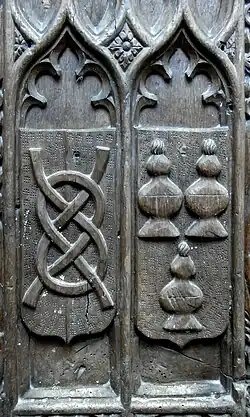
    Bench end in Monkleigh Church, Devon showing the Ormonde knot and arms of Thomas Butler, 7th Earl of Ormond (c.1426 – c.1515): Gules, three covered cups or,[1]

    The Wake knot or Ormond knot is an English heraldic knot used historically as an heraldic badge by the Wake family, lords of the manor of Bourne in Lincolnshire and also by the Butler family, Earls of Ormond.

    Form

    It takes the form of a Carrick bend knot connecting two ropes but the Wake knot shows the knot joining a rope and a strap.

    Usage

    It is depicted in the coat of arms of Bourne Town Council[2] and Bourne Academy, Lincolnshire, where the Wakes were lords of the manor.

    The crest of the arms of the Isle of Ely County Council was a human hand grasping a trident around which an eel was entwined; on the wrist of the hand was a Wake knot, representing Hereward the Wake.[3]

    The crest of No. 2 Squadron RAF includes a Wake knot. Its motto is Hereward.

    References

    1. Debrett’s Peerage, 1968, p. 864, Butler, Earl & Marquess of Ormonde
    2. “Image of coat of arms” (JPG). Civicheraldry.co.uk. Retrieved 25 October 2017.
    3. W. C. Scott-Giles, Civic Heraldry of England and Wales, 2nd edition, London, 1953


    This article is adapted from “Wake knot” on Wikipedia, written by its contributors, and used under CC BY-SA 4.0. Text on this page is available under the same licence. Source snapshot: Wikipedia via Kiwix, 2026-07-20.
  • Gordon–Luecke theorem

    In mathematics, the Gordon–Luecke theorem on knot complements states that if the complements of two tame knots are homeomorphic, then the knots are equivalent. In particular, any homeomorphism between knot complements must take a meridian to a meridian.

    The theorem is usually stated as “knots are determined by their complements”; however this is slightly ambiguous as it considers two knots to be equivalent if there is a self-homeomorphism taking one knot to the other. Thus mirror images are neglected. Often two knots are considered equivalent if they are isotopic. The correct version in this case is that if two knots have complements which are orientation-preserving homeomorphic, then they are isotopic.

    These results follow from the following (also called the Gordon–Luecke theorem): no nontrivial Dehn surgery on a nontrivial knot in the 3-sphere can yield the 3-sphere.

    The theorem was proved by Cameron Gordon and John Luecke. Essential ingredients of the proof are their joint work with Marc Culler and Peter Shalen on the cyclic surgery theorem, combinatorial techniques in the style of Litherland, thin position, and Scharlemann cycles.

    For link complements, it is not in fact true that links are determined by their complements. For example, JHC Whitehead proved that there are infinitely many links whose complements are all homeomorphic to the complement of the Whitehead link. His construction is to twist along a disc spanning an unknotted component (as is the case for either component of the Whitehead link). Another method is to twist along an annulus spanning two components. Gordon proved that for the class of links where these two constructions are not possible there are finitely many links in this class with a given complement.

    References

    • Cameron Gordon and John Luecke, Knots are determined by their complements. J. Amer. Math. Soc. 2 (1989), no. 2, 371–415.
    • Cameron Gordon, Links and their complements. Topology and geometry: commemorating SISTAG, 71–82, Contemp. Math., 314, Amer. Math. Soc., Providence, RI, 2002.


    This article is adapted from “Gordon–Luecke theorem” on Wikipedia, written by its contributors, and used under CC BY-SA 4.0. Text on this page is available under the same licence. Source snapshot: Wikipedia via Kiwix, 2026-07-20.
  • Vortex theory of the atom

    The vortex theory of the atom was a 19th-century attempt by William Thomson (later Lord Kelvin) to explain why the atoms recently discovered by chemists came in only relatively few varieties but in very great numbers of each kind. Based on the idea of stable, knotted vortices in the ether or aether, it contributed an important mathematical legacy.

    Description

    Vortex theory of the atom
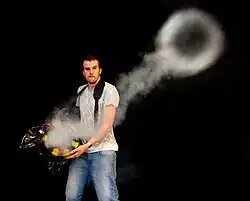
    A smoke ring demonstration. A smoke ring demonstration by Peter Guthrie Tait in 1867 led William Thomson to connect a hydrodynamic theory of Hermann Helmholtz to atomic theory.[1]:38

    The vortex theory of the atom was based on the observation that a stable vortex can be created in a fluid by making it into a ring with no ends. Such vortices could be sustained in the luminiferous aether, a hypothetical fluid thought at the time to pervade all of space. In the vortex theory of the atom, a chemical atom is modelled by such a vortex in the aether.

    Knots can be tied in the core of such a vortex, leading to the hypothesis that each chemical element corresponds to a different kind of knot. The simple toroidal vortex, represented by the circular “unknot” 01, was thought to represent hydrogen. Many elements had yet to be discovered, so the next knot, the trefoil knot 31, was thought to represent carbon.

    History

    Between 1870 and 1890 the vortex atom theory, which hypothesised that an atom was a vortex in the aether, was popular among British physicists and mathematicians. William Thomson, who became better known as Lord Kelvin, first conjectured that atoms might be vortices in the aether that pervades space. About 60 scientific papers were subsequently written on it by approximately 25 scientists.

    Origins

    In the seventeenth century Descartes developed a theory of vortex motion to explain such things as why light radiated in all directions and the planets moved in circular orbits. He believed that there was no vacuum and any object which moved had to be entering a gap left by another moving object. He realised that a circular chain of such objects, all replacing each other, would enable such movement. Thus, all movement consisted of endless circular vortices at all scales. However Descartes model consisted of tiny whirling particles rather than a strictly continuous medium of the vortex theory of atoms.[1]:33

    Hermann Helmholtz, working on the hydrodynamics of idealized fluids, realized in the mid-19th century that the core of a vortex, analogous to the eye of a hurricane, is a line-like filament and in a perfect frictionless fluid these filaments can form closed rings. Helmholtz also showed that vortices exert forces on one another, and those forces take a form analogous to the magnetic forces between electrical wires. However Helmholtz made no connection theories of matter.[1]:36

    During the intervening period, chemist John Dalton had developed his atomic theory of matter. It remained only to bring the two strands of discovery together.

    William Thomson (Lord Kelvin)

    William Thomson, later to become Lord Kelvin, became concerned with the nature of Dalton’s chemical elements, whose atoms appeared in only a few forms but in vast numbers. He was inspired by Helmholtz’s findings, reasoning that the aether, a substance then hypothesised to pervade all of space, should be capable of supporting such stable vortices. According to Helmholtz’s theorems, these vortices would correspond to different kinds of knot. Thomson suggested that each type of knot might represent an atom of a different chemical element. He further speculated that multiple knots might aggregate into molecules of somewhat lower stability.

    He published his paper “On Vortex Atoms” in the Proceedings of the Royal Society of Edinburgh in 1867.[2][3]

    Peter Tait

    Vortex theory of the atom
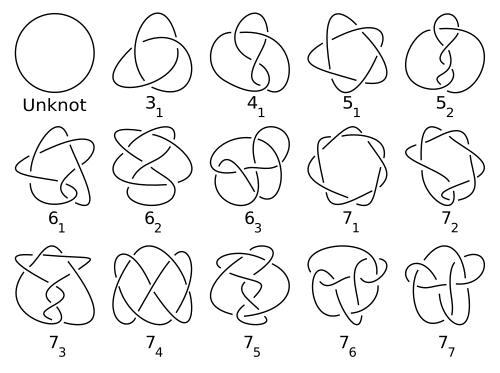
    The knots with up to 7 crossings.

    Thomson’s colleague Peter Guthrie Tait was attracted by the vortex atom theory and undertook a pioneering study of knots, producing a systematic classification of those with up to 10 crossings, in the hope of thus systematizing the various elements.

    J. J. Thomson

    J. J. Thomson took up the challenge in his 1883 Master’s degree thesis, a Treatise on the motion of vortex rings.[4][5] In it, Thomson developed a mathematical treatment of the motions of William Thomson and Peter Tait’s atoms.[6]

    When Thomson later discovered the electron (for which he received a Nobel Prize), he abandoned his “nebular atom” hypothesis based on the vortex atomic theory, in favour of his plum pudding model.

    Demise

    By 1883 William Thomson began to see that the theory could not do all of the things he hoped. It could not explain inertia or gravitation and, worse Helmholtz’s circular ring was not ultimately stable. Even the properties of crystals, and of electrical and chemical forces were unexplainable in the model. However, in an era with increasing evidence for atomic theory and no viable alternative model, the vortex theory was highly influential.[7]:473

    Legacy

    Tait’s work especially founded the branch of topology called knot theory,[1]:93 with J. J. Thomson providing some early mathematical advancements.
    The vortex theory was not successful as a model for the atom, but the theoretical development of the theory had a lasting impact on theoretical hydrodynamics.[7]
    In 1961, inspired by Kelvin’s motivation and results, Tony Skyrme introduced solitons to build a model for nucleons.[1]:93 These solitons were topologically stable vortices of a ‘pion fluid’ and were later called skyrmions.[8]

    See also

    • Loop quantum gravity
    • Magnetic skyrmion, a vortex-like magnetic quasiparticle
    • Quantum vortex, a quantised flux circulation
    • Toroidal ring model of elementary particles

    References

    1. 1 2 3 4 5 Kragh, Helge (2002). “The Vortex Atom: A Victorian Theory of Everything”. Centaurus. 44 (1–2): 32–114. doi:10.1034/j.1600-0498.2002.440102.x. ISSN 0008-8994.
    2. Wm. Thomson (1867) On Vortex Atoms, Proceedings of the Royal Society of Edinburgh 6: 94105
    3. Thomson, William (1869). “On Vortex Atoms”. Proceedings of the Royal Society of Edinburgh. 6: 94–105. doi:10.1017/S0370164600045430.
    4. J. J. Thomson. 1883. A Treatise on the Motion of Vortex Rings: An essay to which the Adams Prize was adjudged in 1882, in the University of Cambridge. London: Macmillan and Co., pp. 146. Recent reprint: ISBN 0-543-95696-2.
    5. “J.J. Thomson – Biographical”. The Nobel Prize in Physics 1906. The Nobel Foundation. Retrieved 11 February 2015.
    6. Kim, Dong-Won (2002). Leadership and creativity: a history of the Cavendish Laboratory, 1871–1919. Dordrecht: Kluwer Acad. Publ. ISBN 978-1402004759. Retrieved 11 February 2015.
    7. 1 2 Silliman, Robert H. (1963) William Thomson: Smoke Rings and Nineteenth-Century Atomism, Isis 54(4): 461474. JSTOR link
    8. Sanyuk, Valery I. (January 10, 1992). “Genesis and Evolution of the Skyrme Model from 1954 to the present”. International Journal of Modern Physics A. 07 (01): 1–40. doi:10.1142/S0217751X92000028. ISSN 0217-751X.

    This article is adapted from “Vortex theory of the atom” on Wikipedia, written by its contributors, and used under CC BY-SA 4.0. Text on this page is available under the same licence. Source snapshot: Wikipedia via Kiwix, 2026-07-20.