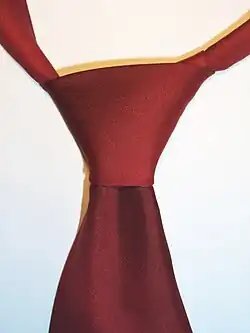
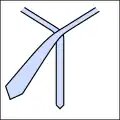
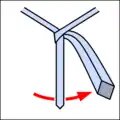
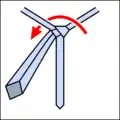
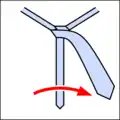
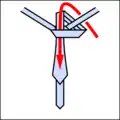
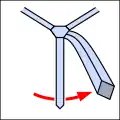
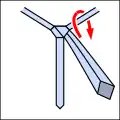
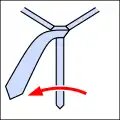
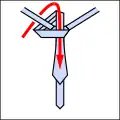
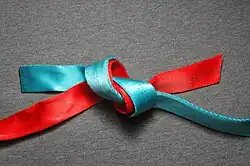
The half-Windsor knot, also known as the single Windsor knot,[1] is a way of tying a necktie which produces a neat, triangular knot. It is larger than the four-in-hand knot and Pratt knot, but smaller than the Windsor knot. The half-Windsor is derived from the Windsor in that it is only brought up around the loop on one side rather than both. It works well with light- and medium-weight fabrics.
This article is adapted from “Half-Windsor knot” on Wikipedia, written by its contributors, and used under CC BY-SA 4.0. Text on this page is available under the same licence. Source snapshot: Wikipedia via Kiwix, 2026-07-20.
In the mathematical theory of knots, a knot is tame if it can be “thickened”, that is, if there exists an extension to an embedding of the solid torus into the 3-sphere. A knot is tame if and only if it can be represented as a finite closed polygonal chain. In knot theory and 3-manifold theory, often the adjective “tame” is omitted. Smooth knots, for example, are always tame.
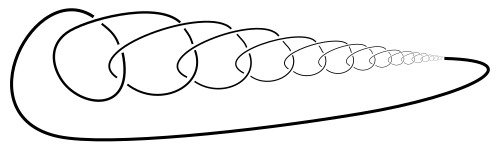
Knots that are not tame are called wild and can have pathological behavior.
Every closed curve containing a wild arc is a wild knot.[1]
It has been conjectured that every wild knot has infinitely many quadrisecants.[2]
As well as their mathematical study, wild knots have also been studied for their potential for decorative purposes in Celtic-styleornamental knotwork.[3]
This article is adapted from “Wild knot” on Wikipedia, written by its contributors, and used under CC BY-SA 4.0. Text on this page is available under the same licence. Source snapshot: Wikipedia via Kiwix, 2026-07-20.
In the mathematical field of knot theory, the HOMFLY polynomial or HOMFLYPT polynomial, sometimes called the generalized Jones polynomial, is a 2-variable knot polynomial, i.e. a knot invariant in the form of a polynomial of variables m and l.
A central question in the mathematical theory of knots is whether two knot diagrams represent the same knot. One tool used to answer such questions is a knot polynomial, which is computed from a diagram of the knot and can be shown to be an invariant of the knot, i.e. diagrams representing the same knot have the same polynomial. The converse may not be true. The HOMFLY polynomial is one such invariant and it generalizes two polynomials previously discovered, the Alexander polynomial and the Jones polynomial, both of which can be obtained by appropriate substitutions from HOMFLY. The HOMFLY polynomial is also a quantum invariant.
The name HOMFLY combines the initials of its co-discoverers: Jim Hoste, Adrian Ocneanu, Kenneth Millett, Peter J. Freyd, W. B. R. Lickorish, and David N. Yetter.[1] The addition of PT recognizes independent work carried out by Józef H. Przytycki and Paweł Traczyk.[2]
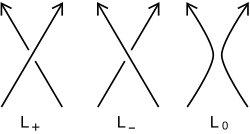
where are links formed by crossing and smoothing changes on a local region of a link diagram, as indicated in the figure.
The HOMFLY polynomial of a link L that is a split union of two links and is given by
See the page on skein relation for an example of a computation using such relations.
Other HOMFLY skein relations
This polynomial can be obtained also using other skein relations:
Main properties
, where # denotes the knot sum. In other words, the HOMFLY polynomial of a composite knot is the product of the HOMFLY polynomials of its components.
, so the HOMFLY polynomial can often be used to distinguish between two knots of different chirality. However there exist chiral pairs of knots that have the same HOMFLY polynomial, e.g. knots 942 and 1071 together with their respective mirror images.[3]
The Jones polynomial, V(t), and the Alexander polynomial, can be computed in terms of the HOMFLY polynomial (the version in and variables) as follows:
This article is adapted from “HOMFLY polynomial” on Wikipedia, written by its contributors, and used under CC BY-SA 4.0. Text on this page is available under the same licence. Source snapshot: Wikipedia via Kiwix, 2026-07-20.
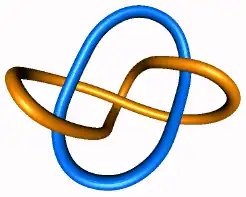
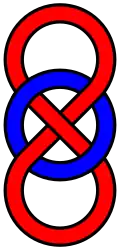
In knot theory, the Whitehead link, named for J. H. C. Whitehead, is one of the most basic links. It can be drawn as an alternating link with five crossings, from the overlay of a circle and a figure-eight shaped loop.
Alternative diagram, symmetric by 3d rotation around a vertical line in the plane of the drawing[1]
A common way of describing this knot is formed by overlaying a figure-eight shaped loop with another circular loop surrounding the crossing of the figure-eight. The above-below relation between these two unknots is then set as an alternating link, with the consecutive crossings on each loop alternating between under and over. This drawing has five crossings, one of which is the self-crossing of the figure-eight curve, which does not count towards the linking number. Because the remaining crossings have equal numbers of under and over crossings on each loop, its linking number is 0. It is not isotopic to the unlink, but it is link homotopic to the unlink.
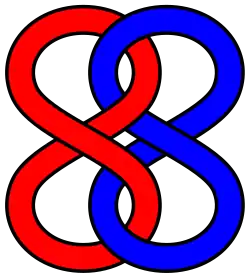
Although this construction of the knot treats its two loops differently from each other, the two loops are topologically symmetric: it is possible to deform the same link into a drawing of the same type in which the loop that was drawn as a figure eight is circular and vice versa.[2] Alternatively, there exist realizations of this knot in three dimensions in which the two loops can be taken to each other by a geometric symmetry of the realization.[1]
This polynomial and are the two factors of the Jones polynomial of the L10a140 link. Notably, is the Jones polynomial for the mirror image of a link having Jones polynomial .
Volume
The hyperbolic volume of the complement of the Whitehead link is 4 times Catalan’s constant, approximately 3.66. The Whitehead link complement is one of two two-cusped hyperbolic manifolds with the minimum possible volume, the other being the complement of the pretzel link with parameters (−2, 3, 8).[3]
Dehn filling on one component of the Whitehead link can produce the sibling manifold of the complement of the figure-eight knot, and Dehn filling on both components can produce the Weeks manifold, respectively one of the minimum-volume hyperbolic manifolds with one cusp and the minimum-volume hyperbolic manifold with no cusps.
History
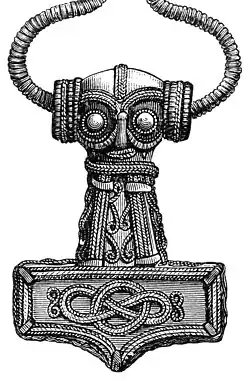
Old Thor’s hammer archaeological artefact
The Whitehead link is named for J. H. C. Whitehead, who spent much of the 1930s looking for a proof of the Poincaré conjecture. In 1934, he used the link as part of his construction of the now-named Whitehead manifold, which refuted his previous purported proof of the conjecture.[4]
↑Agol, Ian (2010), “The minimal volume orientable hyperbolic 2-cusped 3-manifolds”, Proceedings of the American Mathematical Society, 138 (10): 3723–3732, arXiv:0804.0043, doi:10.1090/S0002-9939-10-10364-5, MR2661571
This article is adapted from “Whitehead link” on Wikipedia, written by its contributors, and used under CC BY-SA 4.0. Text on this page is available under the same licence. Source snapshot: Wikipedia via Kiwix, 2026-07-20.
Group-based cryptography is a use of groups to construct cryptographic primitives. A group is a very general algebraic object and most cryptographic schemes use groups in some way. In particular Diffie–Hellman key exchange uses finite cyclic groups. So the term group-based cryptography refers mostly to cryptographic protocols that use infinite non-abelian groups such as a braid group.
Examples
Shpilrain–Zapata public-key protocols
Magyarik–Wagner public key protocol
Anshel–Anshel–Goldfeld key exchange
Ko–Lee et al. key exchange protocol
See also
Non-commutative cryptography
References
Myasnikov, A.G.; Shpilrain, V.; Ushakov, A. (2008). Group-based Cryptography. Advanced Courses in Mathematics – CRM Barcelona. Birkhauser. ISBN9783764388270.
Myasnikov, A.G.; Shpilrain, V.; Ushakov, A. (2011). Non-commutative cryptography and complexity of group-theoretic problems. Amer. Math. Soc. Surveys and Monographs. ISBN9780821853603.
Shpilrain, V.; Zapata, G. (2006). “Combinatorial group theory and public key cryptography”. Appl. Algebra Eng. Commun. Comput. 17 (3–4): 291–302. arXiv:math/0410068. CiteSeerX10.1.1.100.888. doi:10.1007/s00200-006-0006-9. S2CID2251819.
This article is adapted from “Group-based cryptography” on Wikipedia, written by its contributors, and used under CC BY-SA 4.0. Text on this page is available under the same licence. Source snapshot: Wikipedia via Kiwix, 2026-07-20.
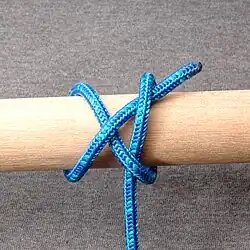
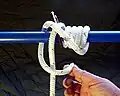
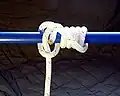
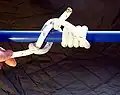
The ground-line hitch is a type of knot used to attach a rope to an object. Worked-up and dressed properly, it is more secure than the simpler clove hitch and has less tendency to jam, but does not respond well to swinging. It can also be used as a simple binding knot and is classed among several knots known as the miller’s knot.[1] The Ground-line hitch is also the start of a three-lead four-bight Turk’s head.[2]
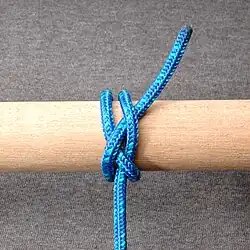
Untightened ground-line hitch
The knot is named for its use to attach a net to the groundline, a weighted or lead cored rope on the bottom of the net (especially a gillnet).
This article is adapted from “Ground-line hitch” on Wikipedia, written by its contributors, and used under CC BY-SA 4.0. Text on this page is available under the same licence. Source snapshot: Wikipedia via Kiwix, 2026-07-20.
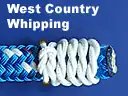
The West Country whipping is a quick practical whipping knot, a method of using twine to secure the end of a rope to prevent it fraying. It has several advantages: it can be tied without a needle; it is simple to understand and remember; if the whipping fails, the loose ends can usually be re-tied to temporarily prevent the rope’s end from fraying.
West Country whipping was the name given by Biddlecombe in 1848 to this particular practice, but most subsequent seamanship books, including the British Admiralty Manual of Seamanship, have modified the name to West County whipping…I have not seen this whipping used but it has this advantage: if any part breaks it will be a very long while before the whole whipping lets go. The break will be evident and the whipping can be replaced in time.
Half knots are tied alternately behind and in front of the rope until the width of the band of twine approaches the diameter of the rope. A reef (square) knot, or better a series of reef (square) knots, completes the whipping. If a needle is available this string of reef (square) knots can be pulled through the rope to bury the ends. Alternatively, a short bight of another rope can be laid first and used to pull the rope ends through. If the rope is a stranded rope, the ends can usually be pulled through without a needle.
Alternatives
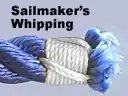
Sailmaker’s whipping
The sailmaker’s whipping is the yardstick for comparison, for its durability. There are two approaches to forming the frapping turns, the source of the durability, both of which are harder to understand and remember compared to the West Country whipping.
This article is adapted from “West Country whipping” on Wikipedia, written by its contributors, and used under CC BY-SA 4.0. Text on this page is available under the same licence. Source snapshot: Wikipedia via Kiwix, 2026-07-20.
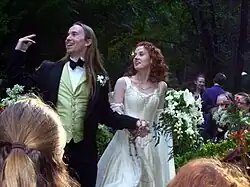
A newly wedded couple carry wedding cords in their hands
The traditional wedding cord, also known as the “wedding lasso”, is a piece of paraphernalia used in some Catholic wedding ceremonies. It is actually a representation of a loop of rosary beads made out of white satin or silk. During the wedding proper, this is traditionally formed into a figure-of-eight shape, and then placed around the neck areas of the bride and the groom after they have made their wedding vows, and are already kneeling on pillows for the pronouncement of a wedding prayer. This cord symbolizes lifetime unity or the everlasting union of the bride and groom when they officially become husband and wife, as well as a symbol of marital protection; while the loops formed signifies their love for one another. After the wedding, this marital twine is typically kept by the bride as a wedding souvenir. Use of the traditional wedding cord for weddings is common in Hispanic countries such as Mexico, the Philippines, and Spain.
Wedding cord ritual
Wedding cord ceremony
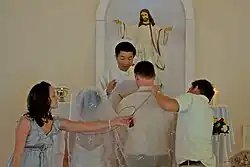
After shrouding the bride and groom with the wedding veils, a pair of wedding participants is assigned in placing the wedding cord around the couple, with the groom being the first to be “lassoed” or “looped” by it at the shoulder area.[1] The cord is held in place by means of pins. In other wedding ceremonies, the wedding cord is tied around the couple’s wrists. The wedding cord stays on and around the couple until the wedding mass or religious service is finished. Then, it is removed by the same pair of wedding participants who were assigned to place the loop around the couple.[2] The significance of the “lassoing” is to symbolize the unification of the couple in matrimony for their entire lives.[3]
On the other hand, the ritual for the cord of three strands is performed by the bride and the groom. The groom holds the end of the cord that has a metal ring, while the bride braids the strands together. The braiding is done while an explanation of the significance of the braiding ritual is being read, or while a wedding music is being played, or while a wedding song is being chanted. The resulting braid is kept in place temporarily by a rubber band, and then permanently by a gold thread. The loop can signify the sacramental union itself or simply the, “yoke of marriage.”[4]
This Hispanic tradition in Spanish was approved by the U.S. Conference of Catholic Bishops in 2010. In September 2016, an English language version was approved and placed in the English Order of Celebrating Matrimony along with the arras.[5]
↑Candelaria, Cordelia; García, Peter J.; Aldama, Arturo J. (2004). Encyclopedia of Latino popular culture (2004ed.). Greenwood Publishing Group. p.879. ISBN0-313-33211-8.
This article is adapted from “Wedding cord” on Wikipedia, written by its contributors, and used under CC BY-SA 4.0. Text on this page is available under the same licence. Source snapshot: Wikipedia via Kiwix, 2026-07-20.
Tie one rope to another rope, boom, spar, shaft, etc., and pull lengthwise.
Michoacan-MartinStep by step for Gripping Sailor’s Hitch
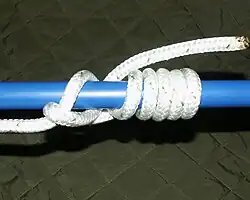
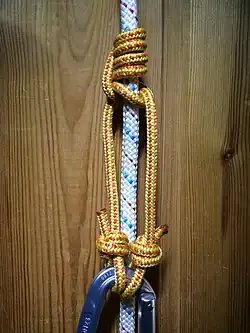
The gripping sailor’s hitch[a] is a secure, jam-proof friction hitch used to tie one rope to another, or a rope to a pole, boom, spar, etc., when the pull is lengthwise along the object. It will even grip a tapered object, such as a marlin spike, in the direction of taper, similar to the Icicle hitch, and it is much superior to the rolling hitch for that purpose.[1][2]
Tying
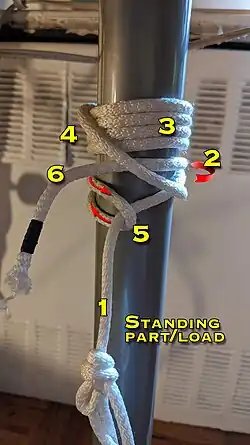
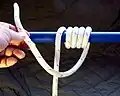
Make 5 turns around the object at opposite side of to the pull direction of the standing part, then cross the standing part to the pull direction and make one more turn
Cross back over the standing part in front, as you change the turn direction to opposite the wraps, come through from the back, and pass under the standing part (following the pen in pic).
Tighten up before loading…
When pulled to the side opposite the 5 turns, this hitch will hold…
↑Sometimes incorrectly presented under name Sailor’s gripping hitch. It is a gripping version of the Sailor’s hitch, not a Sailor’s version of a (non-existent) Gripping hitch.
This article is adapted from “Gripping sailor's hitch” on Wikipedia, written by its contributors, and used under CC BY-SA 4.0. Text on this page is available under the same licence. Source snapshot: Wikipedia via Kiwix, 2026-07-20.
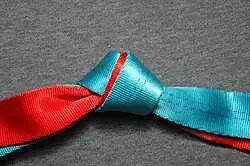
The water knot (also tape knot, ring bend, grass knot, or overhand follow-through) is a knot frequently used in climbing for joining two ends of webbing together, for instance when making a sling.
Tying
It is tied by forming an overhand knot in one end and then following it with the other end, feeding in the opposite direction.
The ends should be left at least 7.5 centimetres (3.0in) long and the knot should be “set” by tightening it with full body weight. The ends can be knotted, taped or lightly sewn to the standing parts to help prevent them from creeping back into the knot.[1]
Variations
The figure-8 water knot (or figure-8 bend or Flemish bend)[2] is based upon a figure-8 (or Flemish) knot instead of an overhand knot. It is easier to untie.
Uses
The knot can be used for joining flat materials such as leather or tape.[3]
Some testing has shown that the water knot, in certain conditions, can slip very slightly but very consistently, with cyclic loading and unloading at relatively low forces; it is the tail on the exterior that slips (this would be the blue tail in the image presented here). In tests using 9/16in (14.3mm) tubular nylon webbing, repeated loading and unloading with 250lbs (113kg) caused one of the 3in (76mm) tails to work back into the knot in just over 800 loading cycles. Another test showed similar results for Spectra tape (but not for new, 1-inch tubular nylon). And yet the knot can be loaded to rupture without slippage. These results validate the need to leave adequate tails and inspect water knots before each use. With single overhand knot safeties on either end, the combination eventually seized and the slipping stopped.[4]
Although used extensively in climbing and caving, there is some opinion that the water knot is unsafe. According to Walter Siebert, several deaths have been reported due to failure of this knot (although, as in many failed-knot cases, the actual mechanism of failure is unknown, and only conjecture can be inferred). He demonstrates in a video how easily the knot can pull loose if snagged.[5] Siebert references an article from Pit Schubert in 1995 that details many deaths investigated where the water knot was used with webbing and failed. Schubert drew the conclusion after reviewing the remaining webbing and the sites where these falls took place that the knot can open if it catches on an edge or any protrusion.
However, these analyses fail to note that this uncommon vulnerability can lead to trouble only if (a) the knot will move much under load, so as to pull out enough tail to fail, and (b) the exterior strand is loaded from the top, resulting in a downwards pull by the interior strand (the red one, as shown here) that pulls it away from the snagged exterior strand.
To remove these failure conditions, orientate the knot in the opposite way –interior strand up, exterior strand down– and place it high so as to minimize sideways movements.[6]
In Germany, the knot is sometimes called Todesknoten, which means death knot.[7]
↑Walter Siebert (2007), Deutscher Alpenverein; Österreichischer Alpenverein; Schweizer Alpen-Club (eds.), “Warten wir noch ein paar Tote ab”(PDF), Bergundsteigen (in German), no.2/2007, Innsbruck, pp.38-45, retrieved 5 March 2008
This article is adapted from “Water knot” on Wikipedia, written by its contributors, and used under CC BY-SA 4.0. Text on this page is available under the same licence. Source snapshot: Wikipedia via Kiwix, 2026-07-20.