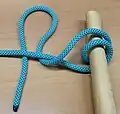
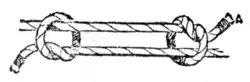
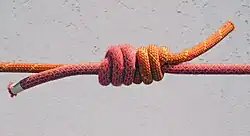
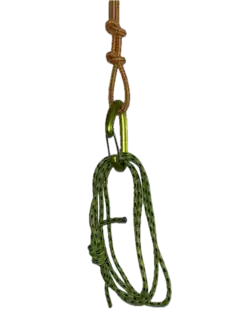
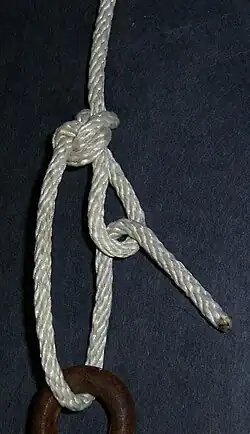
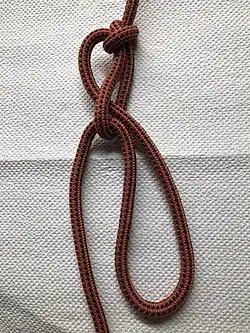
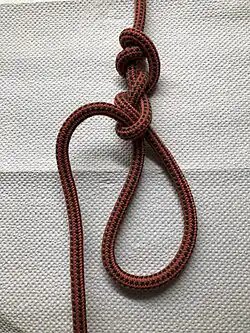
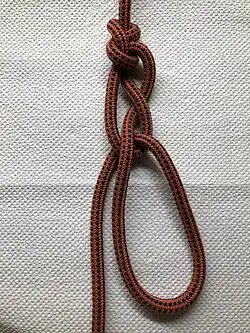
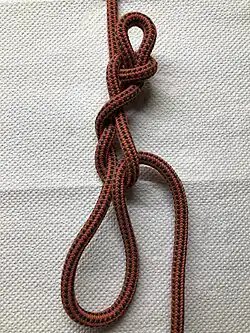
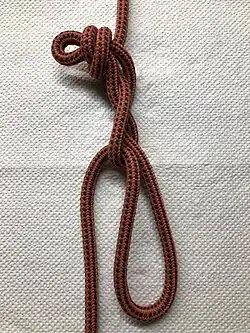
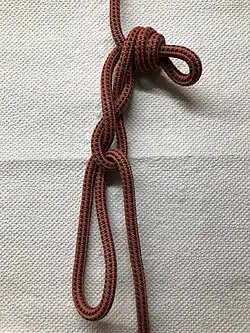
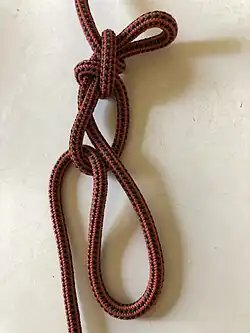
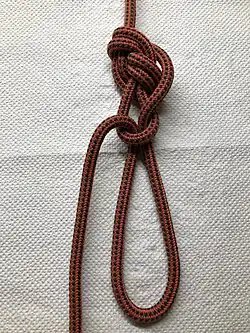
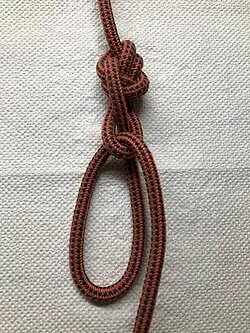
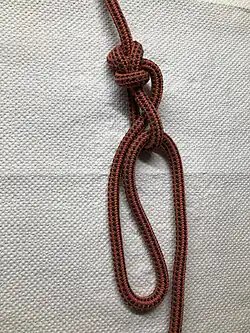
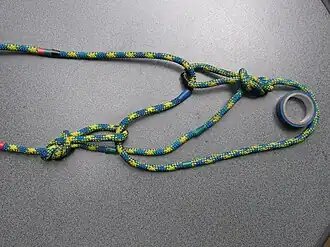
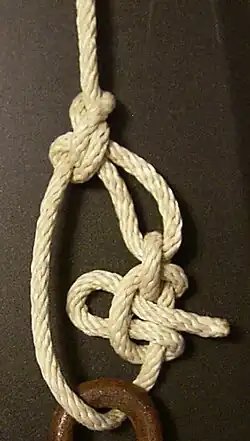
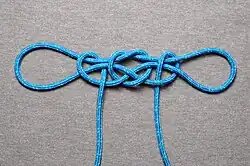
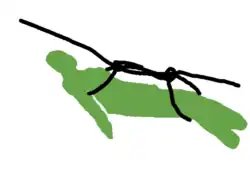
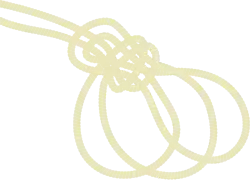
The tumble hitch is a “slip-free”, quick-release hitch knot used for temporarily securing a rope such that it can be released easily to be completely free of the hitched-to object (instead of parts still being wrapped around it). The hitch might be able to be released with a tug of the working end, even when under tension; but the workings depend upon materials and forces; note that in some cases, “under tension” will amount to simply being tied and the line itself giving significant tension by weight. The tumble hitch is tied in the bight.
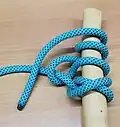
Usually two locking turns (as in the picture here) suffice for a knot secure enough for most purposes, but another could be added for further stability. The general knotting principles evident in this and the well-published “highwayman’s hitch” can be implemented in a variety of ways. This knot was designed specifically to avoid the problem of the highwayman’s hitch of putting the full force of loading upon the locking toggle (“slip”) bight, which esp. in soft cordage can collapse that and pull it through the bight “frame” it had locked against!
Hence, The Notable Knot Index recommends the tumble hitch as a more stable hitch than the highwayman’s hitch.[1]
Tying
Assuming hitching to a high horizontal beam:
A bight is placed over the beam with both the standing part and the working end hanging down.
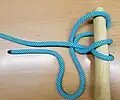
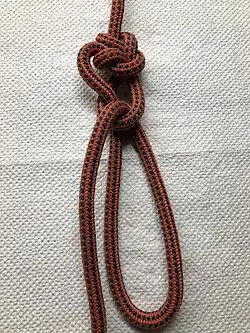
A second bight of the working end is passed behind the beam, and up through the first bight.
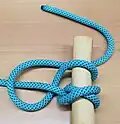
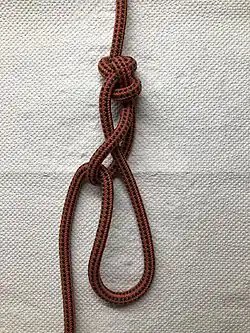
A third bight of the working end is passed in front of the standing part, then back and up through the second bight. This third bight should be sufficiently long, since pulling the standing end from various directions may pull some of it through the knot.
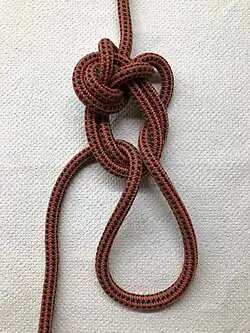
Optionally the previous step can be repeated for increased security, especially if tied around bigger objects. The resulting knot has been called Somersault Hitch.[2]
The standing part just hangs from the first and only bight in front of the beam. All other bights are behind the beam and through the previous bight.
Untying is done by pulling the working end until all bights are released from inside the previous bight and the rope leaves the beam.
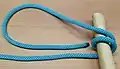
a first bight over the beam.
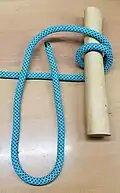
bight of working end up behind and up through the bight.
then around the standing part and up through the last bight.
This article is adapted from “Tumble hitch” on Wikipedia, written by its contributors, and used under CC BY-SA 4.0. Text on this page is available under the same licence. Source snapshot: Wikipedia via Kiwix, 2026-07-20.
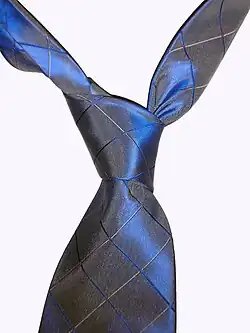
The four-in-hand knot is a method of tying a necktie. Also sometimes known (in UK) as a Bucket Knot, due to the shape of the finished knot. Some reports state that carriage drivers tied their reins with a four-in-hand knot, while others claim that the carriage drivers wore their scarves in the manner of a four-in-hand, but the most likely etymology is that members of the Four-in-Hand Club in London began to wear the neckwear, making it fashionable. The knot produced by this method is on the narrow side, notably asymmetric. For United States Army uniforms, and United States Navy uniforms that include a necktie, the four-in-hand knot is one of three prescribed options for tying the necktie, the other two being the half-Windsor and Windsor.[1][2]
Tying
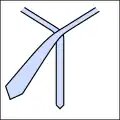
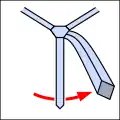
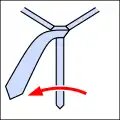
The four-in-hand knot is tied by placing the tie around the neck and crossing the broad end of the tie in front of the narrow end. The broad end is folded behind the narrow end and brought forward on the opposite side, passed across the front horizontally, folded behind the narrow end again, brought over the top of the knot from behind, tucked behind the horizontal pass, and the knot pulled snug. The knot is slid up the narrow end of the tie until snug against the collar.
Using the notation of The 85 Ways to Tie a Tie, by Thomas Fink and Yong Mao, the four-in-hand knot (knot 2) is tied
Li Ro Li Co T.
Other uses
When it is used to attach rope to an object, the four-in-hand knot is known as the buntline hitch. It was used by sailors throughout the Age of Sail to rig ships and remains a useful working knot today.
Onassis knot
A variant of the four-in-hand, with the long end of the tie passed back around and above the just-tied knot, was employed by Aristotle Onassis, who caused it to become briefly fashionable in some circles.[3]Fink and Mao record this variant as Knot 2on; in shorthand notation, it is written Li Ro Li Co T Ri Co.
See also
Small knot – a lesser known but somewhat simpler necktie knot
This article is adapted from “Four-in-hand knot” on Wikipedia, written by its contributors, and used under CC BY-SA 4.0. Text on this page is available under the same licence. Source snapshot: Wikipedia via Kiwix, 2026-07-20.
The Tugboat hitch, also called a Backhanded mooring hitch or Lighterman’s Hitch, is a knot ideal for heavy towing, or securing a craft to a post, bollard, or winch. It is easy to release, even under great load.
Tying
To tie, take a single turn or a round turn around the post. Pass a bight under the standing part, then drop the bight over the top of the post. Then make a bight in the rope on the other side of the standing part and drop it over the post. Note that in each placement of a bight over the post, the end’s side of the bight should lead to the side away from the standing part—this will make casting off easier. Continue this repetition as necessary until secure (usually three bights). Finish by half-hitching a bight around the standing part or a round turn about the post. With heavy loads, it is important to have made enough bights and turns to reduce force on the final turns or a hitch—otherwise, it will be difficult to untie (a hitch) or may slip.
This article is adapted from “Tugboat hitch” on Wikipedia, written by its contributors, and used under CC BY-SA 4.0. Text on this page is available under the same licence. Source snapshot: Wikipedia via Kiwix, 2026-07-20.
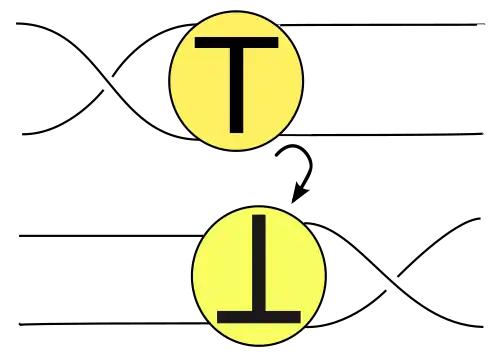
A flype consists of turning a tangle, T, by 180 degrees.
In the mathematical theory of knots, a flype is a kind of manipulation of knot and link diagrams
used in the Tait flyping conjecture.
It consists of twisting a part of a knot, a tangleT, by 180 degrees. Flype comes from a Scots word meaning to fold or to turn back (“as with a sock”).[1][2] Two reduced alternating diagrams of an alternating link can be transformed to each other using flypes. This is the Tait flyping conjecture, proven in 1991 by Morwen Thistlethwaite and William Menasco.[3]
See also
Reidemeister moves are another commonly studied kind of manipulation to knot diagrams.
References
↑Hoste, Jim; Thistlethwaite, Morwen; Weeks, Jeff (1998), “The first 1,701,936 knots”(PDF), The Mathematical Intelligencer, 20 (4): 33–48, doi:10.1007/BF03025227, MR1646740, archived from the original(PDF) on 2013-12-15. Tait used the term to mean, “a change of infinite complementary region”).
This article is adapted from “Flype” on Wikipedia, written by its contributors, and used under CC BY-SA 4.0. Text on this page is available under the same licence. Source snapshot: Wikipedia via Kiwix, 2026-07-20.
The Flemish bend, also known as a figure eight bend, a rewoven figure eight is a knot for joining two ropes of roughly similar size.
A loose figure-eight knot is tied in the end of one rope. The second rope is now threaded backwards parallel to the first rope. When properly dressed, the two strands do not cross each other.
Although fairly secure, it is susceptible to jamming. If tied, dressed and stressed properly it does not need “stopper” or “safety” knots.
The Flemish bend, also called figure-eight bend, is often given in knot monographs but is seldom used. It is bulky and bothersome to tie, and not to be preferred to the following knot [ water knot ], which is made in a similar manner.
This article is adapted from “Flemish bend” on Wikipedia, written by its contributors, and used under CC BY-SA 4.0. Text on this page is available under the same licence. Source snapshot: Wikipedia via Kiwix, 2026-07-20.
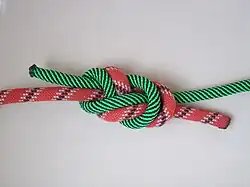
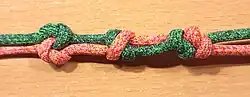
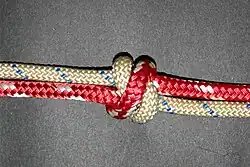
Some knots often referred to as true lover’s knots. the left one is also known as Dutch bend, the middle one is also known as Matthew Walker knot, the right one as Fisherman’s knot.
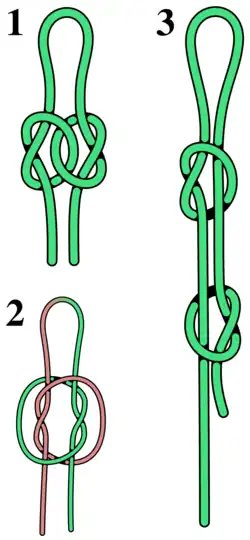
Three knots often referred to as “true lover’s knot”, tied into a single line forming a loop. 1: also known as a Dutch bend; 2: also known as Matthew Walker knot; 3: also known as fisherman’s knot/loop.
The term true lover’s knot, also called true love knot or simply love-knot amongst others, is used for many distinct knots. The association of knots with the symbolism of love, friendship and affection dates back to antiquity (although the term itself is attested from the late 1300s).[2] Because of this, no single knot can be labeled the true “true love knot”.[3]
In practical terms, these knots are generally shown as two interlocked overhand knots made in two parallel ropes or cords. The variations are in the ways in which the overhand knots interweave and in the final arrangement of the knot or knots.[4]
The true lovers’ knot is a motif in several British folk songs, including “Barbara Allen”, “Lord Thomas and Fair Annet”, “Lord Lovel”, and “Fair Margaret and Sweet William”. The knot, made of a rose growing from one lover’s grave and a brier from the other’s, is described at the end of the ballad.[5][6] It symbolises their fidelity in love even after death.[7]
Modern Western knotting literature has the name for these related knots deriving from stories or legends in which the knots symbolize the connection between a couple in love. Many examples feature Algerian sailors separated from their beloveds. Ashley notes that it was once a common style in sailors’ wedding rings, where gold wire was wrought to incorporate the “true lovers” knot, creating a ring containing two tori, inseparable, yet flexible and able to move about each other.[4]
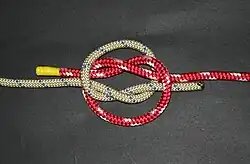
Matthew Walker knot as true lover’s knot (#2421) before tightening.
Matthew Walker knot tightened.
Examples in literature
In Gone With the Wind (novel), part two, chapter XV, when Ashley is about to return to the war after his Christmas furlough, Scarlett makes him a sash and ties the ends in a lover’s knot.
“A Love Knot”; a short story about Bengali Hindus featuring a goldsmithed love knot.[8]
A “love-knotte” is mentioned in the prologue to the Canterbury Tales.
In Sir Gawain and the Green Knight (line 612), Gawain’s neck-support is embroidered with “trueloves”
In The Highwayman, a poem by Alfred Noyes, Bess is “plaiting a dark red love-knot into her long black hair.”
See also
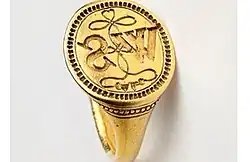
True lover’s knot engraved on the purported Shakespeare’s signet ring[9]
↑van de Griend, P. (1996), “On the True Love Knot”, in Turner, J.C.; van de Griend, P. (eds.), History and Science of Knots, K&E Series on Knots and Everything, vol.11, Singapore: World Scientific Publishing, pp.397–417, ISBN981-02-2469-9
12Ashley, Clifford W. (1944), The Ashley Book of Knots, New York: Doubleday, pp.386–388
↑Würzbach, Natascha; Simone M. Salz (1995). Motif Index of the Child Corpus: The English and Scottish Popular Ballad. Gayna Walls (trans.). Berlin and New York: Walter de Gruyter. pp.25, 57. ISBN3-11-014290-2.
↑Theroux, Paul (1997). The Collected Stories. Penguin Group. pp.164–176.
This article is adapted from “True lover's knot” on Wikipedia, written by its contributors, and used under CC BY-SA 4.0. Text on this page is available under the same licence. Source snapshot: Wikipedia via Kiwix, 2026-07-20.
The fisherman’s knot is a knot—specifically a bend—that joins two lines. The double fisherman’s knot and triple fisherman’s knot are variations used in climbing, arboriculture, and search and rescue. The knot is also commonly used in fishing and medicine. The difference between the three variations is the number of turns in the overhand knots that form the completed bend.
The bend consists of two overhand knots in their strangle knot form, each tied around the standing end of the other. For the double fisherman’s variation a double overhand knot is used, while the triple variation adds a third turn. The knot is generally known for its strength.
History
The fisherman’s knot and its variations developed independently in multiple distinct cultures.[2] The knot was described by Heraklas in the first century as part of an essay on knots for surgical and orthopedic uses.[3] Multiple turn variants of the fisherman’s knot have been used by Inuit peoples fishing with lines made of baleen. These methods work because of the monofilament nature of the material, which could cause slippage in modern nylon materials.[2] Triple fisherman’s knots made in baleen found near Nuuk have been carbon dated to 1700.[2] Single fisherman’s knots have been identified among the knots found at the 4500 year old Qeqertasussuk site of the Saqqaq culture.[2]
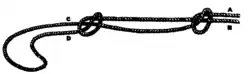
Diagram of a Fisherman’s knot creating a loop
In 1865 the Alpine Club Journal reported on tests conducted on knots in a Manila rope. They found that while all knots weaken ropes, the fisherman’s knot did so least of all the knots tested. The journal published details on the use of the knot in a loop as shown in the diagram.[a] Hereford Brooke George wrote of the knot that he did not “wish to maintain the absolute superiority of this knot over all others, though I have never found one so generally useful.”[4]
Diagram of a single fisherman’s knot
The fisherman’s knot and its variants have been known by various names. According to The Ashley Book of Knots, the fisherman’s knot is known as the angler’s knot, (double) English knot, halibut knot, waterman’s knot, and true lover’s knot. The double fisherman’s knot is also known as a grapevine knot.[1]
Properties
All variations of the fisherman’s knot jam when tightened.[5] It can be difficult to untie especially after being well tightened or weighted. It is generally easier to untie a bend with fewer turns.[6][7] The selection of the number of turns in the overhand knots needs to balance the security of the bend against the ease of untying it.[6][8] While all knots weaken the material they are tied in, the fisherman’s knot is commonly known for its strength.[b]
The fisherman’s knot can slip or come undone when using lines or ropes made of more slippery materials such as HMPE (also known as dyneema, or spectra) or nylon monofilament. In general, increasing the number of turns in the overhand knots increases the security of the completed bend.[5][2][10]
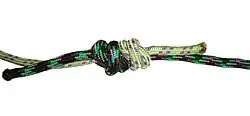
A triple fisherman’s knot
In climbing, the triple fisherman’s knot is recommended when using HMPE or aramid ropes.[11][12] Testing has shown that a failure mode exists at high loads (generally higher than 15 kN) with the fisherman’s knot in ropes using these materials in their core. The sheath of the rope separates at the knot, and the high-lubricity core slips through the fisherman’s knot. This failure occurs at a slightly higher load in the triple fisherman’s knot leading to the recommendation to use the triple fisherman’s knot in these materials. It has also been shown that the knots hold in some types of webbing made of spectra or nylon and not just kernmantle ropes made of these materials.[12]
The technique used in tying the knot is important to determining the behavior of the knot under load and its failure mode. The extent to which the overhand knots are tightened before use is crucial in determining the amount of friction in the system. When pulled until failure, the failure mode of the fisherman’s knot either by the rope breaking or by a topological change (i.e., slipping), is dictated by a combination of the coefficient of friction between the rope strands, elastic stiffness, and the initial geometry. The balance of friction and elasticity determines how the knot tightens and whether it will slip or jam firmly.[5]
Researchers have described loops tied with the knot as undergoing one of three processes when stretched depending on the properties of the material used. First, the overhand knots can slide along the standing ends of one another until they lock against each other,[5] this is the common configuration for most uses.[1] Second, the overhand knots can remain stationary and the system stretches, for example in very elastic materials with high coefficients of friction.[5] Finally, the knotted structures can create elastic loads in the material and the knots untangle themselves, for example in stiff materials that resist knotting or very slippery materials with high elasticity.[5]
Uses
A cordelette tied into a loop with a double fisherman’s knot hanging from a carabiner and a single fisherman’s knot tied in a loop
The double and triple variants of the bend are common in climbing when tied using appropriate ropes or cord. A primary use of the knot in this context is creating closed loops (cordelettes) by connecting the ends of a piece of rope to each other. These cords can be used, for example, for tying a prusik hitch.[13] These variants are also recommended by the International Commission for Alpine Rescue, either as primary bends or as backups, for extending ropes that are placed under rescue loads.[14] The double fisherman’s knot is not recommended for joining ropes where the ropes need to be pulled down and might get snagged in the terrain, such as canyoning.[15]
All variations of the fisherman’s knot are used in fishing, particularly the single overhand variant.[1] Other knots sometimes provide superior performance for this application when using nylon lines, such as the blood knot.[16]
In surgery, the fisherman’s knot is used to repair broken sutures.[9] Surgeons also use its loop form in laparoscopy as part of cinch knots.[17][18]
The fisherman’s knot is one of the true lover’s knots that have been used in weddings as part of handfasting ceremonies.[10][c]
This knot can be used to join the ends of a necklace cord. The two strangle knots are left separated so that the length of the necklace can be adjusted without cutting or untying the cord.[19]
↑This form of the fisherman’s knot in a loop knot is knot #1039 in Ashley’s book of Knots, where it is called the “Improved Englishman’s knot”, on p. 189.
↑Most sources cite “strength” as the percentage of the full breaking strength of a material without knots in it that is maintained when knotted.[5][6][9]
↑Ashley, 1993, p. 387, relates a story about the fisherman’s knot with a loop as a true lovers knot, wherein a sailor waits for the knot to be returned to him by his lover with the overhand knots either apart, together, or capsized and undone.
References
1234Ashley, Clifford W.; Budworth, Geoffrey (1993). The Ashley book of knots: with amendments (Reprinted.). New York: Doubleday. pp.50, 81, 189, 259, & 387. ISBN978-0-385-04025-9.
12345Turner, John Christopher; Van de Griend, Pieter (1996). History and science of knots. Series on knots and everything. Singapore New Jersey London [etc.]: World Scientific. pp.107–134. ISBN978-981-02-2469-1.
123Smith, Bruce; Padgett, Allen (1996). On rope: North American vertical rope techniques for caving … rappellers. National Speleological Society (New rev.ed.). Huntsville, Ala: Vertical Section, National Speleological Society. pp.42, 52. ISBN978-1-879961-05-0.
↑Martin, Jason D. (2022-04-04). “The Double-Fisherman’s Knot”. alpineinstitute.com. American Alpine Institute. Archived from the original on 2026-05-11. Retrieved 2026-01-17.
This article is adapted from “Fisherman's knot” on Wikipedia, written by its contributors, and used under CC BY-SA 4.0. Text on this page is available under the same licence. Source snapshot: Wikipedia via Kiwix, 2026-07-20.
The trucker’s hitch is a compound knot commonly used for securing loads on trucks[7] or trailers. The general arrangement, using loops and turns in the rope itself to form a crude block and tackle, has long been used to tension lines and is known by multiple names.[2][3] Knot author Geoffrey Budworth claims the knot can be traced back to the days when carters and hawkers used horse-drawn conveyances to move their wares from place to place.[8]
Variations
The portion of the trucker’s hitch which differs in the following variations is the method used to form the loop which the working end slides through to produce the mechanical advantage. The different methods of forming the loop affect the ease and speed of tying and releasing, and the stability of the final product.
The variations are presented in order of increasing stability.
Sheepshank style loop
This version of the knot uses a sheepshank,[9] in this kind of application also known as a bell ringer’s knot, to form the loop. It is quicker to make than a fixed loop, but is less dependable.[2][10] It is avoided in critical applications (such as securing a load on a truck) as it can fall apart under too little load or too much load, and can capsize if not dressed properly.[4] However, this knot may be made secure by adding a Half Hitch to the top bight of the Sheepshank. This form of the trucker’s hitch is least likely to jam, coming apart easily once tension is released. Different sources show slight variations in the way the sheepshank portion is formed and dressed.
Versions popular in East Asia use variations of sheep shank using either a simple half hitch[11] or a double turn self crossing half hitch[12] or a triple turn self crossing half hitch.[13] A sheep shank with two consecutive half hitches i.e. a clove hitch to secure the upper eye and to form the lower eye is more popular in the west.
Slipped overhand loop
The loop formed in one version is a simple Slipped Overhand Loop. This version is good for light to moderate loads
Simple friction loop
Another version uses a multiply twisted bight to pass a bight of the working end to form the eye of the loop. This version tolerates higher load.[14]
Fixed loop
The most reliable common variation uses a fixed loop, such as an alpine butterfly loop, artillery loop, figure-eight loop or directional figure-eight loop, or another of many suitable loop knots.[4][15] If a fixed loop is used repeatedly for tying the trucker’s hitch in the same portion of rope, excessive wear or other damage may be suffered by the portion of the loop which working end slides against.[2]
If extra loops are used to form the eye it tends to ease untying. In order to prevent the closing of the loop under load, the loop must be formed by the working end of the rope (which will later pass through the loop). If the standing end goes through the loop, it will close under load.
Truckers’ Hitch With Simple Slip knot as upper loop
Truckers’ Hitch With Twisted Slip knot as upper loop
Truckers’ Hitch With Figure-eight slip knot / noose as upper loop
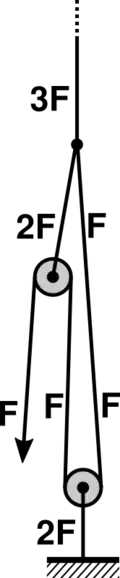
Diagram showing the (theoretical) 3:1 mechanical advantage of the Trucker’s Hitch
In tightening the trucker’s hitch, tension can be effectively increased by repeatedly pulling sideways while preventing the tail end from slipping through the loop, and then cinching the knot tighter as the sideways force is released. This is called “sweating a line”.[16]
If the tail end is wrapped through the last loop twice, the resulting friction may render manual cinching unnecessary.
Once tight, the trucker’s hitch is often secured with a half hitch, usually slipped for easy releasing and to avoid the necessity of access to the end of the rope, though a more secure finish, such as two half-hitches, may be called for. Under large loads, the finishing half hitch can jam, especially if it is not slipped; the difficulty of releasing it can be compounded by the fact that the knot is typically still under tension when it is to be untied.
Finishing with a taut-line hitch or a Farrimond friction hitch to the standing part allows the finishing knot to be tied and untied with no tension. This eliminates any jamming problems and also allows the line to be re-tensioned if necessary.
A mechanical advantage of ideally 3:1 can nearly be achieved when using an equivalent setup with pulleys,[17][18] but is reduced substantially by friction when using knots.
Cultural references
The trucker’s hitch knot is portrayed by comedy duo Ylvis in their 2014 song with the same name. The lyrics and the video pretend (in a humorous way) to demonstrate how to tie the knot.[19]
123Cyrus Lawrence Day (1986), The Art of Knotting and Splicing (4thed.), Annapolis: Naval Institute Press, p.116
1234Gordon Perry (2006), Knots, North Vancouver: Quantum Publishing, pp.134–135
↑Cliff Jacobson (1977), Wilderness Canoeing & Camping, Dutton, p.118, …there seems to be no widely accepted name for this hitch, so I took the liberty of naming it the power-cinch
12Riley, Howard W. (January 1912). “Knots, Hitches, and Splices”. The Cornell Reading-Courses. Rural Engineering Series No. 1. 1 (8). Ithaca, NY: New York State College of Agriculture at Cornell University: 1428. Retrieved 2011-11-08. As collected in Documents of the Assembly of the State of New York, 136th Session, 1913, Vol. 19, No. 29, Part 5.
↑Ashley, Clifford W. (1944), The Ashley Book of Knots, New York: Doubleday, p.344, A quicker but less dependable lashing is based on the Bell Ringer’s Knot #1148.
↑Osamu Fukumoto (2017-06-27). 南京結びを教えてもらいしました. Retrieved 2024-07-26– via YouTube.
↑B-LUCKS (2014-04-07). トラック ロープの縛り方 アメリカン. Retrieved 2024-07-26– via YouTube.
↑Yepoon (2017-10-23). 트럭 로프묶는방법-yepoon-. Retrieved 2024-07-26– via YouTube.
Grog. “Trucker’s Hitch”. Animated Knots. Retrieved 12 February 2013.
This article is adapted from “Trucker's hitch” on Wikipedia, written by its contributors, and used under CC BY-SA 4.0. Text on this page is available under the same licence. Source snapshot: Wikipedia via Kiwix, 2026-07-20.
A fireman’s chair knot (also known as the chair knot) is a knot tied in the bight forming two adjustable, lockable loops. The knot consists of a handcuff knot finished with a locking half hitch around each loop.[1] The loops remain adjustable until the half hitches are tightened.
Usage
A fireman’s chair supporting a person in a horizontal highline configuration.
The knot was first introduced by the Victorian chief fire officer Eyre Massey-Shaw in 1876.[2]
Made with suitable rope by qualified personnel this knot can be used as a rescue harness capable of supporting a person while being hoisted or lowered to safety. One loop supports the body, around the chest and under the arms, and the other loop supports the legs, under the knees. Tied towards the middle of a line, one end is used for lowering and the other end can serve as a tagline, to control the victim’s position with respect to hazards during the descent.[3] A snug fitting of this knot should restrain the victim, even if unconscious.[4] The fireman’s chair can also be used to move a victim laterally when used as a part of a tensioned horizontal highline system.
The fireman’s chair knot is generally considered to be merely a makeshift harness, to be used when conventional rope rescue techniques are not available; it is rarely used by modern rescue teams.
This article is adapted from “Fireman's chair knot” on Wikipedia, written by its contributors, and used under CC BY-SA 4.0. Text on this page is available under the same licence. Source snapshot: Wikipedia via Kiwix, 2026-07-20.
The triple bowline knot is a variation of the bowlineknot. The knot can be applied in emergency situations, such as mountain rescue.[1][2]
Etymology
The name comes from the three loops that would be formed by tying this knot.
Tying
The knot is tied in the same way the original bowline is, except with a doubled rope (using a bight). An overhand loop is formed in the rope, the working end is passed back through that loop, behind the standing part of the rope, back through the loop and pulled tight. The working end (bight) forms a third loop, often larger than the two equal-sized loops. The size of the third loop depends on the length of the bight pulled through the loop.
Bowline on the bight
A bowline on the bight is a similar knot to the triple bowline. Instead of wrapping the bight around the standing end and then passing it back through the nipping loop, the two loops are passed through the bight so that it tightens on the standing end. It has only two active or available loops. This is used in rescue situations, especially in a case where there might be an injured person or people, as it forms a “seat” in which the injured person can be raised or lowered safely. The full triple bowline is also used in rescue situations with the third loop passed around the waist or torso.
Double bowline
The triple bowline is often mistakenly referred to as the double bowline. The double bowline is in fact a bowline tied on a single strand with the nipping loop doubled up, and only has one loop.
This article is adapted from “Triple bowline” on Wikipedia, written by its contributors, and used under CC BY-SA 4.0. Text on this page is available under the same licence. Source snapshot: Wikipedia via Kiwix, 2026-07-20.
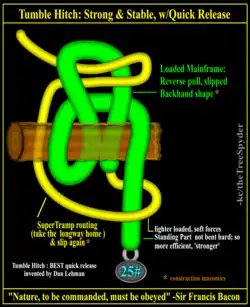
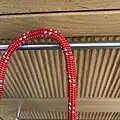 a first bight over the beam.
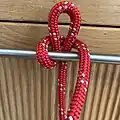 bight of working end up behind and up through the bight.
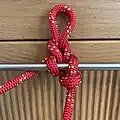 then around the standing part and up through the last bight.
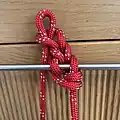 repeat step 3 for more stability.