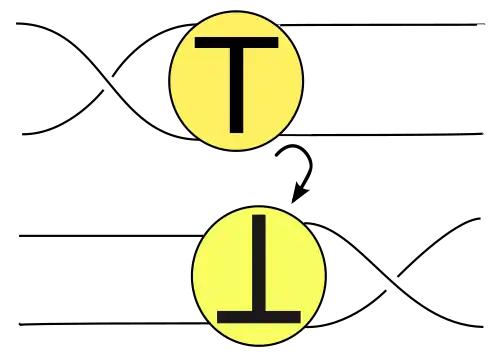
In the mathematical theory of knots, a flype is a kind of manipulation of knot and link diagrams
used in the Tait flyping conjecture.
It consists of twisting a part of a knot, a tangle T, by 180 degrees. Flype comes from a Scots word meaning to fold or to turn back (“as with a sock”).[1][2] Two reduced alternating diagrams of an alternating link can be transformed to each other using flypes. This is the Tait flyping conjecture, proven in 1991 by Morwen Thistlethwaite and William Menasco.[3]
See also
- Reidemeister moves are another commonly studied kind of manipulation to knot diagrams.
References
- ↑ Hoste, Jim; Thistlethwaite, Morwen; Weeks, Jeff (1998), “The first 1,701,936 knots” (PDF), The Mathematical Intelligencer, 20 (4): 33–48, doi:10.1007/BF03025227, MR 1646740, archived from the original (PDF) on 2013-12-15. Tait used the term to mean, “a change of infinite complementary region”).
- ↑ Weisstein, Eric W. “Flype”. MathWorld.
- ↑ Weisstein, Eric W. “Tait’s Knot Conjectures”. MathWorld.
This article is adapted from “Flype” on Wikipedia, written by its contributors, and used under CC BY-SA 4.0. Text on this page is available under the same licence. Source snapshot: Wikipedia via Kiwix, 2026-07-20.