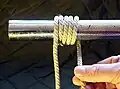
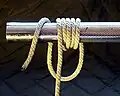
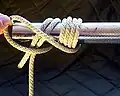
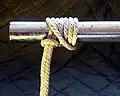
Blog

  • Improved clinch knot

    Improved clinch knot
    Improved clinch knot
    Names Improved clinch knot, fisherman’s knot, salmon knot
    Category Hitch
    Efficiency 98%
    Origin Unknown
    Typical use fishing, angling, trapping
    ABoK #313

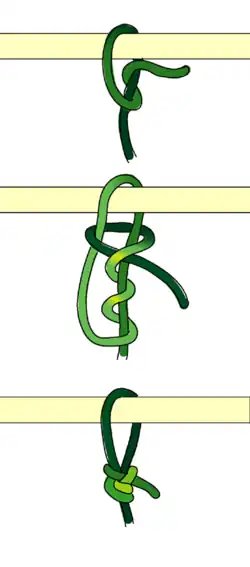
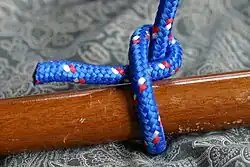
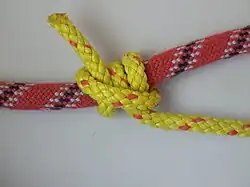
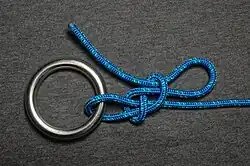
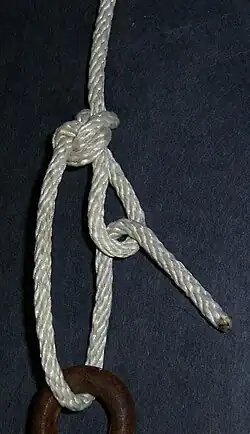
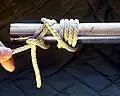
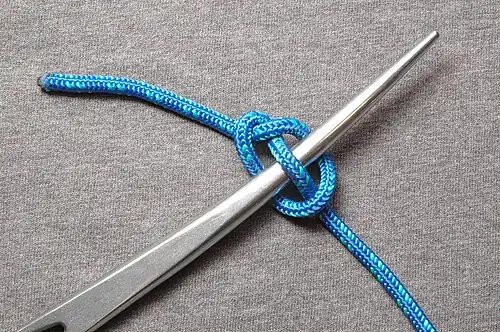
    The improved clinch knot, also known as the fisherman’s knot[1] or the salmon knot,[2] is a knot that is used for securing a fishing line to the fishing lure, but can also affix fishing line to a swivel, clip, or artificial fly. This is a common knot used by anglers because of its simple tie and strong hold. The more tension is applied, the tighter the knot becomes, increasing the strength of the connection. It can be used with many kinds of line including mono-filament, fluorocarbon, and braided fishing line. The difference from the basic clinch knot is that the working end is passed through the loop that is created in the second-last step.[3]

    See also

    External links

    References

    1. “How to tie an Improved Clinch Knot”. Hook-Eze Australia. Retrieved 2026-04-01.
    2. “Best Fishing Knot Guide: How to Tie a Knot for Fishing”. Jackery Australia. Retrieved 2026-04-01.
    3. Ristori, Al (August 14, 2012) [2002]. The Complete Guide to Saltwater Fishing: How to Catch Striped Bass, Sharks, Tuna, Salmon, Ling Cod, and More. New York City: Skyhorse Publishing Inc. p. 111. ISBN 978-1-61608-590-2. OCLC 759908822. OL 26024143M.

    This article is adapted from “Improved clinch knot” on Wikipedia, written by its contributors, and used under CC BY-SA 4.0. Text on this page is available under the same licence. Source snapshot: Wikipedia via Kiwix, 2026-07-20.

  • Icicle hitch

    Icicle hitch
    Icicle hitch
    Category Hitch
    Origin John Smith, 1990
    Related Prusik, Klemheist knot, tautline hitch, gripping sailor’s hitch
    Releasing Unload the working end
    Typical use
    • Tying to a post when weight is applied parallel to the post
    • Tying to a rope when load is applied parallel to that rope
    Caveat The Klemheist knot will look almost identical, but the load with the klemheist should be applied with the bight lying across the turns on the post/rope the knot is tied to

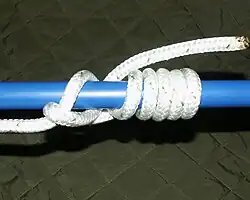
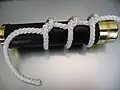
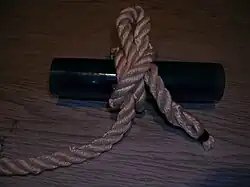
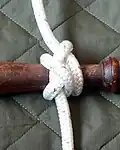
    An icicle hitch[1] is a knot that is used for connecting to a post when weight is applied to an end running parallel to the post in a specific direction. This type of hitch will hold its place even when holding a substantial load on a smooth surface. One can even suspend from a tapered post (such as a marlinspike) with this knot (hence the name “icicle hitch”).[2][3]

    To tie an icicle hitch, bring the working end over the post, front to back, four or five times, working away from the end of the post (and the direction of expected pull). Bring the working end, back to front, alongside the standing end, leaving a substantial bight hanging behind the post. Bring this bight over both ends and over the end of the post. Tighten by pulling both ends perpendicular to the post. The pull on the standing end (running the direction of the post) will tighten the knot as more pull is given.

    This knot is in the class of knots as the Prusik, klemheist, & Hedden knots –the “slip-and-grip” friction type, which pull tight when the load is applied (in the correct direction) and slide easily for re-placement with no load. The Prusik knot can withstand load in both directions, making it ideal for climbing situations. The icicle, like the klemheist, attaches to the hitched object and coils away from its pulling end, and relies on a constriction like the Chinese finger trap –under pull, the coil is drawn longer and thus tighter; whereas in the Hedden (& rolling hitch) the loading tightens the coil at its far end.

    The icicle hitch was developed by John Smith of the International Guild of Knot Tyers, and demonstrated by him at the Guild’s eighth annual general meeting in 1990. It was published in the IGKT’s quarterly newsletter, Knotting Matters, in issue #32 (Summer 1990), pp.6,7.

    Tying

    • Pull direction is LEFT, so make 5 turns to the RIGHT...
      Pull direction is LEFT, so make 5 turns to the RIGHT…
    • Drape working end over rod so it hangs beside standing part...
      Drape working end over rod so it hangs beside standing part…
    • Loop the bight created around working and standing parts and over end of rod.
      Loop the bight created around working and standing parts and over end of rod.
    • Set up tight...
      Set up tight…
    • Knot is now secure when pulled toward the left.
      Knot is now secure when pulled toward the left.

    See also

    References

    1. The Complete Guide to Knots and Knot Tying Geoffrey Budworth, p. 104, ISBN 0754804224
    2. Brion Toss, The Complete Rigger’s Apprentice (Camden: International Marine, 1998), 55–56.
    3. “The Amazing Icicle Hitch”. Archived from the original on 2015-07-22. Retrieved 2016-07-09.

    External links


    This article is adapted from “Icicle hitch” on Wikipedia, written by its contributors, and used under CC BY-SA 4.0. Text on this page is available under the same licence. Source snapshot: Wikipedia via Kiwix, 2026-07-20.

  • I-bundle

    I-bundle
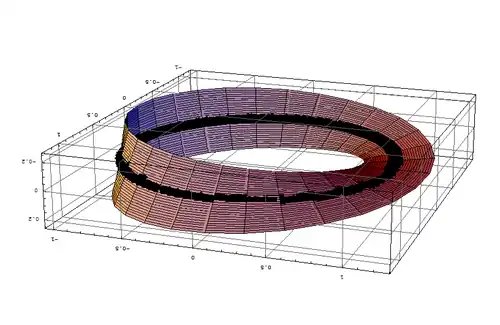
    A Möbius band is a non-orientable I-bundle. The dark line is the base for a set of transversal lines that are homeomorphic to the fiber and that each touch the edge of the band twice.
    I-bundle
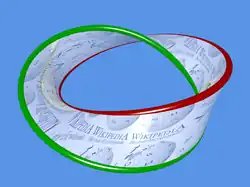
    An annulus is an orientable I-bundle. This example is embedded in 3-space with an even number of twists
    I-bundle
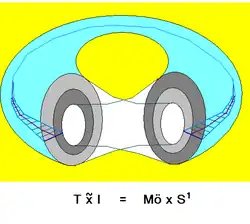
    This image represents the twisted I-bundle over the 2-torus, which is also fibered as a Möbius strip times the circle. So, this space is also a circle bundle

    In mathematics, an I-bundle is a fiber bundle whose fiber is an interval and whose base is a manifold. Any kind of interval, open, closed, semi-open, semi-closed, open-bounded, compact, even rays, can be the fiber. An I-bundle is said to be twisted if it is not trivial.

    Two simple examples of I-bundles are the annulus and the Möbius band, the only two possible I-bundles over the circle S 1 {\displaystyle S^{1}} {\displaystyle S^{1}}. The annulus is a trivial or untwisted bundle because it corresponds to the Cartesian product S 1 × I {\displaystyle S^{1}\times I} {\displaystyle S^{1}\times I}, and the Möbius band is a non-trivial or twisted bundle. Both bundles are 2-manifolds, but the annulus is an orientable manifold while the Möbius band is a non-orientable manifold.

    There are only two kinds of I-bundles when the base manifold is any surface but the Klein bottle K {\displaystyle K} {\displaystyle K}. That surface has three I-bundles: the trivial bundle K × I {\displaystyle K\times I} {\displaystyle K\times I} and two twisted bundles.

    Together with the Seifert fiber spaces, I-bundles are fundamental elementary building blocks for the description of three-dimensional spaces. These observations are simple well known facts on elementary 3-manifolds.

    Line bundles are both I-bundles and vector bundles of rank one. When considering I-bundles, one is interested mostly in their topological properties and not their possible vector properties, as one might be for line bundles.

    See also

    References

    • Scott, Peter (1983). “The geometries of 3-manifolds”. Bulletin of the London Mathematical Society. 15 (5): 401–487. doi:10.1112/blms/15.5.401. hdl:2027.42/135276. MR 0705527.
    • Hempel, John (1976). 3-manifolds. Annals of Mathematics Studies. Vol. 86. Princeton University Press. ISBN 978-0-8218-6939-0.

    External links


    This article is adapted from “I-bundle” on Wikipedia, written by its contributors, and used under CC BY-SA 4.0. Text on this page is available under the same licence. Source snapshot: Wikipedia via Kiwix, 2026-07-20.

  • Hyperbolic link

    Hyperbolic link
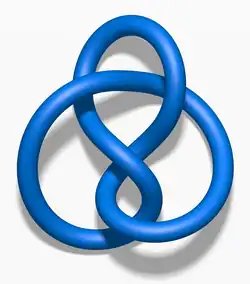
    41 knot

    In mathematics, a hyperbolic link is a link in the 3-sphere with complement that has a complete Riemannian metric of constant negative curvature, i.e. has a hyperbolic geometry. A hyperbolic knot is a hyperbolic link with one component.

    As a consequence of the work of William Thurston, it is known that every knot is precisely one of the following: hyperbolic, a torus knot, or a satellite knot. As a consequence, hyperbolic knots can be considered plentiful. A similar heuristic applies to hyperbolic links.

    As a consequence of Thurston’s hyperbolic Dehn surgery theorem, performing Dehn surgeries on a hyperbolic link enables one to obtain many more hyperbolic 3-manifolds.

    Examples

    Hyperbolic link
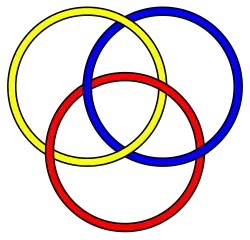
    Borromean rings are a hyperbolic link.

    See also

    Further reading

    • Colin Adams (1994, 2004) The Knot Book, American Mathematical Society, ISBN 0-8050-7380-9.
    • William Menasco (1984) “Closed incompressible surfaces in alternating knot and link complements”, Topology 23(1):37–44.
    • William Thurston (1978-1981) The geometry and topology of three-manifolds, Princeton lecture notes.

    External links


    This article is adapted from “Hyperbolic link” on Wikipedia, written by its contributors, and used under CC BY-SA 4.0. Text on this page is available under the same licence. Source snapshot: Wikipedia via Kiwix, 2026-07-20.

  • Hopf link

    Hopf link
    Braid length 2
    Braid no. 2
    Crossing no. 2
    Hyperbolic volume 0
    Linking no. 1
    Stick no. 6
    Unknotting no. 1
    Conway notation [2]
    A–B notation 22
    1
    Thistlethwaite L2a1
    Last / Next L0 / L4a1
    Other
    alternating, torus, fibered
    Hopf link
    Skein relation for the Hopf link.

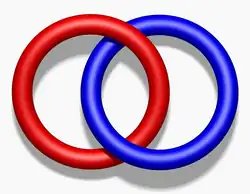
    In mathematical knot theory, the Hopf link is the simplest nontrivial link with more than one component.[1] It consists of two circles linked together exactly once,[2] and is named after Heinz Hopf.[3]

    Geometric realization

    A concrete model consists of two unit circles in perpendicular planes, each passing through the center of the other.[2] This model minimizes the ropelength of the link and until 2002 the Hopf link was the only link whose ropelength was known.[4] The convex hull of these two circles forms a shape called an oloid.[5]

    Properties

    Depending on the relative orientations of the two components the linking number of the Hopf link is ±1.[6]

    The Hopf link is a (2,2)-torus link[7] with the braid word σ 1 2 {\displaystyle \sigma _{1}^{2}} {\displaystyle \sigma _{1}^{2}}.[8]

    The knot complement of the Hopf link is R × S1 × S1, the cylinder over a torus.[9] This space has a locally Euclidean geometry, so the Hopf link is not a hyperbolic link. The knot group of the Hopf link (the fundamental group of its complement) is Z2 (the free abelian group on two generators), distinguishing it from an unlinked pair of loops which has the free group on two generators as its group.[10]

    The Hopf-link is not tricolorable: it is not possible to color the strands of its diagram with three colors, so that at least two of the colors are used and so that every crossing has one or three colors present. Each link has only one strand, and if both strands are given the same color then only one color is used, while if they are given different colors then the crossings will have two colors present.

    Hopf bundle

    The Hopf fibration is a continuous function from the 3-sphere (a three-dimensional surface in four-dimensional Euclidean space) into the more familiar 2-sphere, with the property that the inverse image of each point on the 2-sphere is a circle. Thus, these images decompose the 3-sphere into a continuous family of circles, and
    each two distinct circles form a Hopf link. This was Hopf’s motivation for studying the Hopf link: because each two fibers are linked, the Hopf fibration is a nontrivial fibration. This example began the study of homotopy groups of spheres.[11]

    Biology

    The Hopf link is also present in some proteins.[12][13] It consists of two covalent loops, formed by pieces of protein backbone, closed with disulfide bonds. The Hopf link topology is highly conserved in proteins and adds to their stability.[12]

    History

    Hopf link
    Buzan-ha crest

    The Hopf link is named after topologist Heinz Hopf, who considered it in 1931 as part of his research on the Hopf fibration.[14] However, in mathematics, it was known to Carl Friedrich Gauss before the work of Hopf.[3] It has also long been used outside mathematics, for instance as the crest of Buzan-ha, a Japanese Buddhist sect founded in the 16th century.

    See also

    References

    1. Adams, Colin Conrad (2004), The Knot Book: An Elementary Introduction to the Mathematical Theory of Knots, American Mathematical Society, p. 151, ISBN 9780821836781.
    2. 1 2 Kusner, Robert B.; Sullivan, John M. (1998), “On distortion and thickness of knots”, Topology and geometry in polymer science (Minneapolis, MN, 1996), IMA Vol. Math. Appl., vol. 103, New York: Springer, pp. 67–78, doi:10.1007/978-1-4612-1712-1_7, MR 1655037. See in particular p. 77.
    3. 1 2 Prasolov, V. V.; Sossinsky, A. B. (1997), Knots, links, braids and 3-manifolds: An introduction to the new invariants in low-dimensional topology, Translations of Mathematical Monographs, vol. 154, Providence, RI: American Mathematical Society, p. 6, ISBN 0-8218-0588-6, MR 1414898.
    4. Cantarella, Jason; Kusner, Robert B.; Sullivan, John M. (2002), “On the minimum ropelength of knots and links”, Inventiones Mathematicae, 150 (2): 257–286, arXiv:math/0103224, Bibcode:2002InMat.150..257C, doi:10.1007/s00222-002-0234-y, MR 1933586, S2CID 730891.
    5. Dirnböck, Hans; Stachel, Hellmuth (1997), “The development of the oloid” (PDF), Journal for Geometry and Graphics, 1 (2): 105–118, MR 1622664.
    6. Adams (2004), p. 21.
    7. Kauffman, Louis H. (1987), On Knots, Annals of Mathematics Studies, vol. 115, Princeton University Press, p. 373, ISBN 9780691084350.
    8. Adams (2004), Exercise 5.22, p. 133.
    9. Turaev, Vladimir G. (2010), Quantum Invariants of Knots and 3-manifolds, De Gruyter studies in mathematics, vol. 18, Walter de Gruyter, p. 194, ISBN 9783110221831.
    10. Hatcher, Allen (2002), Algebraic Topology, p. 24, ISBN 9787302105886.
    11. Shastri, Anant R. (2013), Basic Algebraic Topology, CRC Press, p. 368, ISBN 9781466562431.
    12. 1 2 Dabrowski-Tumanski, Pawel; Sulkowska, Joanna I. (2017-03-28), “Topological knots and links in proteins”, Proceedings of the National Academy of Sciences, 114 (13): 3415–3420, Bibcode:2017PNAS..114.3415D, doi:10.1073/pnas.1615862114, ISSN 0027-8424, PMC 5380043, PMID 28280100
    13. Dabrowski-Tumanski, Pawel; Jarmolinska, Aleksandra I.; Niemyska, Wanda; Rawdon, Eric J.; Millett, Kenneth C.; Sulkowska, Joanna I. (2017-01-04), “LinkProt: a database collecting information about biological links”, Nucleic Acids Research, 45 (D1): D243–D249, doi:10.1093/nar/gkw976, ISSN 0305-1048, PMC 5210653, PMID 27794552
    14. Hopf, Heinz (1931), “Über die Abbildungen der dreidimensionalen Sphäre auf die Kugelfläche”, Mathematische Annalen, 104 (1), Berlin: Springer: 637–665, doi:10.1007/BF01457962, S2CID 123533891.

    External links


    This article is adapted from “Hopf link” on Wikipedia, written by its contributors, and used under CC BY-SA 4.0. Text on this page is available under the same licence. Source snapshot: Wikipedia via Kiwix, 2026-07-20.

  • Honda knot

    Honda knot
    Honda knot
    Names Honda knot, Lariat loop, Bowstring knot
    Category Loop
    Releasing Non-jamming
    Typical use Lassos, stringing bows
    ABoK #227, #1024, #1127, #151

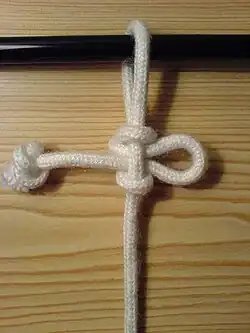
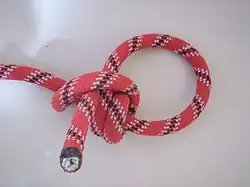
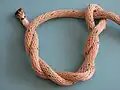
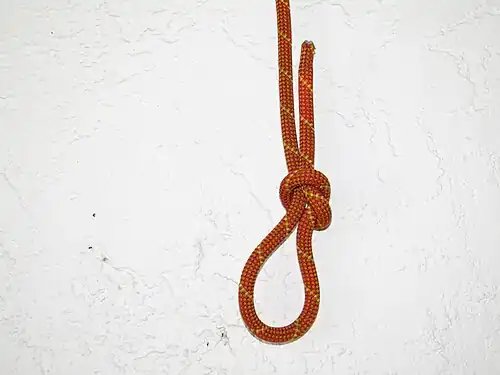
    A honda knot is the loop knot commonly used in a lasso.[1] Its round shape, especially when tied in stiff rope, helps it slide freely along the rope it is tied around. To tie, first place an overhand knot in the end of the rope. Then tie a second overhand knot, pass the running end of the rope through it, and tighten.

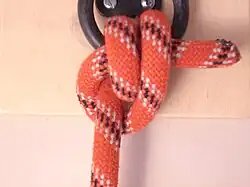
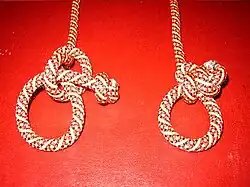
    A lariat loop is similarly constructed but will not slip from the running end. To tie a lariat loop: first tie an overhand knot, then pinch it so that the running end slides freely back and forth. Pass the rope end through just that “free-sliding” loop, and tighten. The photograph at right displays a lariat loop, with an additional overhand knot acting as a stopper knot because the lariat loop can slip by way of the rope’s end when tension is not applied to the running end. It can be quickly adjusted, but does not function exactly the same as a lasso knot, which makes it perhaps safer.

    See also

    References

    1. John ‘Lofty’ Wiseman SAS Survival Handbook, Revised Edition; William Morrow Paperbacks (2009) ISBN 978-1875900060


    This article is adapted from “Honda knot” on Wikipedia, written by its contributors, and used under CC BY-SA 4.0. Text on this page is available under the same licence. Source snapshot: Wikipedia via Kiwix, 2026-07-20.

  • Hitching tie

    Hitching tie
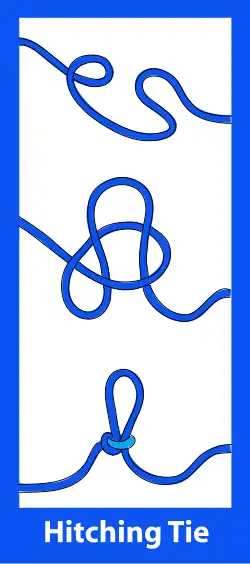
    A diagram of how to tie the hitching tie knot

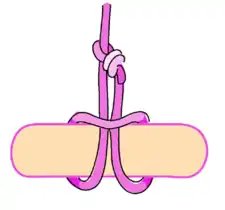
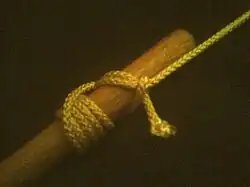
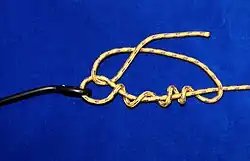
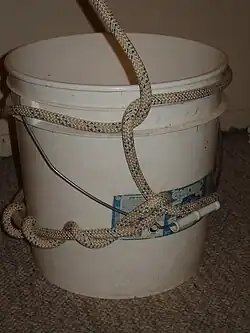
    The hitching tie is a simple knot used to tie off stuff sacks that allows quick access as it unties quickly.[1][2] To untie the knot, just pull hard on the free end of the rope and the knot will fall open. This is simply a noose or slip knot, with the loop tightened around an object. This is not a very strong knot for climbing or other extreme activities.

    Related knots

    See also

    References

    1. Smith, R.H. (1925). Agricultural Mechanics. Lippincott’s farm manuals. J. B. Lippincott. p. 290. Retrieved 13 November 2024. Hitching Tie. – 1. Pass halter rope around post from right to left forming a bight. 2. Cross free end beneath standing part and bend back over to the left forming turn around standing part. (Fig. 283) 3. Pull bight of rope up …
    2. Macfarlan, A. P. (2012). Knotcraft: The Practical and Entertaining Art of Tying Knots. EBL-Schweitzer. Dover Publications. pp. 94–95. ISBN 978-0-486-15771-9. Retrieved 13 November 2024.


    This article is adapted from “Hitching tie” on Wikipedia, written by its contributors, and used under CC BY-SA 4.0. Text on this page is available under the same licence. Source snapshot: Wikipedia via Kiwix, 2026-07-20.

  • Hitch (knot)

    A hitch is a type of knot used to secure a rope to an object or another rope. Hitches are used in a variety of situations, including climbing, sailing, and securing loads. They are classified based on their ability to be tightened or released, their resistance to slipping, and their strength. Some common types of hitch knots include the clove hitch, the timber hitch, and the round turn and two half-hitches.

    Physical theory

    A simple mathematical theory of hitches has been proposed by Bayman.[1] It predicts whether or not a hitch will hold, given the diameter of the post, the diameter of the rope, and the coefficient of friction between the post and the rope. The theory has been extended by Maddocks and Keller, including an approximate treatment of knots that are not hitches.[2] For example, they predict that a square knot will hold when the coefficient of friction of the rope with itself is greater than 0.24. These predictions are approximately correct when tested empirically.[3]

    Alphabetical list

    Knot Description Image
    Adjustable grip hitch A simple and useful friction hitch which may easily be shifted up and down the rope while slack. Hitch (knot)
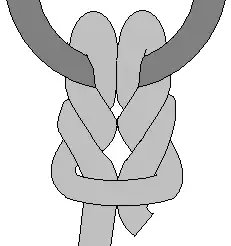
    Alternate ring hitching A type of ringbolt hitching formed with a series of alternate left and right hitches made around a ring Hitch (knot)
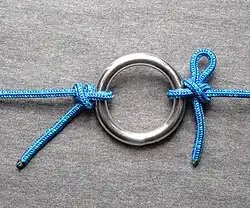
    Anchor bend A knot used for attaching a rope to a ring Hitch (knot)
    Bale sling hitch A knot which traditionally uses a continuous loop of strap to form a cow hitch around an object in order to hoist or lower it. Hitch (knot)
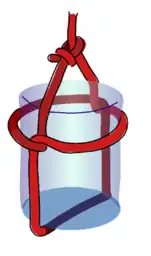
    Barrel hitch The “barrel hitch” and “barrel sling,” named for their use in hoisting cargo aboard ships, are a simple yet effective way to suspend an object. Hitch (knot)
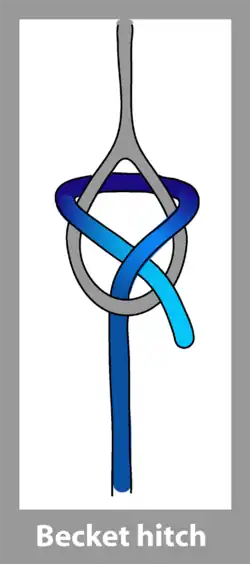
    Becket hitch Any hitch that is made on an eye loop, i.e., on a becket. Hitch (knot)
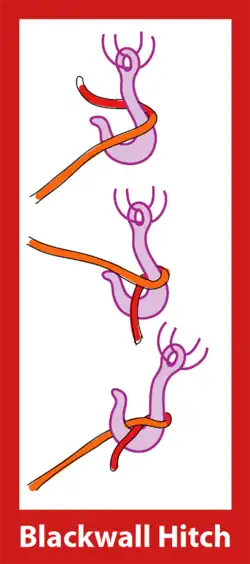
    Blackwall hitch A temporary means of attaching a rope to a hook. Hitch (knot)
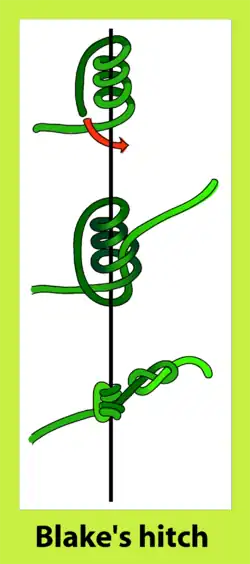
    Blake’s hitch A friction hitch commonly used by arborists and tree climbers as an ascending knot. Hitch (knot)
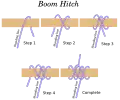
    Boom hitch A rather robust and secure method of attaching a line, or rope to a fixed object like a pipe, post, or sail boom Hitch (knot)
    Bottom-loaded release hitch
    Buntline hitch A knot used for attaching a rope to an object. It is formed by passing the working end around an object, then making a clove hitch around the rope’s standing part, taking care that the turns of the clove hitch progress towards the object rather than away from it. Hitch (knot)
    Cat’s paw A knot used for connecting a rope to an object. Hitch (knot)
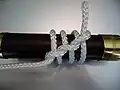
    Chain hitch A knot used to connect a rope to a cylindrical object. Similar to the marline hitch, but formed with successive Clove hitch knots. Hitch (knot)
    Clinging clara
    Clove hitch A clove hitch is two successive half-hitches around an object. Hitch (knot)
    Continuous ring hitching A series of identical hitches made around a ring Hitch (knot)
    Cow hitch variant
    Cow hitch with toggle
    Cow hitch A hitch knot used to attach a rope to an object. Hitch (knot)
    Double overhand noose A hitch knot used to bind a rope to a carabiner. Hitch (knot)
    Farrimond friction hitch A quick release adjustable friction hitch for use on lines under tension. Hitch (knot)
    Garda hitch A ratcheting knot used to disallow dual direction rope travel. Hitch (knot)
    Gripping sailor’s hitch A secure, jam-proof hitch used to tie one rope to another, or a rope to a pole, boom, spar, etc., when the pull is lengthwise along the object. Hitch (knot)
    Ground-line hitch A type of knot used to attach a rope to an object. Hitch (knot)
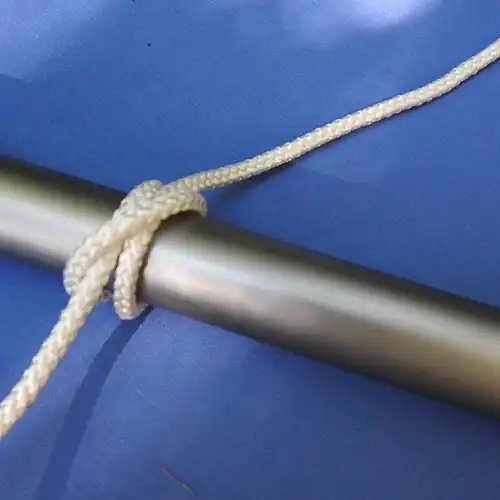
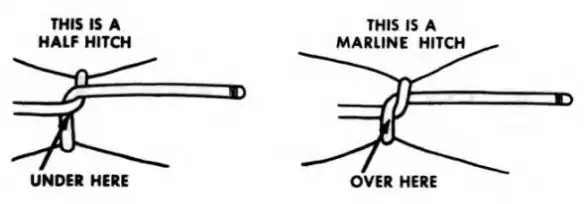
    Half hitch A simple overhand knot, where the working end of a line is brought over and under the standing part. Hitch (knot)
    Halter hitch A type of knot used to connect a rope to an object. Hitch (knot)
    Highpoint hitch A type of knot used to attach a rope to an object. Hitch (knot)
    Highwayman’s hitch A quick-release draw loop knot used for temporarily securing a rope that will need to be released easily and cleanly. Hitch (knot)
    Hitching tie A simple knot used to tie off stuff sacks that allows quick access as it unties quickly. Hitch (knot)
    Icicle hitch A knot for connecting to a post when weight is applied to an end running parallel to the post in a specific direction. Hitch (knot)
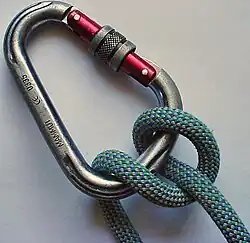
    Improved clinch knot Also known as the Salmon Knot, a knot that is often used for securing a fishing line to a hook or lure. Hitch (knot)
    Killick hitch A type of hitch knot used to attach a rope to oddly shaped objects. Hitch (knot)
    Knute hitch A knot used to attach a lanyard of small stuff to a marlingspike or other tool.
    Magnus hitch A knot used to attach a rope to a rod, pole, or other rope. (See also Rolling hitch) Hitch (knot)
    Marline Hitching A knot used to attach a rope to a cylindrical object. Similar in appearance to the Chain Hitch, but a succession of overhand knots. Hitch (knot)
    Marlinespike hitch A temporary knot used to attach a rod to a rope in order to form a handle. Hitch (knot)
    Midshipman’s hitch An adjustable loop knot for use on lines under tension. Hitch (knot)
    Munter hitch A simple knot, commonly used by climbers and cavers as part of a life-lining or belay system Hitch (knot)
    Ossel hitch A knot used to attach a rope or line to an object. Hitch (knot)
    Palomar knot A knot that is used for securing a fishing line to a fishing lure, snap or swivel. Hitch (knot)
    Pile hitch A kind of hitch, which is a knot used for attaching rope to a pole or other structure. Hitch (knot)
    Pipe hitch A hitch-type knot used to secure smooth cylindrical objects. Hitch (knot)
    Prusik knot A friction hitch or knot used to put a loop of cord around a rope, applied in climbing, canyoneering, mountaineering, caving, rope rescue, and by arborists. Hitch (knot)
    Reverse half hitches
    Round turn and two half-hitches Hitch (knot)
    Sailor’s hitch A secure, jam-proof hitch. Hitch (knot)
    Siberian hitch A knot used to attach a rope to an object. Hitch (knot)
    Slippery hitch A knot used to attach a line to a rod or bar. Hitch (knot)
    Snell knot A hitch knot used to attach an eyed fishing hook to fishing line.
    Snuggle hitch A modification of the clove hitch Hitch (knot)
    Taut-line hitch An adjustable loop knot for use on lines under tension. Hitch (knot)
    Tensionless hitch An anchor knot used for rappelling or rope rescue.
    Timber hitch A knot used to attach a single length of rope to a cylindrical object. Hitch (knot)
    Trilene knot A multi-purpose fishing knot that can be used for attaching monofilament line to hooks, swivels and lures.
    Trucker’s hitch A compound knot commonly used for securing loads on trucks or trailers. Hitch (knot)
    Tugboat hitch (Lighterman’s hitch) An easy release knot ideal for heavy towing.
    Tumble hitch A quick-release draw loop knot used for temporarily securing a rope that will need to be released easily and cleanly. Hitch (knot)
    Two half-hitches A type of knot, specifically a binding knot or hitch knot. Hitch (knot)
    Uni knot A multi purpose fishing knot that can be used for attaching the fishing line to the arbor of a reel, for joining lines, and for attaching lures, snaps, and swivels. Hitch (knot)
    Hitch (knot)
    Distinguishing between a half hitch and a marline hitch

    See also

    References

    1. Bayman, Benjamin F. (1977). “Theory of hitches”. American Journal of Physics. 45 (2): 185. Bibcode:1977AmJPh..45..185B. doi:10.1119/1.10652.
    2. Maddocks, J. H.; Keller, J. B. (1987). “Ropes in Equilibrium”. SIAM Journal on Applied Mathematics. 47 (6): 1185–1200. doi:10.1137/0147080.
    3. Crowell, Ben. “The physics of knots”. Retrieved 2014-06-29.

    This article is adapted from “Hitch (knot)” on Wikipedia, written by its contributors, and used under CC BY-SA 4.0. Text on this page is available under the same licence. Source snapshot: Wikipedia via Kiwix, 2026-07-20.

  • Highwayman’s hitch

    Highwayman’s hitch
    Highwayman's hitch

    A Highwayman’s hitch tied around a wooden pole
    Names Highwayman’s hitch, Highwayman’s hitch, draw hitch, Highwayman’s cutaway, Bank Robbers Knot, Getaway hitch or Quick-release knot
    Category Hitch
    Related Tumble hitch, Mooring Hitch
    Releasing Non-jamming
    Typical use Quick-release, draw loop hitch
    Caveat Potentially unstable, especially when tied around large objects

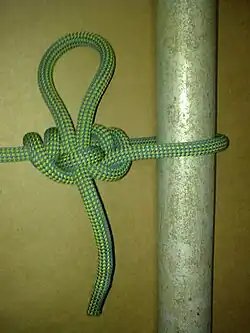
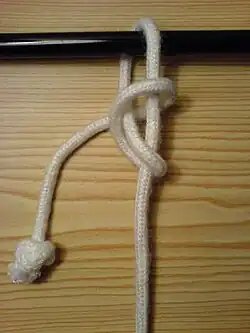
    The Highwayman’s hitch is a quick-release draw hitch used for temporarily securing a load that will need to be released easily and cleanly –i.e, that will come completely free of the hitched object.[1] The hitch can be untied with a tug of the working end, even when under tension. The highwayman’s hitch can be tied in the middle of a rope, and so the working end does not need to be passed around the anchor when tying or releasing.[2]

    History

    The hitch was called the highwayman’s cutaway in 1947 by Cyrus L. Day. He related that, according to Hal McKail, the knot was attributable to the notorious 18th-century English highwayman Dick Turpin. Day’s book, however, suggested it for use as a quick-release mooring hitch for solo sailing.[2]

    While the knot is alleged to have actually been used by highwaymen,[3] this claim is rejected by knot expert Geoffrey Budworth, who stated, “there is no evidence to substantiate the reputation of the highwayman’s hitch as a quick-getaway-knot for robbers on horseback.”[1]

    Tying

    The knot is three bights that each successively lock the previous one:

    1. the first one, in the middle of the rope, wraps around the pole,
    2. the second one (called the toggle bight) is a bight of the standing part locking the first one so the pole is held tight, and
    3. the third one (called the slip-tuck) is a bight of the working part (slack end) locking the second bight.

    The locking actions are achieved by reaching through each bight to pull the next one through.

    The knot has to be finished by pulling the standing part tight to ensure that it holds.

    Weakness

    Until the knot is tightened and properly dressed, the highwayman’s hitch has little holding power.
    The highwayman’s hitch is susceptible to capsizing when the pole is substantially larger than the rope diameter. The failure occurs because the second bight sees the force of the standing part, but is held in place by the working part, which has no tension. When capsizing, tension on the standing part pulls the second bight through the first bight. This drags the slip-tuck through, and will release the hitch if the third bight isn’t long enough.

    Alternatives to the highwayman’s hitch have been devised to mitigate collapse when tied around large objects.

    Alternatives

    One simple improvement is to repeat the second and third bights i.e. one more bight of the standing part and then one more bight of the working part, each successively locking the previous bight; this has the disadvantage of requiring longer rope from both parts.

    Another technique is to twist each bight before reaching through it for the next locking bight; the disadvantage here is the difficulty of tightening afterwards.

    In his book Outdoor Knots, Clyde Soles presents one of Dan Lehman’s revisions to the highwayman’s hitch that is simple and effective, naming it the “slip-free hitch” (actually, this name denotes all such hitches).[4] One simply rearranges the trio of bights so that the heavily loaded bight in the standing part will surround, rather than go through, the next-made bight; the finishing slipped-tuck bight will thus go through the 2nd-made bight, and so be less severely loaded. As the frame against which this rope toggle is nipped is entirely parts of the knot (and not depending upon proximity to the hitched object), this revision avoids the capsizing vulnerability of the highwayman’s hitch.

    The Notable Knot Index recommends the tumble hitch as a more stable hitch. It’s a similar hitch, but less prone to capsizing because the main part remains passive and the locking is done by two successive bights of the working part (no end needed) wrapping around both the standing part and the post/pole before locking the previous bight.[5]

    See also

    References

    1. 1 2 Budworth, Geoffrey (1997), The Complete Book of Knots, London: Octopus, p. 73
    2. 1 2 Day, Cyrus Lawrence (1947), The Art of Knotting and Splicing (1st ed.), New York: Dodd, Mead &Co., pp. 114–115
    3. Meier, Joel F.; Viola, Mitchell A. (1993), Camp Counseling: Leadership and Programming For the Organized Camp, Brown & Benchmark
    4. Soles, Clyde (2004). The outdoor knots book : hikers, campers, climbers, kayakers (1st ed.). Seattle (WA): Mountaineers Books. pp. 143–144. ISBN 9780898869620.
    5. “The Tumble Hitch”. Notable Knot Index. Archived from the original on 2015-05-24. Retrieved 2012-02-25.


    This article is adapted from “Highwayman's hitch” on Wikipedia, written by its contributors, and used under CC BY-SA 4.0. Text on this page is available under the same licence. Source snapshot: Wikipedia via Kiwix, 2026-07-20.

  • Highpoint hitch

    Highpoint hitch
    Highpoint hitch
    Names Highpoint hitch, High post hitch
    Category Hitch
    Related Buntline hitch
    Releasing Non-jamming
    Typical use Quick-release, draw loop hitch
    ABoK #398, #1809

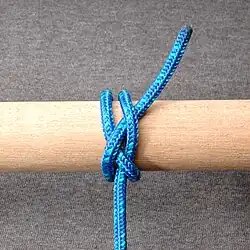
    The highpoint hitch (or high post hitch[1]) is a type of knot used to attach a rope to an object. The main feature of the hitch is that it is very secure, yet if tied as a slipped knot it can be released quickly and easily with one pull, even after heavy loading. The highpoint hitch is tied in the same manner as a slipped buntline hitch until the final turn, where they diverge.[2]

    Security

    The highpoint hitch is very secure, since any load will tighten the turns against each other, at the same time tightening the grip on the working end.

    Releasing

    To release the slipped version of this knot, pull the working end in the direction of the load. This action pulls the two turns apart at the same time as releasing the draw-loop, and the whole knot simply falls apart.

    Tying

    To tie the hitch around a pole, begin by passing the working end a half turn round the pole. Next, pass a half turn round the standing part. Then, pass a half turn round both the working end and the standing part, above the first turn (i.e. closer to the pole). Finally, push a bight of the working end through the middle of the hitch – between the two half turns, and between the standing part and the working end. Pull on the standing part to tighten, if necessary sliding the hitch snugly up against the pole.

    Tying the highpoint hitch
    Highpoint hitch
    Partially tied slipped highpoint hitch
    Highpoint hitch
    Completed slipped highpoint hitch

    References

    1. Ashley, Clifford. “The Ashley Book of Knots”. Doubleday, pp. 63,305.
    2. Ashley, Clifford. “The Ashley Book of Knots”. Doubleday, p. 63.

    This article is adapted from “Highpoint hitch” on Wikipedia, written by its contributors, and used under CC BY-SA 4.0. Text on this page is available under the same licence. Source snapshot: Wikipedia via Kiwix, 2026-07-20.