| Anchor bend | |
|---|---|
 |
|
| Names | Anchor bend, fisherman’s bend |
| Category | Hitch |
| Related | Round turn and two half hitches |
| Releasing | Jamming |
| Typical use | attaching a rope to a ring or similar termination |
| ABoK | #24, #1518, #1722 – #1724, #1840 – #1842 |
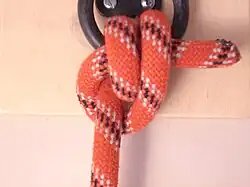
The anchor bend is a knot used for attaching a rope to a ring or similar termination. The name is a misnomer, as it is technically not a bend, but a hitch.
Origins

Its name originates from the time when “bend” was understood to simply mean “tie to”; today, a bend strictly refers to a knot that joins two lines.
Techniques
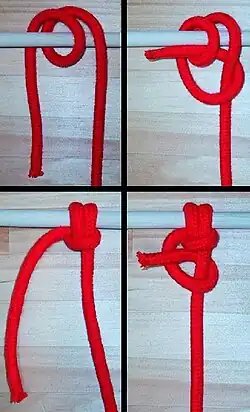
While the knot can become jammed in some modern materials, it is usually easily untied after moderate loads; it can be made more resistant to jamming by taking an extra turn around the object—this will make for a one-diameter longer span of the end to reach around the standing part to be tucked (although in a case of tying to a small shackle or link of a chain, this might not be possible). It is the accepted knot for attaching anchors (or more usually anchor chains) to warps. The knot is very similar to a round turn and two half hitches except that the first half hitch is passed under the turn. In many everyday uses, the finishing half-hitch need not be made; alternatively, one might seek surer security by tying off the end with a strangle knot to the standing part.
See also
External links
- Grog. “Anchor Bend”. Animated Knots. Retrieved May 5, 2013.
This article is adapted from “Anchor bend” on Wikipedia, written by its contributors, and used under CC BY-SA 4.0. Text on this page is available under the same licence. Source snapshot: Wikipedia via Kiwix, 2026-07-20.