Blog

  • Bachmann knot

    Bachmann knot
    Bachmann knot
    Names Bachmann knot, Bachman knot
    Category Hitch
    Related Prusik knot, Klemheist knot, Blake’s hitch
    Typical use Mountaineering

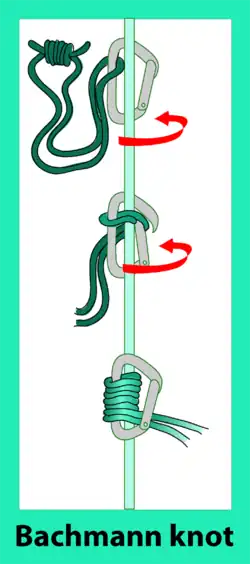
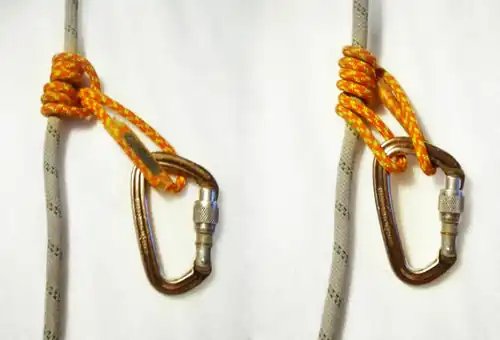
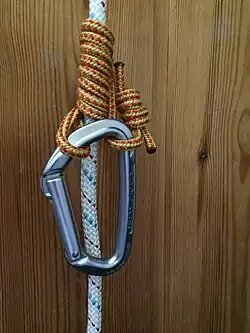
    The Bachmann hitch (sometimes misspelled ‘Bachman’) is a friction hitch, named after the Austrian alpinist Franz Bachmann.[1] It is useful when the friction hitch needs to be reset quickly or often or made to be self-tending as in crevasse and self-rescue. (See Prusik knot)

    The Bachmann hitch requires the use of a carabiner. It does not matter if the carabiner is locking or not. Most importantly, the carabiner must be of round cross section for friction. Grabbing hold of the carabiner will release the friction and allow the hitch to slide freely and thus be moved appropriately. To remove the Bachmann hitch, just unclip the top loop, hold on to the carabiner and pull the cord free.

    This knot is frequently tied using a sling made from 1″ tubular webbing. In this case wrap the webbing 3 times around the rope (this means the carabiner gate must be opened 3 times in the tying of the knot) for normal (dry) applications. There are a limited number of applications that involve repeated shock loads to the knot and in these 4 wraps are usually sufficient.

    However, with a non-locking carabiner it is safer to use the knot with the carabiner gate opening facing down (opposite to what is shown in the picture). This decreases the risk of self-unclipping: at maximum, one twist goes off. Otherwise, the whole knot may fail.

    It is important for safety reasons to mention that the rope used for the friction hitch should be smaller in diameter than the tension rope. This allows for movement when resetting the hitch position but when a large load is applied to the friction hitch, the hitch locks on to the tension rope. If two ropes of the same diameter are used for the friction hitch and tension rope, the hitch may move freely like a slip knot (lasso or noose) and not lock into place. When encircling any cylindrical object, most ropes can only be tightened to a diameter slightly greater than the ropes own diameter(USMC Assault Climber Course).

    References

    1. Luebben, Craig (2011). Knots for Climbers. Rowman & Littlefield. ISBN 978-0-7627-6858-5.

    See also

    External links


    This article is adapted from “Bachmann knot” on Wikipedia, written by its contributors, and used under CC BY-SA 4.0. Text on this page is available under the same licence. Source snapshot: Wikipedia via Kiwix, 2026-07-20.
  • Packer’s knot

    Packer’s knot
    Packer's knot
    Names Packer’s knot, Packing Knot
    Category Binding
    Related Corned beef knot, Butcher’s knot
    Releasing Jamming
    Typical use Baling, parcel tying, butchery, cooking
    Caveat Less secure than the corned beef knot
    ABoK #187, #408, #2083

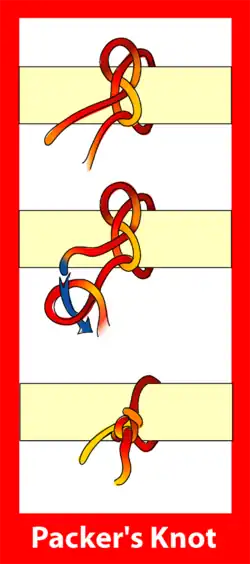
    The packer’s knot is a binding knot which is easily pulled taut and quickly locked in position. It is most often made in small line or string, such as that used for hand baling, parcel tying, and binding roasts. This latter use, and its general form, make it a member of a class of similar knots known as butcher’s knots.[1][2]

    Tying and variations

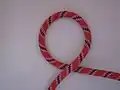
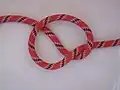
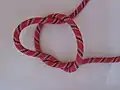
    A lightly tightened figure-eight knot is formed around the standing part of the line such that both ends emerge from the same point. Pulling on the standing part tightens the binding. After the desired degree of tension is reached, a locking half-hitch is added over the working end and pulled taut.

    Even without the locking half-hitch the knot will generally maintain tension while additional tying is accomplished, such as putting a second, perpendicular, wrap on a package.[3][4]

    A similar knot made with an overhand knot instead of a figure-eight works almost as well.[5] Many other variations also exist finishing with this style of locking half-hitch. In fact, Clifford Ashley claimed that there were more knots of this type to be found than any other used for a single purpose.[1]

    See also

    References

    1. 1 2 Clifford W. Ashley, The Ashley Book of Knots (New York: Doubleday, 1944), 36-38.
    2. Clifford W. Ashley, The Ashley Book of Knots (New York: Doubleday, 1944), p. 65 (# 408).
    3. Ashley(1944), p. 337 (# 2083)
    4. Gordon Perry, Knots (North Vancouver, Canada: Quantum Publishing, 2006), 130-131.
    5. Des Pawson, Pocket Guide to Knots & Splices (Edison, NJ: Chartwell Books, Inc., 2002), 108-109.

    External links


    This article is adapted from “Packer's knot” on Wikipedia, written by its contributors, and used under CC BY-SA 4.0. Text on this page is available under the same licence. Source snapshot: Wikipedia via Kiwix, 2026-07-20.
  • Axle hitch

    Axle hitch
    Category Hitch
    Related Bowline
    Typical use attaching a line to a relatively inaccessible object, such as a vehicle axle
    ABoK #162, #1850

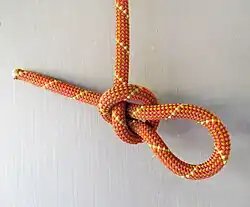
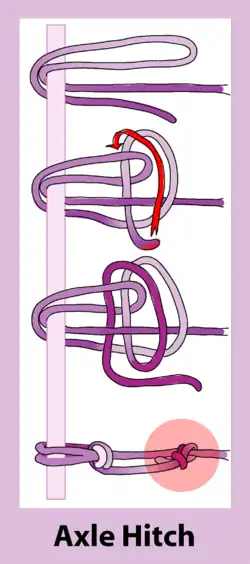
    The axle hitch is used to tie a hitch in a hard-to-reach place, or for extra security by having a double hold on an object. When the initial bight is passed around the object, the rest of the knot can be completed out away from the cramped location.[1] The knot is finished with a bowline knot or other reliable knot that connects the working end to the standing part.[2]

    It provides distributed strength and is useful when a shock load needs to be spread along an anchor point, since it provides four lines distributed across two points, in which case a double bowline or water bowline should be used as the security knot.

    See also

    References

    1. Brion Toss (1998). The Complete Rigger’s Apprentice. Camden: International Marine. p. 56.
    2. Ashley, Clifford W. (1944), The Ashley Book of Knots, New York: Doubleday, p. 33


    This article is adapted from “Axle hitch” on Wikipedia, written by its contributors, and used under CC BY-SA 4.0. Text on this page is available under the same licence. Source snapshot: Wikipedia via Kiwix, 2026-07-20.
  • Overhand loop

    Overhand loop
    Overhand loop
    Names Overhand loop, Loop knot
    Category Loop
    Origin Ancient
    Releasing Jamming
    ABoK #1009, #1046, #518

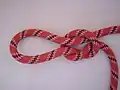
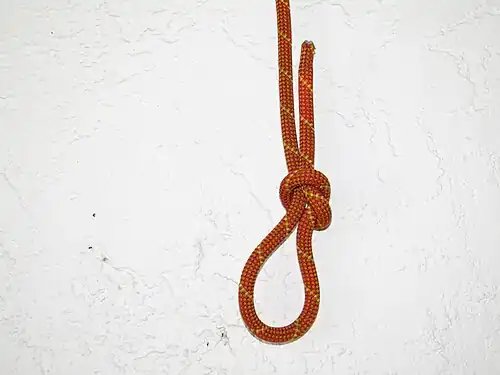
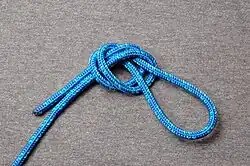
    The overhand loop is a simple knot which forms a fixed loop in a rope. Made by tying an overhand knot in the bight, it can be tied anywhere along a rope (does not need any working end). The knot can be used for attaching clips, hooks, other rope, etc., but has the disadvantage that it is likely to jam tight when the rope has been pulled and the knot may need to be cut off. It also has some uses in kite-flying, though other knots may be better. It is commonly disapproved by cadets because of its tendency to be misused as an alternative to the bowline.[1] (Reference 1 also contains a sequence of images that show how to tie an overhand knot.)

    References

    1. “Overhand Loop Knot”. Archived from the original on 2008-01-02.


    This article is adapted from “Overhand loop” on Wikipedia, written by its contributors, and used under CC BY-SA 4.0. Text on this page is available under the same licence. Source snapshot: Wikipedia via Kiwix, 2026-07-20.
  • Average crossing number

    In the mathematical subject of knot theory, the average crossing number of a knot is the result of averaging over all directions the number of crossings in a knot diagram of the knot obtained by projection onto the plane orthogonal to the direction. The average crossing number is often seen in the context of physical knot theory.

    Definition

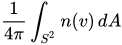
    More precisely, if K is a smooth knot, then for almost every unit vector v giving the direction, orthogonal projection onto the plane perpendicular to v gives a knot diagram, and we can compute the crossing number, denoted n(v). The average crossing number is then defined as the integral over the unit sphere:[1]

    1 4 π S 2 n ( v ) d A {\displaystyle {\frac {1}{4\pi }}\int _{S^{2}}n(v)\,dA} {\displaystyle {\frac {1}{4\pi }}\int _{S^{2}}n(v)\,dA}

    where dA is the area form on the 2-sphere. The integral makes sense because the set of directions where projection doesn’t give a knot diagram is a set of measure zero and n(v) is locally constant when defined.

    Alternative formulation

    A less intuitive but computationally useful definition is an integral similar to the Gauss linking integral.

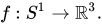
    A derivation analogous to the derivation of the linking integral will be given. Let K be a knot, parameterized by

    f : S 1 R 3 . {\displaystyle f:S^{1}\rightarrow \mathbb {R} ^{3}.} {\displaystyle f:S^{1}\rightarrow \mathbb {R} ^{3}.}

    Then define the map from the torus to the 2-sphere

    g : S 1 × S 1 S 2 {\displaystyle g:S^{1}\times S^{1}\rightarrow S^{2}} {\displaystyle g:S^{1}\times S^{1}\rightarrow S^{2}}

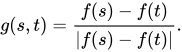
    by

    g ( s , t ) = f ( s ) f ( t ) | f ( s ) f ( t ) | . {\displaystyle g(s,t)={\frac {f(s)-f(t)}{|f(s)-f(t)|}}.} {\displaystyle g(s,t)={\frac {f(s)-f(t)}{|f(s)-f(t)|}}.}

    (Technically, one needs to avoid the diagonal: points where s = t.) We want to count the number of times a point (direction) is covered by g. This will count, for a generic direction, the number of crossings in a knot diagram given by projecting along that direction. Using the degree of the map, as in the linking integral, would count the number of crossings with sign, giving the writhe. Use g to pull back the area form on S2 to the torus T2 = S1 × S1. Instead of integrating this form, integrate the absolute value of it, to avoid the sign issue. The resulting integral is[2]

    1 4 π T 2 | ( f ( s ) × f ( t ) ) ( f ( s ) f ( t ) ) | | ( f ( s ) f ( t ) ) | 3 d s d t . {\displaystyle {\frac {1}{4\pi }}\int _{T^{2}}{\frac {|(f'(s)\times f'(t))\cdot (f(s)-f(t))|}{|(f(s)-f(t))|^{3}}}\,ds\,dt.} {\displaystyle {\frac {1}{4\pi }}\int _{T^{2}}{\frac {|(f'(s)\times f'(t))\cdot (f(s)-f(t))|}{|(f(s)-f(t))|^{3}}}\,ds\,dt.}

    References

    Further reading

    • Buck, Gregory; Simon, Jonathan (1999), “Thickness and crossing number of knots”, Topology and Its Applications, 91 (3): 245–257, doi:10.1016/S0166-8641(97)00211-3, MR 1666650.
    • Ernst, C.; Por, A. (2012), “Average crossing number, total curvature and ropelength of thick knots”, Journal of Knot Theory and Its Ramifications, 21 (3): 1250028, 9, doi:10.1142/S0218216511009601, MR 2887660.
    • Diao, Yuanan; Ernst, Claus (2001). “The Crossing Numbers of Thick Knots and Links”. In Jorgr Alberto Calvo; Kennrth C. Millet; Eric J. Rawdon (eds.). Physical Knots: Knotting, Linking, and Folding Geometric Objects in R3. Contemporary Mathematics. Vol. 304. Las Vegas, Nevada. ISBN 0-8218-3200-X.{{cite book}}: CS1 maint: location missing publisher (link).
    • O’Hara, Jun (2003). Energy of knots and conformal geometry. K&E Series on Knots and Everything. Vol. 33. Singapore: World Scientific Publixhing Co. Pte. Ltd. ISBN 981-238-316-6.

    This article is adapted from “Average crossing number” on Wikipedia, written by its contributors, and used under CC BY-SA 4.0. Text on this page is available under the same licence. Source snapshot: Wikipedia via Kiwix, 2026-07-20.

  • Overhand knot with draw-loop

    Overhand knot with draw-loop
    Overhand knot with draw-loop
    Category Hitch
    ABoK 52

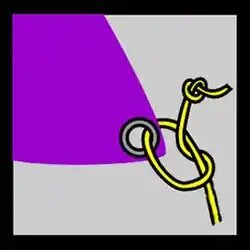
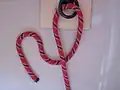
    A slipped half hitch[1][2] is a knot in which the weight of the load the rope carries depresses the loop sufficiently to keep it in place until the load item is placed in its location. When no longer required the free end may be pulled and draw the loop through and so release the load.

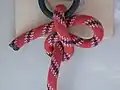
    • Tying onto a ring.
      Tying onto a ring.
    • Overhand knot with draw-loop

    The Overhand Noose[3]
    is sometimes used as a Slip Knot to form the loops of a Trucker’s Hitch, or as a Stopper. Double Noose is used in arboriculture to fix a rope to a carabiner. Today this knot is mistakenly named like Barrel Hitch.

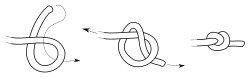
    • Make an eye, the working end is shown on the right.
      Make an eye, the working end is shown on the right.
    • Bring the eye left and down, in front of the standing part.
      Bring the eye left and down, in front of the standing part.
    • Pull the standing part through the eye, forming a bight. The working end is shown below the standing end.
      Pull the standing part through the eye, forming a bight. The working end is shown below the standing end.
    • Tighten
      Tighten

    Similar knots

    See also

    References

    1. Day, Cyrus (1986). The Art of Knotting and Splicing, 4th Edition. Annapolis, Maryland: Naval Institute Press. pp. 36 (Knot #15). ISBN 0-87021-062-9. [first edition 1947]
    2. Ashley, Clifford W.. The Ashley Book of Knots. Published by Faber and Faber, 1993 — #52 — p14 — ISBN 9780571096596
    3. Day. The Art of Knotting and Splicing, 4th Edition. pp. 84 (Knot #88).


    This article is adapted from “Overhand knot with draw-loop” on Wikipedia, written by its contributors, and used under CC BY-SA 4.0. Text on this page is available under the same licence. Source snapshot: Wikipedia via Kiwix, 2026-07-20.
  • Autoblock

    Autoblock
    An autoblock using a Prusik knot on the left and an autoblock using the Machard knot (“autoblock knot”) on the right.
    Autoblock

    An autoblock (or autobloc or “third hand”) is a rope device used in climbing and caving for both rappelling (downward) and ascending (upward).[1][2]

    While rappelling, it slides freely down the rope when pushed downward by the hand, allowing a controlled descent, but jams in the event of a sudden drop or loss of control, stopping the descent. This prevents uncontrolled falls in the event of an accident in which the rappeler loses control of the rope.[3] For ascending, it likewise can be pushed up the rope manually when unweighted, but jams and holds when weighted by the body.

    It is made using a friction hitch around the rope, connected by a carabiner to the climber’s harness, and may be combined with other climbing equipment for further safety.[4] For instance, it is typically used as a backup while rappelling using a tube belay device.[1]

    The term autoblock is also used for a specific type of friction hitch,[5][2][6] which is also known as a French prusik or Machard knot, named after its inventor, Serge Machard.[7][8]

    Other friction hitches that can be used to build an autoblock system include the Prusik knot, Klemheist knot, and Bachmann knot.

    The Ashley Book of Knots #505.

    See also

    References

    1. 1 2 “6-Step Guide to Rappelling with an Autobloc Backup”. Devils Lake Climbing Guides. Retrieved 2018-07-10.
    2. 1 2 Gaines, Bob; Martin, Jason D. (2014-05-20). Rock Climbing: The AMGA Single Pitch Manual. Rowman & Littlefield. ISBN 9781493009626. Sometimes called the “third hand,” the autoblock is … friction hitches like the prusik, klemheist, and autoblock
    3. “How to Tie and Use an Autoblock Knot for Climbing”. Archived from the original on 2015-04-04. Retrieved 2015-04-24.
    4. “6-Step Guide to Rappelling with an Autoblock Backup”. Retrieved 2015-04-24.
    5. “Canyoneering 101 – Autoblock | The Dye Clan”. dyeclan.com. Retrieved 2018-07-09. The term “autoblock” is kind of ambiguous as it refers to both the knot and the system. As such, you can create an autoblock system with the autoblock knot, a Klemheist (French Prusik), or a valdôtain tresse.
    6. Rock climbing. Kidd, Timothy W., Hazelrigs, Jennifer., Wilderness Education Association (U.S.). Champaign, IL: Human Kinetics. 2009. ISBN 9780736068024. OCLC 251227945. Examples of appropriate hitches include autoblock, klemheist, and Prusik{{cite book}}: CS1 maint: others (link)
    7. “The Machard Knot”. Retrieved 2016-10-20. the Knot invented in 1961 by Serge Marchard, a young climber from Marseille
    8. Vola, Eric (2016-06-03). “Le noeud Machard et son histoire – CAF Marseille Provence” (in French). Archived from the original on 2016-06-03. Retrieved 2018-07-09. [from French] Serge had sent André a letter on December 28, 1961 which among other things included the description of his knot. The two diagrams of his letter are reproduced here.

    External links


    This article is adapted from “Autoblock” on Wikipedia, written by its contributors, and used under CC BY-SA 4.0. Text on this page is available under the same licence. Source snapshot: Wikipedia via Kiwix, 2026-07-20.

  • Austrian knot

    Austrian knot
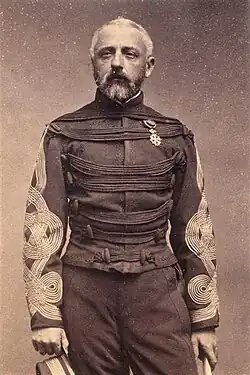
    French General Félix Douay wearing nœuds hongrois on his sleeves, c1870.
    Austrian knot
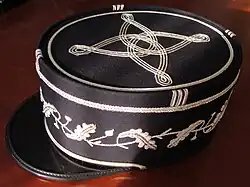
    kepi (no longer in use) of a French commissaire de police, with the cruciform pattern nœud hongrois on the top. 1986

    An Austrian knot (or Hungarian knot), alternatively warrior’s knot or vitézkötés, is an elaborate design of twisted cord or lace worn as part of a dress uniform, usually on the lower sleeve. It is usually a distinction worn by officers; the major exception is the hussars, in which Austrian knots are worn by all ranks. British cadet under officers wear Austrian knots as part of their rank insignia.

    History

    Of Hungarian origin, the vitézkötés (in English “warrior’s knot”) evolved as an indicator of rank among hussars of the Hungarian army, and became part of the Hungarian noble attire since the 16th century. Later, as other nations added hussars to their armies, they started to use the knot as well. The reason for this was that hussar regiments were often established by Hungarian nobles and some retained the name of their founder; for example the Ladislas Ignace de Bercheny.

    In the Austrian (later Austro-Hungarian) army of the 18th century epaulettes were widely perceived as foreign (due to their French origin) and thus unacceptable. In the hussar regiments ranks came to be denoted by braided gold cords on the sleeve, with the number of gold cords representing the seniority of the officer. Other branches of the Austrian Army used a system of waist-sashes and collar stars to distinguish commissioned rank.

    Austrian knots soon appeared as part of the distinctive uniform of hussar regiments in the armies of other European nations but did not gain wider popularity until the last decades of the nineteenth century. First the French army, then the Dutch,[1] Romanian, Japanese,[2] Turkish[3] and several Latin American armies adopted this insignia to distinguish officer ranks. British officers of most regiments wore Austrian knots of a simplified pattern in gold braid on the cuffs of their full-dress tunics[4] until this order of uniform ceased to be generally worn after 1914.

    Along with most other elaborate and conspicuous indicators of rank, Austrian knots fell into disuse during the First World War and were not revived in everyday wear. An exception was the French Army where the kepis still worn by most officers have Austrian knots in cruciform pattern on the top crown. French officers of North African regiments such as the zouaves and the Algerian tirailleurs continued to wear Austrian knots in gold braid on the sleeves of their colourful full-dress uniforms until 1939. They are still worn on some parade uniforms in France, where they are called nœuds hongrois (“Hungarian knots”).

    United States usage

    During the American Civil War, Confederate officers often wore gold Austrian knots on their uniforms. More elaborate braiding indicated higher rank. This type of insignia was worn by officers of the US Army on the sleeves of the blue full-dress uniforms authorised until 1917. It is a feature of the blue mess-dress uniform adopted as optional wear for officers in 1937 and still worn for formal social or evening functions.

    See also

    • Frog (fastening) – decorative fastener which originated from China and was adopted in the military clothing of Western countries.

    References

    1. Knotel, Richard (1980). Uniforms of the World. A Compendium of Army, Navy, and Air Force Uniforms 1700-1937. p. 334. ISBN 0-684-16304-7.
    2. Nakanishi, Ritta. Japanese Military Uniforms 1841-1929. p. 44. ISBN 4-499-22737-2.
    3. Drury, Ian (14 November 1994). The Russo-Turkish War 1877. p. F. ISBN 1-85532-371-0.
    4. Encyclopædia Britannica, Eleventh Edition, page 585, Vol. 27

    This article is adapted from “Austrian knot” on Wikipedia, written by its contributors, and used under CC BY-SA 4.0. Text on this page is available under the same licence. Source snapshot: Wikipedia via Kiwix, 2026-07-20.
  • Overhand knot

    Overhand knot
    Overhand knot

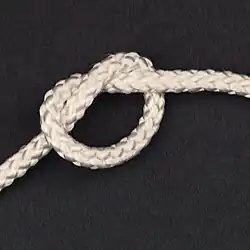
    The overhand knot
    Names Overhand knot, thumb knot
    Category Stopper
    Efficiency 50%
    Origin Ancient
    Related Simple noose, overhand loop, figure-eight knot, angler’s loop, reef knot, fisherman’s knot, water knot, half hitch
    Releasing Jamming
    Typical use fishing, climbing, shoelaces, making other knots.
    Caveat Spills if the standing part is pulled forcibly in the wrong direction
    ABoK #4, #46, #514, #515, #519
    Conway Notation 3
    A/B notation 31
    Overhand knot
    The use of a half hitch and an overhand knot, the last used as a stopper.

    The overhand knot is one of the most fundamental knots, and it forms the basis of many others, including the simple noose, overhand loop, angler’s loop, reef knot, fisherman’s knot, half hitch, and water knot. The overhand knot is a stopper, especially when used alone, and hence it is very secure, to the point of jamming badly. It should be used if the knot is intended to be permanent. It is often used to prevent the end of a rope from unraveling. An overhand knot becomes a trefoil knot, a true knot in the mathematical sense, by joining the ends. It can also be adjusted, faired, or mis-tied as a half hitch.

    46. The overhand is the simplest of the single-strand stopper knots, and is tied with one end around its own standing part, its purpose being to prevent unreeving.
    47. The half knot is a binding knot, being the first movement of the reef or square knot. It is tied with two ends around an object and is used when reefing, furling, and tying up parcels, shoestrings, and the like.
    48. The half hitch is tied with one end of a rope which is passed around an object and secured to its own standing part with a single hitch.

    Tying

    Overhand knot
    Tying an overhand knot

    There are a number of ways to tie the Overhand knot.

    • Thumb method – create a loop and push the working end through the loop with your thumb.
    • Overhand method – create a bight, by twisting the hand over at the wrist and sticking your hand in the hole, pinch the working end with your fingers and pull through the loop.

    Heraldry

    Overhand knot
    Stafford knot of heraldry

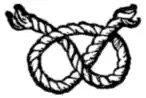
    In heraldry, the overhand knot is known as a “Stafford knot“, owing to a representation of it being used first as a heraldic badge by the Earls of Stafford, and later as a general symbol of Staffordshire.[2]

    In nature

    As a defensive measure, hagfishes, which resemble eels, produce large volumes of thick slime when disturbed. A hagfish can dislodge large quantities of slime on its skin, which it uses to evade predation, by tying its own body into an overhand knot, then sliding the knot from its head down to the tail. This action scrapes the slime off the fish’s body. Hagfish also tie their bodies into overhand knots in order to create leverage to rip off chunks of their prey’s flesh, but do so “in reverse” (starting at the tail, and sliding the knot towards the head for mechanical advantage).[3]

    Knot theory

    If the two loose ends of an overhand knot are joined together (without creating additional crossings), this becomes equivalent to the trefoil knot of mathematical knot theory.

    In paper-folding

    Overhand knot
    Pentagonal overhand knot tied in flat material

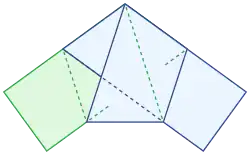
    If a flat ribbon or strip is tightly folded into a flattened overhand knot, it assumes a regular pentagonal shape.[4]

    See also

    References

    1. Ashley, Clifford W. (1944). The Ashley Book of Knots. Doubleday. ISBN 0-385-04025-3. p. 14.
    2. Arthur Charles Fox-Davies, A Complete Guide to Heraldry (1909), pp. 462, 469.
    3. Helfman, Gene; Collette, Bruce B.; Facey, Douglas E.; Bowen, Brian W. (2009-04-03). The Diversity of Fishes: Biology, Evolution, and Ecology (2nd ed.). Wiley–Blackwell. pp. 234–236. ISBN 978-1-4051-2494-2.
    4. Mathematical Models by H. Martyn Cundy and A.P. Rollett, second edition, 1961 (Oxford University Press), p. 57.

    External links


    This article is adapted from “Overhand knot” on Wikipedia, written by its contributors, and used under CC BY-SA 4.0. Text on this page is available under the same licence. Source snapshot: Wikipedia via Kiwix, 2026-07-20.
  • Ossel hitch

    Ossel hitch
    Ossel hitch
    Category Hitch
    Related clove hitch, ground-line hitch, snuggle hitch, Munter hitch

    The ossel hitch[1] is a knot used to attach a rope or line to an object. It was originally used on Scottish gill nets to tie small line to larger rope that supported the net. Ossel is actually the Scottish word for “gill net” and for the line attaching the net to the float rope.[2][3]

    Rather, the ossel hitch works only on objects that are approximately the same diameter as the line, as the tail must be nipped under the initial turn, which if made on a larger object will have a gap between line and object.

    To what extent the true history of this knot can be learned is a matter of speculation; knots books are notoriously inaccurate. Examination of such “snood”/”gangion” hitches in commercial fishing in the present day will show that it is typical to tuck the hitching line (the snood) through the lay of the object line – which implies that braided lines are not used here. In such cases, various simple hitches – e.g., the clove hitch, the ground line hitch – can be used, with the tucked tail providing security of the knot against both loosening and shifting position along the line. In some areas, lobster fishing is done with long ground lines to which numerous lobster pots are connected via approximately 10′-long snoods. It is possible that the ground line will at times be hauled up from different ends, so hitches might need to endure pulls from either direction.

    Tying

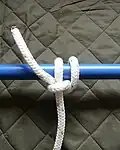
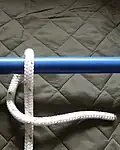
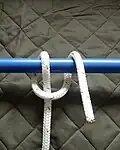
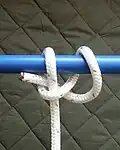
    Place a turn around the rope or spar and come up to the left of the standing part of the line. Cross over the standing part and make a turn around the rope or spar in the opposite direction. Finally, pass the working end over the second turn and tuck it under the first turn. Set the knot and tighten the knot.

    • 1. Turn and cross over...
      1. Turn and cross over…
    • 2. Turn in opposite direction...
      2. Turn in opposite direction…
    • 3. Tuck behind 2nd turn, through 1st...
      3. Tuck behind 2nd turn, through 1st…
    • 4. Completed Ossel hitch.
      4. Completed Ossel hitch.

    See also

    References

    1. The complete guide to knots and knot tying — Geoffrey Budworth — p.91— ISBN 0-7548-0422-4
    2. Brian W. Coad; Don E. McAllister, Dictionary of Ichthyology, retrieved 2009-05-30
    3. Charles Edmund Gibson (1995), Handbook of Knots and Splices, New York: Barnes & Noble, p. 34

    External links


    This article is adapted from “Ossel hitch” on Wikipedia, written by its contributors, and used under CC BY-SA 4.0. Text on this page is available under the same licence. Source snapshot: Wikipedia via Kiwix, 2026-07-20.