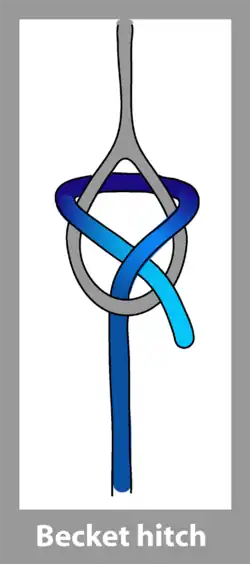
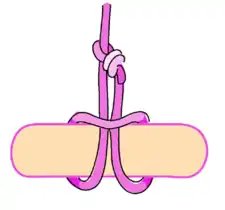
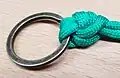
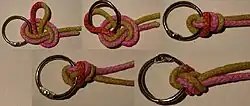
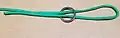
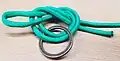
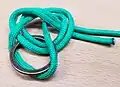
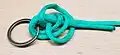
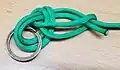
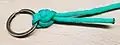
A becket hitch, including the double becket or figure-of-eight becket hitch, is any hitch that is made on an eye loop, i.e. on a becket.[1][2] A becket hitch has the same structure as the sheet bend, which joins, or “bends”, the ends of two ropes together. The becket hitch, in contrast, fixes a rope to a closed eye or hook.[3] In this instance, a becket means the eye or hook of a pulley block, an eye in the end of a rope, or a rope handle on a sailor’s sea chest.
Tying
For greater security, an additional round turn may be taken above the first before the line’s working end is brought back under itself, creating a double becket or figure-of-eight becket. In the figure-of-eight becket hitch, the working end of the line is also passed through the becket loop, wrapped around the becket then under itself, but then the line is wrapped in the opposite direction over the incoming line, but tucked under and inside the first wrap to align with the length of the becket. The figure-of-eight becket hitch contains 2 bends: one bend around under the becket, and the other bend under and over the incoming line, then tucked under inside the first bend.[2]
12Budworth, Geoffrey (September 2002). “Becket hitch”. The Illustrated Encyclopedia of Knots. see image on page 59, showing 2 bends in figure-of-eight line. ISBN9781585746262.
↑Ashley, Clifford W. (1944), The Ashley Book of Knots, New York: Doubleday, p.18
This article is adapted from “Becket hitch” on Wikipedia, written by its contributors, and used under CC BY-SA 4.0. Text on this page is available under the same licence. Source snapshot: Wikipedia via Kiwix, 2026-07-20.
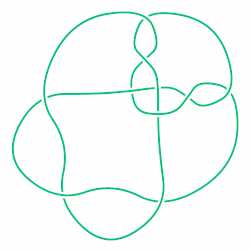
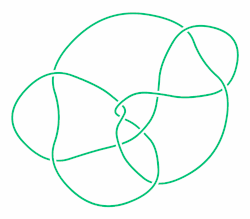
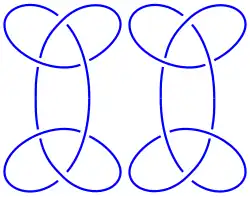
In the mathematical theory of knots, the Perko pair, named after Kenneth Perko, is a pair of entries in classical knot tables that actually represent the same knot. In Dale Rolfsen‘s knot table, this supposed pair of distinct knots is labeled 10161 and 10162. In 1973, while working to complete the classification by knot type of the Tait–Little knot tables of knots up to 10 crossings (dating from the late 19th century),[1] Perko found the duplication in Charles Newton Little’s table.[2] This duplication had been missed by John Horton Conway several years before in his knot table and subsequently found its way into Rolfsen’s table.[3] The Perko pair gives a counterexample to a “theorem” claimed by Little in 1900 that the writhe of a reduced diagram of a knot is an invariant (see Tait conjectures), as the two diagrams for the pair have different writhes.
In some later knot tables, the knots have been renumbered slightly (knots 10163 to 10166 are renumbered as 10162 to 10165) so that knots 10161 and 10162 are different. Some authors have mistaken these two renumbered knots for the Perko pair and claimed incorrectly that they are the same.[4]
The Perko pair
10161
10162 (in Rolfsen’s original numbering)
The Perko pair was correctly illustrated and explained on the first page of the Science section of the July 8, 1986 New York Times.
The Perko pair is one of five knots with 10 crossings where the topological and smooth 4-genus are different; the former is equal to 2, while the latter is 3.[5]
Pictures of the equivalence between the two knots, as given by Perko: “The Perko pair“, WebArchive archive of page hosted by Brian Sanderson. Accessed April 2025.
Pictures of a different equivalence between the two knots: “Perko pair knots“, KnotPlot. Accessed February 2016.
This article is adapted from “Perko pair” on Wikipedia, written by its contributors, and used under CC BY-SA 4.0. Text on this page is available under the same licence. Source snapshot: Wikipedia via Kiwix, 2026-07-20.
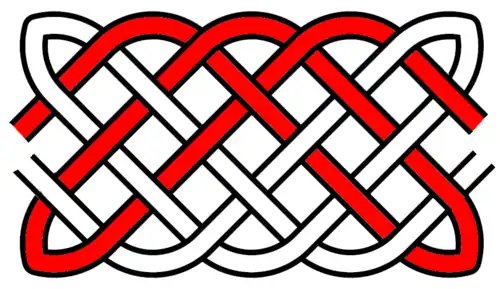
A diagram of a basket weave knot on a 3×5 rectangular grid
The basket weave knots are a family of bend and lanyardknots with a regular pattern of over–one, under–one. All of these knots are rectangular and lie in a plane.[1] They are named after plait-woven baskets, which have a similar appearance.
Construction
A diagram of a long basket weave knot on a 2×5 grid
A basket weave knot is made up of two sets of parallel lines drawn inside a rectangle such that the lines meet at the edges of the rectangle. For a true basket weave knot that can be tied with two strands, the number of intersections in each direction cannot have a common divisor. Within this constraint, there is no theoretical upper limit to the size of a basket weave knot.[1] Thus, a knot that has two intersections in one direction can be lengthened with any odd number in the perpendicular direction. If the dimension n in the smaller direction is odd, it is always possible to construct a knot with n+2 intersections in the other dimension. However, large basket weave knots have a tendency to twist and curl because they are completely flat.[1]
A basket weave knot can be tied from a single strand by first forming a bight in the middle of the line. The ends near the bight become the standing ends. This method will keep the knot in one plane only for knots in which the standing ends enter the same side; these knots are called bosun’s knots because they can be tied in a lanyard.[1] For knots in which the standing ends enter from different sides of the rectangle, the bight will wrap across one side of the knot after it is set.
Any basket weave knot that can be tied from two strands can be drawn as an endless knot by connecting the standing ends together and the working ends together. An example of this can be seen in the carrick mat.
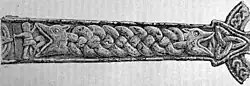
A decorative use on the Gosforth Cross, from the 10th century AD
If a basket weave knot is tied with a flat line such as ribbon instead of a round line such as rope or cord, the method of turning the line at the edges affects the final appearance. Deflecting the line will form a series of bights or scallops along the edge, while folding it over will leave the edge flat.[2]
Examples
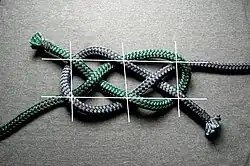
A carrick bend knot with a 2×3 rectangular grid superimposed upon it
The simplest basket weave knots consist of a two–by–three rectangle of intersections and include the following:
In the granny knot, the standing ends enter the short side, while in the double coin knot, the standing ends enter the long side. Therefore, any of these knots could be used for a lanyard. In the carrick bend, which is otherwise similar to the double coin knot, the standing ends enter opposite long sides.
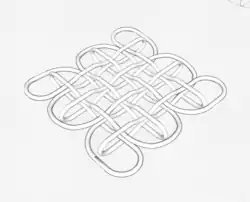
The next smallest possible basket weave knot is made up of a three–by–four rectangle, and may be called a boatswain’s lanyard, whistle lanyard, Napoleon knot, or Chinese knot,[2] although the art of Chinese knotting includes many more knots besides this one.
References
1234Ashley, Clifford W. (1993) [1944]. The Ashley Book of Knots. New York: Doubleday. pp.139–140. ISBN0-385-04025-3.
This article is adapted from “Basket weave knot” on Wikipedia, written by its contributors, and used under CC BY-SA 4.0. Text on this page is available under the same licence. Source snapshot: Wikipedia via Kiwix, 2026-07-20.
In algebraic topology, a peripheral subgroup for a space-subspace pair X⊃Y is a certain subgroup of the fundamental group of the complementary space, π1(X−Y). Its conjugacy class is an invariant of the pair (X,Y). That is, any homeomorphism (X,Y)→(X′,Y′) induces an isomorphism π1(X−Y)→π1(X′−Y′) taking peripheral subgroups to peripheral subgroups.
A peripheral subgroup consists of loops in X−Y which are peripheral to Y, that is, which stay “close to” Y (except when passing to and from the basepoint). When an ordered set of generators for a peripheral subgroup is specified, the subgroup and generators are collectively called a peripheral system for the pair (X,Y).
Peripheral systems are used in knot theory as a complete algebraic invariant of knots. There is a systematic way to choose generators for a peripheral subgroup of a knot in 3-space, such that distinct knot types always have algebraically distinct peripheral systems. The generators in this situation are called a longitude and a meridian of the knot complement.
Full definition
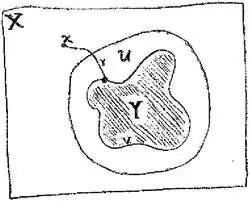
Peripheral loops live in U∪γ
Let Y be a subspace of the path-connected topological space X, whose complement X−Y is path-connected. Fix a basepoint x∈X−Y. For each path component Vi of X−Y∩Y, choose a path γi from x to a point in Vi. An element [α]∈π1(X−Y,x) is called peripheral with respect to this choice if it is represented by a loop in U∪∪iγi for every neighborhood U of Y. The set of all peripheral elements with respect to a given choice forms a subgroup of π1(X−Y,x), called a peripheral subgroup.
In the diagram, a peripheral loop would start at the basepoint x and travel down the path γ until it’s inside the neighborhood U of the subspace Y. Then it would move around through U however it likes (avoiding Y). Finally it would return to the basepoint x via γ. Since U can be a very tight envelope around Y, the loop has to stay close to Y.
Any two peripheral subgroups of π1(X−Y,x), resulting from different choices of paths γi, are conjugate in π1(X−Y,x). Also, every conjugate of a peripheral subgroup is itself peripheral with respect to some choice of paths γi. Thus the peripheral subgroup’s conjugacy class is an invariant of the pair (X,Y).
A peripheral subgroup, together with an ordered set of generators, is called a peripheral system for the pair (X,Y). If a systematic method is specified for selecting these generators, the peripheral system is, in general, a stronger invariant than the peripheral subgroup alone. In fact, it is a complete invariant for knots.
In knot theory
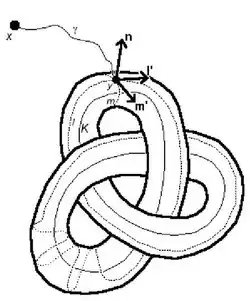
Peripheral loops live in γ union the tube.
The peripheral subgroups for a tame knotK in R3 are isomorphic to Z⊕Z if the knot is nontrivial, Z if it is the unknot. They are generated by two elements, called a longitude [l] and a meridian [m]. (If K is the unknot, then [l] is a power of [m], and a peripheral subgroup is generated by [m] alone.) A longitude is a loop that runs from the basepoint x along a path γ to a point y on the boundary of a tubular neighborhood of K, then follows along the tube, making one full lap to return to y, then returns to x via γ. A meridian is a loop that runs from x to y, then circles around the tube, returns to y, then returns to x. (The property of being a longitude or meridian is well-defined because the tubular neighborhoods of a tame knot are all ambiently isotopic.) Note that every knot group has a longitude and meridian; if [l] and [m] are a longitude and meridian in a given peripheral subgroup, then so are [l]·[m]n and [m]−1, respectively (n∈Z). In fact, these are the only longitudes and meridians in the subgroup, and any pair will generate the subgroup.
A peripheral system for a knot can be selected by choosing generators [l] and [m] such that the longitude l has linking number 0 with K, and the ordered triple (m′,l′,n) is a positively oriented basis for R3, where m′ is the tangent vector of m based at y, l′ is the tangent vector of l based at y, and n is an outward-pointing normal to the tube at y. (Assume that representatives l and m are chosen to be smooth on the tube and cross only at y.) If so chosen, the peripheral system is a complete invariant for knots, as proven in [Waldhausen 1968].
A square knot (left) and a granny knot (right).
Example: Square knot versus granny knot
The square knot and the granny knot are distinct knots, and have non-homeomorphic complements. However, their knot groups are isomorphic. Nonetheless, it was shown in [Fox 1961] that no isomorphism of their knot groups carries a peripheral subgroup of one to a peripheral subgroup of the other. Thus the peripheral subgroup is sufficient to distinguish these knots.
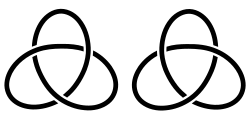
A trefoil and a mirror trefoil.
Example: Trefoil versus mirror trefoil
The trefoil and its mirror image are distinct knots, and consequently there is no orientation-preserving homeomorphism between their complements. However, there is an orientation-reversing self-homeomorphism of R3 that carries the trefoil to its mirror image. This homeomorphism induces an isomorphism of the knot groups, carrying a peripheral subgroup to a peripheral subgroup, a longitude to a longitude, and a meridian to a meridian. Thus the peripheral subgroup is not sufficient to distinguish these knots. Nonetheless, it was shown in [Dehn 1914] that no isomorphism of these knot groups preserves the peripheral system selected as described above. An isomorphism will, at best, carry one generator to a generator going the “wrong way”. Thus the peripheral system can distinguish these knots.
Wirtinger presentation
It is possible to express longitudes and meridians of a knot as words in the Wirtinger presentation of the knot group, without reference to the knot itself.
References
Fox, Ralph H., A quick trip through knot theory, in: M.K. Fort (Ed.), “Topology of 3-Manifolds and Related Topics”, Prentice-Hall, NJ, 1961, pp.120–167. MR0140099
This article is adapted from “Peripheral subgroup” on Wikipedia, written by its contributors, and used under CC BY-SA 4.0. Text on this page is available under the same licence. Source snapshot: Wikipedia via Kiwix, 2026-07-20.
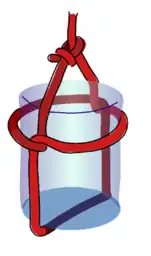
The “barrel hitch” and “barrel sling“, named for their use in hoisting cargo aboard ships, are two simple yet effective ways to suspend an object. The barrel sling lays the barrel on its side, while the barrel hitch keeps it vertical. They work by forming a “sling” around the object, which supports it from either side and underneath.
The barrel sling (not pictured) is made with a strop. The barrel is laid on its side, both sides of the strop are spread out and passed underneath, the ends of the strop are raised together, one end is tucked through the other and hooked to an eyehook. The tightened knot looks like a cow hitch. A cow hitch and bowline can achieve the same effect and are called a “cow hitch hoist”. The barrel hitch for lifting bales of hay is called a “bale sling hitch”.
Tying
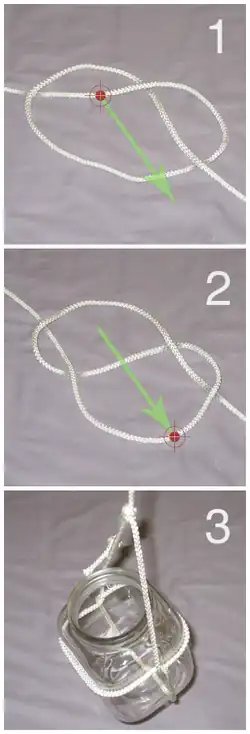
How to tie a barrel hitch
The barrel hitch is made by tying an overhand knot, leaving plenty of free rope at the working end. Where the rope crosses itself in the middle of the knot (near the target), grab the strand of rope on top and bring it towards you, then lay it back down. The result should resemble stage 2: note where the target is.
Place your object on top of the diagonal strand of rope in the centre of the knot.
Carefully draw the rope up at the working and fixed ends, forming the “sling” around the object. Tie the working end off using a bowline, making sure the sling is tight around the object.
This article is adapted from “Barrel hitch” on Wikipedia, written by its contributors, and used under CC BY-SA 4.0. Text on this page is available under the same licence. Source snapshot: Wikipedia via Kiwix, 2026-07-20.
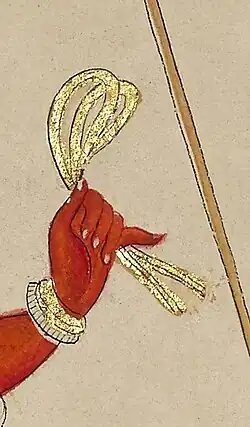
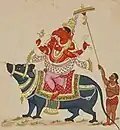
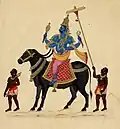
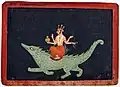
A pasha (Sanskrit: पाश, romanized:pāśa, lit.‘noose, lasso‘) is a supernatural weapon depicted in Hindu iconography. Hindu deities such as Ganesha, Yama, Shyamala devi, and Varuna are depicted with the pasha in their hands.
Pasha is a common attribute of Ganesha,[1] the Lord of removing obstacles; a pasha represents his power to bind and free obstacles. Yama, the god of death, uses the Pasha to extract a soul from a being’s body at the time of death.[2] In sculpture, it is depicted as two or three bound into one or a double loop.[3]
The Sanskrit word “pasha” originally meant “knot” or “loop”.[4] In general usage, the pasha is used to bind a foe’s arms and legs or for hunting animals.[4][3] Pasha represents worldly attachment as well as power of a deity to capture and bind evil and ignorance.[1] Ananda Coomaraswamy explores the connection of pasha to worldly bonds.[4]
In the Shaiva Siddhanta school of Hinduism, pasha is part of the trinity Pati-pashu-pasha, meaning “Master, animal, tether”, symbolizing God, man and world. Pati is God as Shiva, the patron god of the sect. Pashu is the soul or man. Pasha is the power by which Shiva leads souls to the Truth or the power of his maya (illusion) by which he entices “unenlightened” beings.[2][5]
Illustrations
Ganesha
Yama
Varuna holding a pasha in the form of a snake
References
12Eva Rudy Jansen (1993). The Book of Hindu Imagery: Gods, Manifestations and Their Meaning. Binkey Kok Publications. ISBN978-90-74597-07-4.
12James G. Lochtefeld (2002). “Pasha”. The Illustrated Encyclopedia of Hinduism: N–Z. The Rosen Publishing Group. p.505. ISBN978-0-8239-3180-4.
12Rao, T. A. Gopinatha (1914). Elements of Hindu iconography. Vol.1: Part I. Madras: Law Printing House. p.8.
This article is adapted from “Pasha (Hinduism)” on Wikipedia, written by its contributors, and used under CC BY-SA 4.0. Text on this page is available under the same licence. Source snapshot: Wikipedia via Kiwix, 2026-07-20.
In geometric topology, a band sum of two n-dimensional knotsK1 and K2 along an (n+1)-dimensional 1-handle h called a band is an n-dimensional knot K such that:
There is an (n+1)-dimensional 1-handle h connected to (K1,K2) embedded in Sn+2.
There are points and such that is attached to along .
K is the n-dimensional knot obtained by this surgery.
A band sum is thus a generalization of the usual connected sum of knots.
See also
Manifold decomposition
References
Cromwell, Peter R. (2004), Knots and Links, Cambridge University Press, p.90, ISBN9780521548311.
This article is adapted from “Band sum” on Wikipedia, written by its contributors, and used under CC BY-SA 4.0. Text on this page is available under the same licence. Source snapshot: Wikipedia via Kiwix, 2026-07-20.
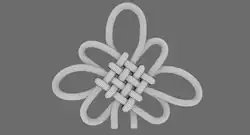
The Pan Chang Knot is one of the eight symbols of Buddhism. It communicates that religion’s belief in a cycle of life with no beginning and no end. It was illustrated in a painting of the Emperor Xiaozhong (the second ruling member of the southern Song dynasty, which existed from AD 960 to 1279) that is now in the Palace Museum in Beijing. The knot is also known as the Mystic Knot, and is believed to impart good fortune to those who wear and observe it. It is an intricate knot that forces the tyer to think in three dimensions.[2]
↑The Complete Book of Chinese Knotting (2014) by Lydia Chen — ISBN978-0 8048-3679-1
1234The Ultimate Book of Decorative Knots by Lindsey Philpott (2010) — ISBN978-1-4081-5726-8
↑The Complete Book of Chinese Knotting (2014) by Lydia Chen — ISBN978-0 8048-3679-1
↑HISTORY AND SCIENCE OF KNOTS (Series on Knots & Everything) — ISBN978-9810224691
↑Ashley, Clifford W.. The Ashley Book of Knots. Published by Faber and Faber, 1993, ISBN057109659X, 978-0571096596
↑Демус Валерий Анатольевич, Большая книга узлов. Рыбацкие, охотничьи, морские, туристские, альпинистские, бытовые: Издательство «Клуб Семейного Досуга»; 2014; ISBN978-966-14-8264-6 — p.127
This article is adapted from “Pan Chang knot” on Wikipedia, written by its contributors, and used under CC BY-SA 4.0. Text on this page is available under the same licence. Source snapshot: Wikipedia via Kiwix, 2026-07-20.
The bale sling hitch (or strap hitch) is a knot which traditionally uses a continuous loop of strap to form a cow hitch around an object in order to hoist or lower it. In practice, a similar arrangement can also be formed using a fixed loop at the end of a rope. This loop could be formed at the end of a line with a knot, such as the bowline, or a large eye splice.[1]
↑Ashley, Clifford W. (1944), The Ashley Book of Knots, New York: Doubleday, pp.348–9
This article is adapted from “Bale sling hitch” on Wikipedia, written by its contributors, and used under CC BY-SA 4.0. Text on this page is available under the same licence. Source snapshot: Wikipedia via Kiwix, 2026-07-20.
The Palomar knot (/ˈpæləmɑːr/PAL-ə-mar) is a knot that is used for securing a fishing line to a fishing lure, hook, or swivel.[1] It is strong and easy to tie and with practice can even be tied in the dark.[2] If tied properly, it leaves the hook free to rotate in the knot.[2]
Steps in tying a Palomar knot (free end is colored red). 1. Tie the loose overhand knot. 2. Pass the object through the remaining loop. 3. Start snug. 4. Finish snug (pull evenly on standing ends). 5. View of obverse side.
To tie the knot first double 20-30 cm (8–12 in) of line into a loop and pass it through the eye of the hook, lure or swivel. Tie a very loose overhand knot using the doubled loop and the doubled section of line leading back to the fishing rod. Pass the object to be tied through the remaining loop of the overhand knot and slide the loop up onto the line just above the eye of the hook. Moisten the knot to lessen the friction and pull on the tag and standing ends evenly to snug the knot down. Trim the free end of the line to a length of about 3 mm.
This knot is good for all kinds of light fishing lines, especially braided Dacron, and retains almost all of the original line strength, even with monofilaments. It also is nearly impossible (if tied correctly) to “pull out”. It is equally effective with other fastening applications – such as a dog clip to a rope – provided the object being tied to can pass through the loop, and the line or rope is not too thick to pass through the object twice, and, with practice, it can be tied in the dark with cold hands.
The Palomar Knot was developed by Chester J. “Chet” Palomar, a Scout leader and public servant from Pomona, California. He introduced the knot at a Fred Hall fishing show in 1971, where it impressed reps from DuPont so much that they adopted it as one of their best knots.[3]
This article is adapted from “Palomar knot” on Wikipedia, written by its contributors, and used under CC BY-SA 4.0. Text on this page is available under the same licence. Source snapshot: Wikipedia via Kiwix, 2026-07-20.