A framing of a knot is a choice of a non-zero non-tangent vector at each point of the knot. More precisely, a framing is a choice of a non-zero section in the normal bundle of the knot, i.e. a (non-zero) normal vector field. Given a framed knot C, the self-linking number is defined to be the linking number of C with a new curve obtained by pushing points of C along the framing vectors.
Given a Seifert surface for a knot, the associated Seifert framing is obtained by taking a tangent vector to the surface pointing inwards and perpendicular to the knot. The self-linking number obtained from a Seifert framing is always zero.[1]
The blackboard framing of a knot is the framing where each of the vectors points in the vertical (z) direction. The self-linking number obtained from the blackboard framing is called the Kauffman self-linking number of the knot. This is not a knot invariant because it is only well-defined up to regular isotopy.
References
↑Sumners, De Witt L.; Cruz-White, Irma I.; Ricca, Renzo L. (2021). “Zero helicity of Seifert framed defects”. J. Phys. A. 54 (29): 295203. Bibcode:2021JPhA…54C5203S. doi:10.1088/1751-8121/abf45c. S2CID233533506.
Chernov, Vladimir (2005), “Framed knots in 3-manifolds and affine self-linking numbers”, Journal of Knot Theory and its Ramifications, 14 (6): 791–818, arXiv:math/0105139, doi:10.1142/S0218216505004056, MR2172898.
Moskovich, Daniel (2004), “Framing and the self-linking integral”, Far East Journal of Mathematical Sciences, 14 (2): 165–183, arXiv:math/0211223, Bibcode:2002math…..11223M, MR2105976
This article is adapted from “Self-linking number” on Wikipedia, written by its contributors, and used under CC BY-SA 4.0. Text on this page is available under the same licence. Source snapshot: Wikipedia via Kiwix, 2026-07-20.
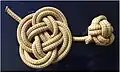
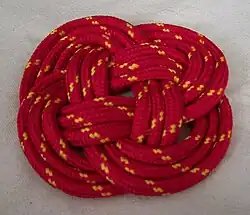
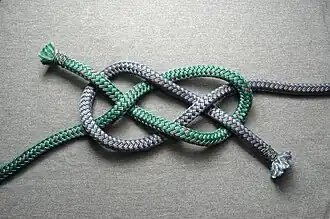
The carrick mat is a flat woven decorative knot which can be used as a mat or pad.[1] Its name is based on the mat’s decorative-type carrick bend with the ends connected together, forming an endless knot. A larger form, called the prolong knot, is made by expanding the basic carrick mat by extending, twisting, and overlapping its outer bights, then weaving the free ends through them. This process may be repeated to produce an arbitrarily long mat.[2]
This article is adapted from “Carrick mat” on Wikipedia, written by its contributors, and used under CC BY-SA 4.0. Text on this page is available under the same licence. Source snapshot: Wikipedia via Kiwix, 2026-07-20.
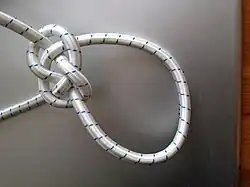
A carrick loop[2] is a knot used to make a reliable and stable loop at the end of a rope formed by the tail turned around and attached to the main part using a carrick bend.
Tying
The carrick bend knot closing the carrick bend loop will consist of
a simple closed loop of the main part and
a small closed loop of the rope tail
woven together in a basket weave pattern and then
tightened.
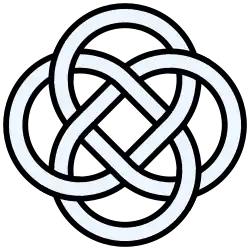
The knot will have 8 crossing points, 7 holes, the central hole with 4 straight edges, and the 6 others with 2 straight and one external curved edge. The main part, the end, and the two loop edges will enter the knot from the four corners of the knot when tied flat; If the ones that will carry the heaviest loads are placed at opposite corners the knot will hold better.
The carrick loop is reliable, and easy to untie, but there are no advantages over other loops that are easier to tie.[2]
Variations
There are two possible variations depending on the loop ends angle of entry to the knot relative to each other, roughly 90 degrees, or 180 degrees; The former giving a more flat and decorative knot and the latter, double coin knot, being more secure.
12Ashley, Clifford W. (1993) [1944], The Ashley Book of Knots, New York: Doubleday, p.knot nr. 1033, ISBN0-385-04025-3
External links
This article is adapted from “Carrick bend loop” on Wikipedia, written by its contributors, and used under CC BY-SA 4.0. Text on this page is available under the same licence. Source snapshot: Wikipedia via Kiwix, 2026-07-20.
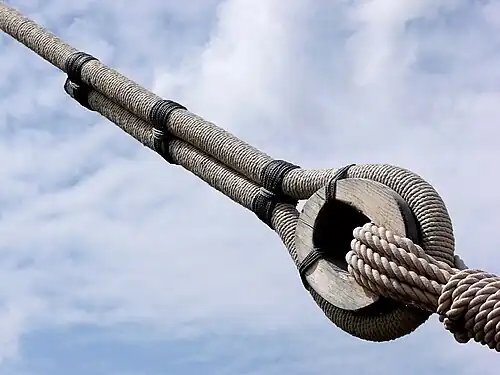
The eye of a forestay secured with three round seizings
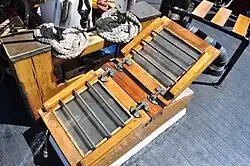
Seizings are a class of stopping knots used to semi-permanently bind together two ropes, two parts of the same rope, or rope and another object.[1] Akin to lashings, they use string or small-stuff to produce friction and leverage to immobilize larger ropes. Seizings are not recommended for heavy loads for critical use as strain reduces the diameter of the main rope and can permit slippage even with proper construction. According to The Ashley Book of Knots, “A seizing holds several objects together.”[1] The other type of stopping knots are whipping knots.
A throat seizing is a seized round turn. It is used when turning in deadeyes, and has riding turns but no crossing turns. The end of the stay or shroud should first be stopped around the deadeye. — The Ashley Book of Knots[1]
This article is adapted from “Seizing” on Wikipedia, written by its contributors, and used under CC BY-SA 4.0. Text on this page is available under the same licence. Source snapshot: Wikipedia via Kiwix, 2026-07-20.
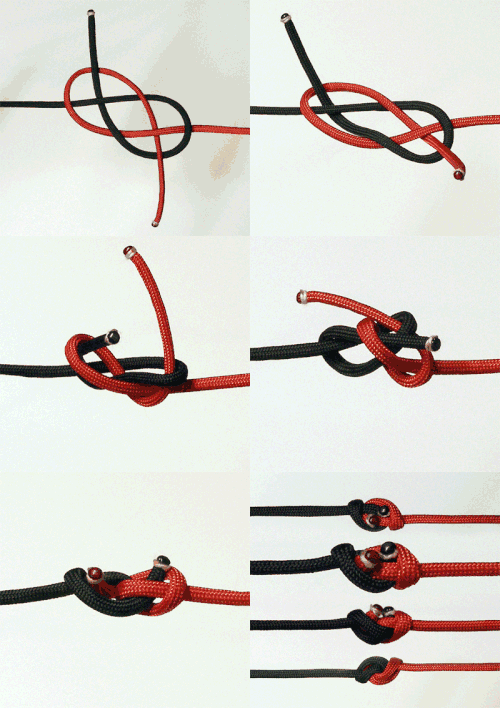
The Carrick bend, also known as the Sailor’s breastplate, is a knot used for joining two lines. It is particularly appropriate for very heavy rope or cable that is too large and stiff to be easily formed into other common bends.[1][2] It will not jam even after carrying a significant load or being soaked with water.[3]
As with many other members of the basket weave knot family, the carrick bend’s aesthetically pleasing interwoven and symmetrical shape has also made it popular for decorative purposes.
Heraldry
The Carrick bend is known as the “Wake knot” or “Ormonde knot” when it is used as a heraldic badge.[4]
Etymology
This knot’s name dates back to at least 1783, when it was included in a nautical bilingual dictionary authored by Daniel Lescallier.[1][5] Its origins prior to that are not known with certainty. There are several possible explanations for the name “Carrick” being associated with this bend. The Elizabethan era plasterwork of Ormonde Castle in Carrick-on-Suir shows numerous carrick bends molded[6] in relief. Or the name may come from Carrick Roads—a large natural anchorage by Falmouth in Cornwall, England. The name may also have been derived from the Carrack, a medieval type of ship.[7]
Variations
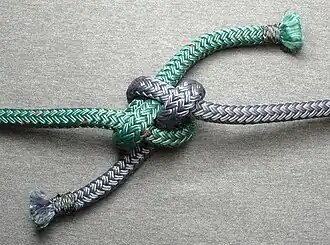
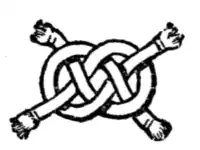
The eight crossings within the carrick bend allow for many similar-looking knots to be made. The lines in a “full” or “true” carrick bend alternate between over and under at every crossing. There are also two ways the ends can emerge from the knot: diagonally opposed or from the same side. The latter form is also called the double coin knot. The form with the ends emerging diagonally opposed is considered more secure.[1]
Unfortunately, with so many permutations, the carrick bend is prone to being tied incorrectly.[3]
Appearance
The carrick bend, also called full carrick bend, sailor’s knot, and anchor bend, is perhaps the nearest thing we have to a perfect bend. It is symmetrical, it is easy to tie, it does not slip easily in wet material, it is among the strongest of knots, it cannot jam and is readily untied. To offset this array of excellencies is the sole objection that it is somewhat bulky.
The carrick bend is generally tied in a flat interwoven form as shown above. Without additional measures it will collapse into a different shape when tightened, a process known as capsizing, with the degree of capsizing depending on the looseness of the weave. This capsized form is both secure and stable once tightened, although it is bulkier than the seized form below. Incomplete capsizing resulting from a tight weave produces a form that is likewise secure and stable, but which is more difficult to untie, countering one of the advantages of the carrick bend. When the knot is allowed to capsize naturally under tension, considerable slippage of line through the knot can occur before tightening, so the knot should be set carefully before loading to avoid this slippage in use.[9]
Seized
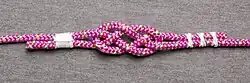
Seized carrick bend. The seizings preserve the initial shape of the knot.
In the interest of making the carrick bend easier to untie, especially when tied in extremely large rope, the ends may be seized to prevent the knot from collapsing when load is applied. This practice also keeps the knot’s profile flatter and can ease its passage over capstans or winches.[10]
The ends are traditionally seized to their standing part using a round seizing. For expediency, a series of double constrictor knots, drawn very tight, may also be used.[2] When seizing the carrick bend, both ends must be secured to their standing parts or the bend will slip.
Decorative uses
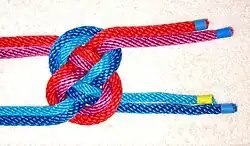
Decorative form made with doubled lines
In the decorative variation, both standing ends enter from one side and both working ends exit from the other. In this configuration, the knot is known as the Josephine knot (macrame) or double coin knot (Chinese knotting). This form of the carrick bend is found depicted in heraldry, sometimes with the tails of heraldic serpents woven (or “nowed”) into this knot.[11] In heraldry, the knot is associated with Hereward the Wake and is known under the name Wake knot.[7] It is depicted in the coat of arms of Bourne Town Council, Lincolnshire.[12]
The knot can be tied using doubled lines for an even flatter, more elaborate appearance. A doubled carrick bend was used to ornamentally secure the lanyards on the breastplate of the US Navy Mark V diving helmet during inspection and between dives.[13][14]
When the ends of the carrick bend are connected together, or more practically hidden behind the knot, it becomes a carrick mat. This same configuration is also one of the most basic Turk’s head knots.
Security
The fully interwoven diagonal carrick bend is the most secure variation. All other forms are inferior[3] and not recommended as bends.[1]
Although the carrick bend has a reputation for strength, some tests have shown it to be as weak as 65% efficiency.[1]
↑Davis, RH (1955). Deep Diving and Submarine Operations (6thed.). Tolworth, Surbiton, Surrey: Siebe Gorman & Company Ltd.
↑Stillson, George D (1915). “Report in Deep Diving Tests”. US Bureau of Construction and Repair, Navy Department. Technical Report. Retrieved 2009-06-03.{{cite journal}}: CS1 maint: deprecated archival service (link)
This article is adapted from “Carrick bend” on Wikipedia, written by its contributors, and used under CC BY-SA 4.0. Text on this page is available under the same licence. Source snapshot: Wikipedia via Kiwix, 2026-07-20.
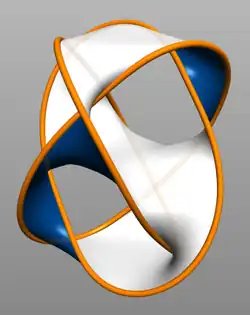
In mathematics, a Seifert surface (named after German mathematician Herbert Seifert[1][2]) is an orientable surface whose boundary is a given knot or link.
Such surfaces can be used to study the properties of the associated knot or link. For example, many knot invariants are most easily calculated using a Seifert surface. Seifert surfaces are also interesting in their own right, and the subject of considerable research.
Specifically, let L be a tame oriented knot or link in Euclidean 3-space (or in the 3-sphere). A Seifert surface is a compact, connected, oriented surface S embedded in 3-space whose boundary is L such that the orientation on L is just the induced orientation from S.
Note that any compact, connected, oriented surface with nonempty boundary in Euclidean 3-space is the Seifert surface associated to its boundary link. A single knot or link can have many different inequivalent Seifert surfaces. A Seifert surface must be oriented. It is possible to associate surfaces to knots which are neither oriented nor orientable as well.
Examples
A Seifert surface for the Hopf link. This is an annulus, not a Möbius strip. It has two half-twists and is thus orientable.
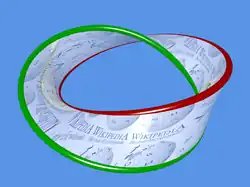
The standard Möbius strip has the unknot for a boundary but is not a Seifert surface for the unknot because it is not orientable.
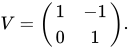
The “checkerboard” coloring of the usual minimal crossing projection of the trefoil knot gives a Mobius strip with three half twists. As with the previous example, this is not a Seifert surface as it is not orientable. Applying Seifert’s algorithm to this diagram, as expected, does produce a Seifert surface; in this case, it is a punctured torus of genus g = 1, and the Seifert matrix is
Existence and Seifert matrix
It is a theorem that any link always has an associated Seifert surface. This theorem was first published by Frankl and Pontryagin in 1930.[3] A different proof was published in 1934 by Herbert Seifert and relies on what is now called the Seifert algorithm. The algorithm produces a Seifert surface , given a projection of the knot or link in question.
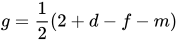
Suppose that link has m components (m = 1 for a knot), the diagram has d crossing points, and resolving the crossings (preserving the orientation of the knot) yields f circles. Then the surface is constructed from f disjoint disks by attaching d bands. The homology group is free abelian on 2g generators, where
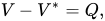
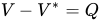
is the genus of . The intersection form Q on is skew-symmetric, and there is a basis of 2g cycles with equal to a direct sum of the g copies of the matrix
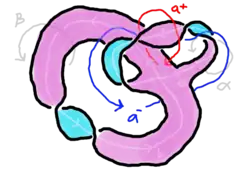
An illustration of (curves isotopic to) the pushoffs of a homology generator a in the positive and negative directions for a Seifert surface of the figure eight knot.
The 2g × 2g integer Seifert matrix
has the linking number in Euclidean 3-space (or in the 3-sphere) of ai and the “pushoff” of aj in the positive direction of . More precisely, recalling that Seifert surfaces are bicollared, meaning that we can extend the embedding of to an embedding of , given some representative loop which is homology generator in the interior of , the positive pushout is and the negative pushout is .[4]
With this, we have
where V∗ = (v(j, i)) the transpose matrix. Every integer 2g × 2g matrix with arises as the Seifert matrix of a knot with genus g Seifert surface.
The Alexander polynomial is computed from the Seifert matrix by which is a polynomial of degree at most 2g in the indeterminate The Alexander polynomial is independent of the choice of Seifert surface and is an invariant of the knot or link.
The signature of a knot is the signature of the symmetric Seifert matrix It is again an invariant of the knot or link.
Genus of a knot
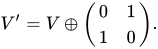
Seifert surfaces are not at all unique: a Seifert surface S of genus g and Seifert matrix V can be modified by a topological surgery, resulting in a Seifert surface S′ of genus g + 1 and Seifert matrix
The genus of a knot K is the knot invariant defined by the minimal genus g of a Seifert surface for K.
For instance:
An unknot—which is, by definition, the boundary of a disc—has genus zero. Moreover, the unknot is the only knot with genus zero.
The genus of a (p,q)-torus knot is (p − 1)(q − 1)/2
The degree of a knot’s Alexander polynomial is a lower bound on twice its genus.
A fundamental property of the genus is that it is additive with respect to the knot sum:
In general, the genus of a knot is difficult to compute, and the Seifert algorithm usually does not produce a Seifert surface of least genus. For this reason other related invariants are sometimes useful. The canonical genus of a knot is the least genus of all Seifert surfaces that can be constructed by the Seifert algorithm, and the free genus is the least genus of all Seifert surfaces whose complement in is a handlebody. (The complement of a Seifert surface generated by the Seifert algorithm is always a handlebody.) For any knot the inequality obviously holds, so in particular these invariants place upper bounds on the genus.[5]
The knot genus is NP-complete by work of Ian Agol, Joel Hass and William Thurston.[6]
It has been shown that there are Seifert surfaces of the same genus that do not become isotopic either topologically or smoothly in the 4-ball.[7][8]
↑Seifert, H. (1934). “Über das Geschlecht von Knoten”. Math. Annalen (in German). 110 (1): 571–592. doi:10.1007/BF01448044. S2CID122221512.
↑van Wijk, Jarke J.; Cohen, Arjeh M. (2006). “Visualization of Seifert Surfaces”. IEEE Transactions on Visualization and Computer Graphics. 12 (4): 485–496. Bibcode:2006ITVCG..12..485V. doi:10.1109/TVCG.2006.83. PMID16805258. S2CID4131932.
↑Frankl, F.; Pontrjagin, L. (1930). “Ein Knotensatz mit Anwendung auf die Dimensionstheorie”. Math. Annalen (in German). 102 (1): 785–789. doi:10.1007/BF01782377. S2CID123184354.
↑Brittenham, Mark (24 September 1998). “Bounding canonical genus bounds volume”. arXiv:math/9809142.
↑Agol, Ian; Hass, Joel; Thurston, William (2002-05-19). “3-manifold knot genus is NP-complete”. Proceedings of the thiry-fourth annual ACM symposium on Theory of computing. STOC ’02. New York, NY, USA: Association for Computing Machinery. pp.761–766. arXiv:math/0205057. doi:10.1145/509907.510016. ISBN978-1-58113-495-7. S2CID10401375– via author-link.
↑Hayden, Kyle; Kim, Seungwon; Miller, Maggie; Park, JungHwan; Sundberg, Isaac (2022-05-30). “Seifert surfaces in the 4-ball”. arXiv:2205.15283 [math.GT].
The SeifertView programme of Jack van Wijk visualizes the Seifert surfaces of knots constructed using Seifert’s algorithm.
This article is adapted from “Seifert surface” on Wikipedia, written by its contributors, and used under CC BY-SA 4.0. Text on this page is available under the same licence. Source snapshot: Wikipedia via Kiwix, 2026-07-20.
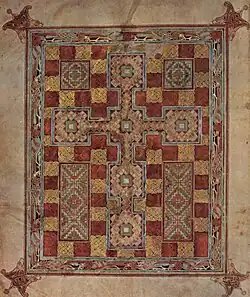
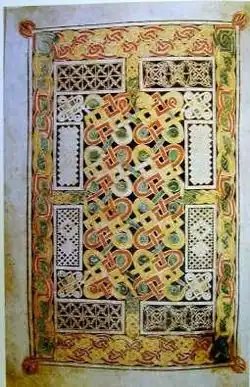
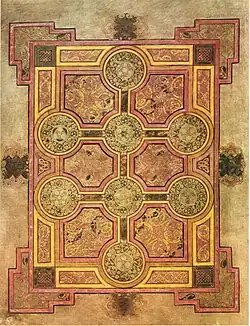
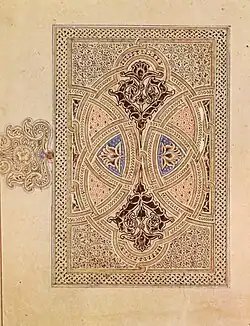
A carpet page is a full page in an illuminated manuscript containing intricate, non-figurative, patterned designs.[1] They are a characteristic feature of Insular manuscripts, and typically placed at the beginning of a Gospel Book. Carpet pages are characterised by mainly geometrical ornamentation which may include repeated animal forms. They are distinct from pages devoted to highly decorated historiated initials, though the style of decoration may be very similar.[2]
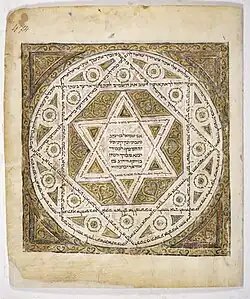
Carpet pages are characterised by ornamentation with brilliant colors, active lines and complex patterns of interlace. They are normally symmetrical, or very nearly so, about both a horizontal and vertical axis, though for example the pictured page from the Lindisfarne Gospels is only symmetrical about a vertical axis. Some art historians find their origin in similar Coptic decorative book pages,[3] and they also clearly borrow from contemporary metalwork decoration. Oriental carpets, or other textiles, may themselves have been influences. The tooled leather book binding of the St Cuthbert Gospel represents a simple carpet page in another medium,[4] and the few surviving treasure bindings – metalwork book covers or book shrines – from the same period, such as that on the Lindau Gospels, are also close parallels.[5] Roman floor mosaics seen in post-Roman Britain, are also cited as a possible source.[6] The Hebrew Codex Cairensis, from 9th century Galilee, also contains a similar type of page, but stylistically very different.
Examples
The earliest surviving example is from the early 7th-century Bobbio Orosius, and relates more closely to Late Antique decoration. There are notable carpet pages in the Book of Kells, the Lindisfarne Gospels, the Book of Durrow, and other manuscripts.[7]
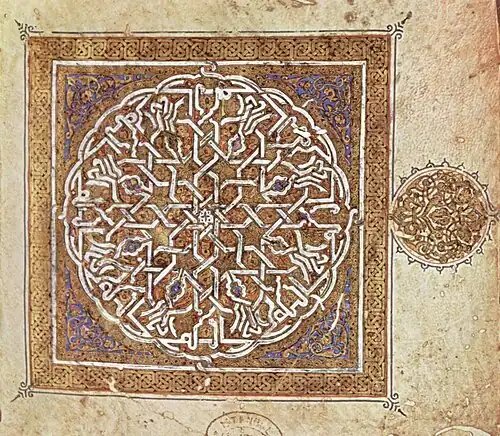
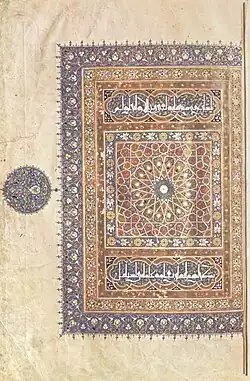
Carpet pages are also found in some medieval Hebrew manuscripts, typically opening the major sections of the book. Islamic manuscripts, especially Qur’ans, often have pages entirely devoted to complex geometrical decoration, but the term is not usually used of them.
Calkins, Robert G. Illuminated Books of the Middle Ages. Ithaca, New York: Cornell University Press, 1983.
Moss, Rachel. The Book of Durrow. Dublin: Trinity College Library; London: Thames and Hudson, 2018. ISBN978-0-5002-9460-4
Further reading
Alexander, J.J.G. A Survey of Manuscripts Illuminated in the British Isles: Volume One: Insular Manuscripts from the 6th to the 9th Century. London England: Harvey Miller. 1978.
Brown, Michelle P. Understanding Illuminated Manuscripts: A Guide to Technical Terms. Malibu, California: The J. Paul Getty Museum. 1994.
Laing, Lloyd and Jennifer. Art of the Celts: From 700 BC to the Celtic Revival. Singapore: Thames and Hudson. 1992.
Megaw, Ruth and Vincent. Celtic Art: From its Beginnings to the Book of Kells. New York: Thames and Hudson. 2001.
Nordenfalk, Carl. Celtic and Anglo-Saxon Painting: Book Illumination in the British Isles. 600-800. New York: George Braziller Publishing. 1977.
Pacht, Otto. Book Illumination in the Middle Ages. England: Harvey Miller Publishers. 1984.
This article is adapted from “Carpet page” on Wikipedia, written by its contributors, and used under CC BY-SA 4.0. Text on this page is available under the same licence. Source snapshot: Wikipedia via Kiwix, 2026-07-20.
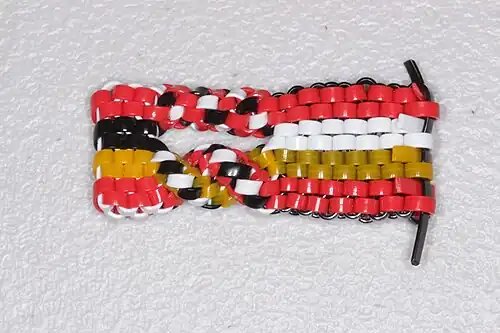
A fairly complex box stitch is shown here. Beginning at the left, it begins with quadruple box for 5 stitches, and then splits into single barrel (top) and double barrel (bottom) thus incorporating a window. After 11 stitches, the two independent barrels rejoin for another 13 stitches until the end (right).
Scoubidou (Craftlace, scoobies, lanyard, gimp, or boondoggle) is material used in knotting craft. It originated in France, where it became a fad in the late 1950s and has lost popularity. It is named after the 1958 song of the same name as sung by the French singer Sacha Distel.
Scoubidou returned to fashion in various countries in the 1980s, and later in 2004 and 2005. It uses commercially supplied plastic strips or tubes.[1]
Thread
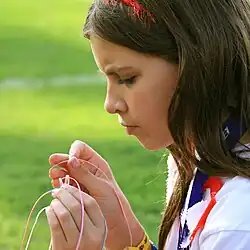
Stitching the thin thread requires concentration.
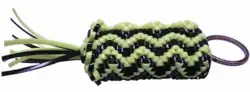
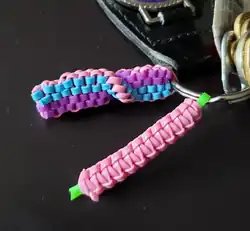
The most common kind of thread used for the craft is flat and comes in many colors, sometimes called “lanyard” or “gimp thread”, often depending on region. Another kind of scoubidou thread is supple, round, and hollow plasticized PVC tubes usually about 80 centimetres in length. They are sold in various colors, sizes, and types, and are used to make items by binding them together with knots. On account of their elasticity and hollow cross-section—which enables them to collapse and deform when pulled—they form tight and stable knots. Key chains, friendship bands and other trinkets are most commonly woven, although more complicated shapes and figures can also be created.[2]
Most of the knots used in scoubidou were already used in bast fibre, while the creations possible with scoubidou are similar to traditional corn dollies and macrame.
Knots
Square stitch
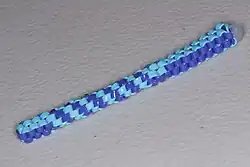
Single square stitch light and dark blue. This particular example starts in box, switches to barrel, and then returns to box.
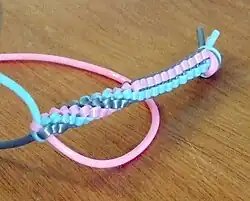
Also known as a box stitch, the square stitch is the most common knot used in making keychains. It uses two strands of gimp. The square stitch is made by taking the end and crossing opposite ends, then taking one of the other ends and going over the first string and going under the second string. To finish, the last end is woven over the first strand and under the second strand.[3][4]
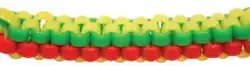
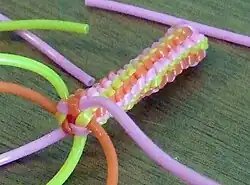
More complex stitches can be made by using more strands and incorporating them adjacent to one another while sharing the same cross strand. Thus, one can have double, triple, quadruple and more, with the number of boxes being n-1, with n being the number of strands used (because one of the strands is used as the cross stitch). An endless variety of stitches can be made in this way, incorporating multiple rows, adding rows in the middle of the stitch, forming windows, switching to barrel, etc. Strands can also be added in perpendicular formation.
Barrel knot
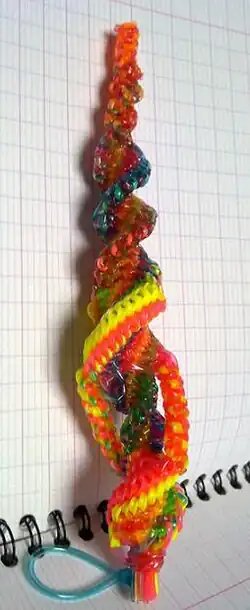
By crossing the stitch, box can be made into a helical arrangement, often referred to as barrel or spiral, and the formed stitching becomes cylindrical as single barrel,[5] but can take on quite interesting patterns when the stitch is a larger one, such as double, triple, or quadruple barrel.
Other numbers of strands
A three-strand scoubidou, with the first part done in a square knot and the second done in a spiralA four-strand scoubidou, with three lacesA six-strand scoubidouA ten-strand scoubidou
The square stitch uses four strands (resulting from the two ends of each of two scoubidous). Other numbers of strands may be used for the simple woven scoubidou chain, although with more than six the structure becomes difficult to support. Using even numbers of strands enables one end of the construction to be neatly terminated in the middle of a strand (as in the example of the square stitch).
As with the square stitch, each layer may be constructed either with the same direction of weave (leading to a chiral spiral structure) or as a mirror image of the previous layer (leading to a more angular appearance).
Double spiral
The double spiral, or twist, is the same concept as the spiral knot however the number of strings is doubled.[6]
Cobra twist
The cobra stitch (or snake) involves tying two strands around two other strands back and forth.[7][8] A super cobra (or king cobra) is created when the strands are tied around the cobra itself, making it wider and larger.[9]
The Chinese staircase
One strand is tied around one or more other strands. The more strands that are used in the middle the fatter the Chinese staircase is. This is made with different colour strings.[10]
The butterfly stitch
One loop strand is put through another and the latter loop pulled. The loops are then twisted together to resemble a butterfly.[11]
Large stitches
A sixteen-strand scoubidou
Many scoubidou stitches which are commonly done with small numbers of strands can be generalized to use any number of strands. The super-16 is a large scoubidou consisting of sixteen strands woven together. The super-16 can be compared to the square stitch but on a much larger scale.[12]
Making objects
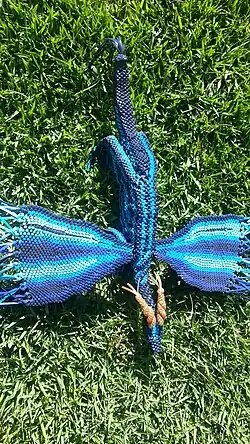
A dragon made with lanyard (scoubidou). More than 60 different strings were used to make it.
Creations such as dragons, Eiffel Towers, bridges, and birds can be made by putting wires inside the stitch to keep it stable, and to enable bending the stitch and keeping it bent.
Gallery
Various knot types
Cobra in the foreground, double box / double barrel in the rear
This article is adapted from “Scoubidou” on Wikipedia, written by its contributors, and used under CC BY-SA 4.0. Text on this page is available under the same licence. Source snapshot: Wikipedia via Kiwix, 2026-07-20.
A button knot is a knot that forms a bulge of thread. Button knots are essentially stopper knots, but may be aesthetically pleasing enough to be used as a button on clothes.
The single-strand button is a third type of knob knot, in which the working end leaves the knot at the neck, parallel with the standing part, so that the two parts, or ends, together form a stem. The lay of the two ends is the same, and the knot is symmetrical throughout. — The Ashley Book of Knots[1]
This article is adapted from “Button knot” on Wikipedia, written by its contributors, and used under CC BY-SA 4.0. Text on this page is available under the same licence. Source snapshot: Wikipedia via Kiwix, 2026-07-20.
Note(s): The first to bear the knot is said to have been Thomas I, Count of Savoy, in the 13th century.[1]
The Savoy knot, a type of decorative knot, is a heraldic knot used primarily in Italian heraldry. It is most notable for its appearance on the heraldic badge of the House of Savoy, where it is accompanied by the motto Stringe ma non costringe, “It tightens, but does not constrain”.[2] The Cavendish knot is an identical heraldic knot. In shape, the Savoy knot is comparable to a figure eight.
When used outside heraldry (as a real knot), it is known as a figure-eight knot.
The Savoy knot can also be seen on the Alfa Romeo automobile badge (founded and manufactured in Milan, Italy) up to 1943.[3]
↑Burgess, Joseph Tom (1884). Knots, Ties and Splices: A Handbook for Seafarers, Travellers and All Who Use Cordage, with Historical, Heraldic and Practical Notes. Oxford: G. Routledge and Sons. p.12.
This article is adapted from “Savoy knot” on Wikipedia, written by its contributors, and used under CC BY-SA 4.0. Text on this page is available under the same licence. Source snapshot: Wikipedia via Kiwix, 2026-07-20.







![{\displaystyle S\times [-1,1]}](/wp-content/uploads/wiki-images/e47ae91617b44e3a2f91d571aa9a3e4cffd4137a-58f84046.svg)