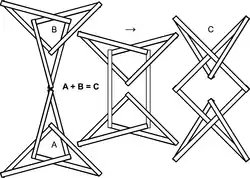
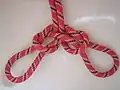
In knot theory, the square knot is a composite knot obtained by taking the connected sum of a trefoil knot with its reflection. It is closely related to the granny knot, which is also a connected sum of two trefoils. Because the trefoil knot is the simplest nontrivial knot, the square knot and the granny knot are the simplest of all composite knots.
The square knot is the mathematical version of the common reef knot.
Construction
The square knot can be constructed from two trefoil knots, one of which must be left-handed and the other right-handed. Each of the two knots is cut, and then the loose ends are joined together pairwise. The resulting connected sum is the square knot.
It is important that the original trefoil knots be mirror images of one another. If two identical trefoil knots are used instead, the result is a granny knot.
Properties
The square knot is amphichiral, meaning that it is indistinguishable from its own mirror image. The crossing number of a square knot is six, which is the smallest possible crossing number for a composite knot.
which is simply the square of the Alexander polynomial of a trefoil knot. Similarly, the Alexander–Conway polynomial of a square knot is
These two polynomials are the same as those for the granny knot. However, the Jones polynomial for the square knot is
This is the product of the Jones polynomials for the right-handed and left-handed trefoil knots, and is different from the Jones polynomial for a granny knot.
The knot group of the square knot is given by the presentation
This article is adapted from “Square knot (mathematics)” on Wikipedia, written by its contributors, and used under CC BY-SA 4.0. Text on this page is available under the same licence. Source snapshot: Wikipedia via Kiwix, 2026-07-20.
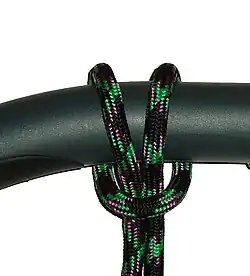
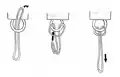
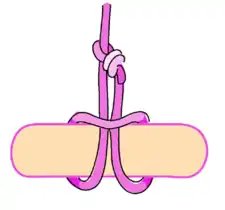
The cow hitch, also called the lark’s head, is a hitchknot used to attach a rope to an object. The cow hitch comprises a pair of single hitches tied in opposing directions, as compared to the clove hitch in which the single hitches are tied in the same direction. It has several variations and is known under a variety of names. It can be tied either with the end of the rope or with a bight.
History
A simple and useful knotted structure, the cow hitch has been known since at least the first century when described by Greek physician Heraklas in a monograph on surgical knots and slings.[1] Known under a variety of names, this knot has been used both on land and at sea.[2] The common alternate name “lark’s head” is attributed to Tom Bowling (pseudonym) in the 1866 work The Book of Knots which is presumed to have been adapted from a French manuscript; lark’s head is a literal translation of the French name for the knot, tête d’alouette.[3]
Variations
The underlying cow hitch structure can be formed and used in a variety of ways. These variations are differentiated by method used to form the knot and the way in which it is loaded.[4] In particular, the knot can be formed with an end of the rope, in a closed loop or strap, or a combination of these two in which it is tied with the end and then formed into a loop by securing the free end to the standing part. Although certain names tend to be historically associated with a particular variations, real-world naming is not necessarily consistent between various users and applications.
With the end
When tied using the end of a rope, such as when securing an animal’s lead to a vertical post or stake, this knot was said to be more resistant to loosening than the clove hitch as the animal wanders around the post.[5] In general, however, this single-ended form of the cow hitch is less stable compared to the variations in which both ends are loaded.[6][7]
In a closed loop or strap
This form is commonly known as a strap hitch or girth hitch, the latter term being common among climbers. It is the method commonly used to attach luggage tags which have a pre-tied loop of string or elastic. This form is also often used to connect loop-ended lanyards to handheld electronic equipment, since it can be tied without access to the ends of the fastening loop.
When used to connect two closed loops, and dressed so as to be symmetrical, it is known as a strop bend.[8] This can be used to attach pre-sewn or permanently tied slings.
With the end, then secured into a loop
When tied by threading the end and then the end is secured to the standing part, the knot is known as a bale sling hitch.
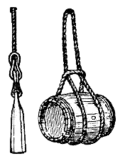
Made with a closed loop
Shown being used to hoist a barrel, and (left) for tying a lead to a sounding line
Made with an eye splice around a ring
Made with end and then secured to standing part
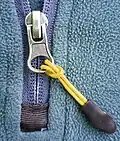
Cow hitch at Zipper
Applications
Tatting
The craft of tatting is composed primarily of lark’s head knots over carrier threads. A lark’s head is called a double stitch in tatting.
Friendship bracelets
In the context of friendship bracelets, the lark’s head is called the reverse knot or the forward backward knot or the backward forward knot if the author is being directionally specific for instructional purposes.
Cableman’s hitch
Another application for the cow hitch is in the handling of large electric power cable in surface mines. Known colloquially as a “Cableman’s hitch”, it is also used to attach loops of cable to the back of a pick-up truck during a shovel move. As the cable can weigh upwards of 22 pounds per foot (33kg/m) and 3–4 loops of cable can be attached to one length of rope, a clove hitch’s shearing force would damage the cable jacket. The Cableman’s hitch puts the strain onto the hitch crossing over the two running ends of the rope.
Products that use cow hitch knots
The Nintendo Wiimote, for securing the strap to the Wiimote
Some Mobile phones accessory use this knot to secure themselves to the phones
Textile/Rubber Bands attached to the Zip Pullers is usually tied with Cow Hitch, usually to reduce the size of the Puller.
↑Hage, J. Joris (April 2008), “Heraklas on Knots: Sixteen Surgical Nooses and Knots from the First Century A.D.”, World Journal of Surgery, vol.32, no.4, pp.648–55, doi:10.1007/s00268-007-9359-x, PMID18224483
↑Ashley, Clifford W. (1944), The Ashley Book of Knots, New York: Doubleday, p.305
This article is adapted from “Cow hitch” on Wikipedia, written by its contributors, and used under CC BY-SA 4.0. Text on this page is available under the same licence. Source snapshot: Wikipedia via Kiwix, 2026-07-20.
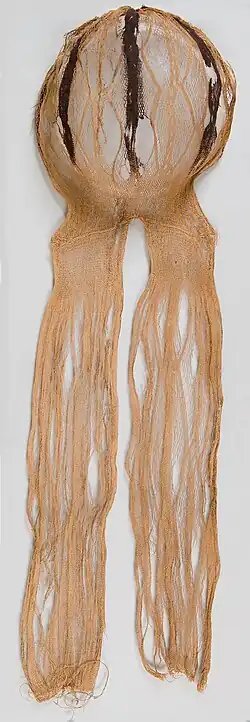
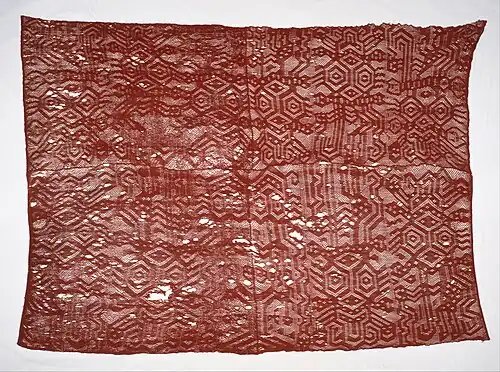
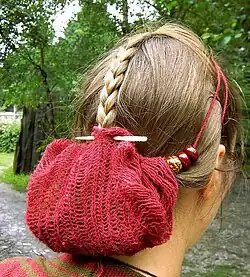
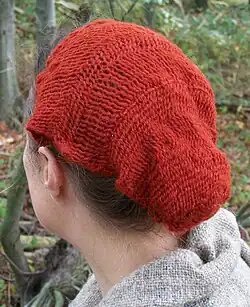
Sprang Headdress from the Head of a Mummy of a Child (MET, 90.5.33)Mantle, Peru, Ocucaje (MET, 1986.488.1)Reconstruction of a Saxon sprang hairnet
Sprang is an ancient method of constructing fabric that has a natural elasticity. Its appearance is similar to netting, but unlike netting, sprang is constructed entirely from warp threads. Archaeological evidence indicates that sprang predates knitting; the two needlework forms bear a visible resemblance and serve similar functions but require different production techniques.
Although examples of sprang have been unearthed from as early as the Bronze Age, sprang was almost entirely undocumented in written records until the late nineteenth century when archaeological finds generated interest in Europe. Museum examples of sprang had been misidentified as knitting or lace until discoveries of ancient examples prompted reexamination of newer pieces. Subsequently, sprang has been identified in a variety of cultures and traditions across several continents. Its practice as a folk art waned during the twentieth century and sprang traditions have disappeared in most locales. Knitting has largely supplanted sprang.
Technique
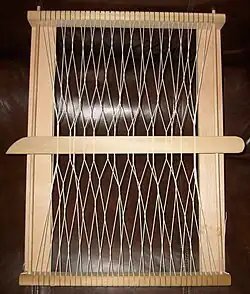
In principle, sprang may be regarded as a practical application of the fiber manipulation techniques used in the children’s game known as cat’s cradle.[1] Sprang is made by preparing a set of warp threads either on a rectangular frame or between a pair of beams. The crafter then generates a fabric by interlinking the warp threads. Unlike most textile production techniques that add new rows at the end of completed rows, sprang works upon the center of a group of fibers and the material grows inward from both ends with symmetrical top and bottom halves. The crafter must maintain control of the center area or the structure unravels: most sprang worked upon has too many fibers to keep in hand, so rods or sticks maintain the appropriate fiber positions. The fiber manipulation itself is done by the crafter’s fingers. Decorative patterns may be generated by regular variations in the fiber crossings. As crossings accumulate the crafter beats the material flat with a stick.[2][3] Work continues with the material growing from both edges toward the middle until the center band becomes too tight to continue work.[4] The completed fabric is either separated into two identical items or permanently secured at the middle to stabilize the contrary twists.[3] In traditions where two halves of sprang are not severed by cutting, this center seam is a telltale sign of sprang manufacture.[3]
History and uses
While the word sprang is of Swedish origin, the technique has been practiced by many cultures around the world.[3][5] The earliest surviving example of sprang is a hair net, c.1400 BC, that was recovered from a bog in Denmark.[2] Most archaeological finds of sprang fabric come from the later classical era and the start of the Early Medieval period: locations include Norway (third to fifth centuries AD), Switzerland, Egypt (possibly twenty-second dynasty, also early Coptic), and various Roman sites. Use of sprang has also been conjectured from archaeological recoveries of ancient looms and from depictions in period artwork.[1]
Reconstruction of an Iron Age sprang hairnet from Denmark
Sprang is also an indigenous needlework technique among the peoples of South America, with the earliest known examples dating from before 900AD among the Paracas culture and Nazca culture in present-day Peru.[6] Recreation of archeological discoveries continue to inform about the presence and range of sprang in the Americas.[7] Sprang has also been noted in the Middle East, Central Asia, the Indian subcontinent, and North America. Indigenous North American sprang includes woolen scarves by the Ho-Chunk of Wisconsin, and Hopi wedding sashes.[5]
The natural elasticity of sprang makes it suitable for stockings, hair nets, sleeves, bags, scarves, and other purposes where pliant material is required.[1][5] Most sprang needlework is utilitarian and hence was overlooked by scholars until late in its history, according to needlework historian Catherine Amoroso Leslie:[5]
In fact, it was not until the nineteenth century and the discovery of sprang at archaeological sites that it was recognized as a separate and distinct form of needlework. Many museum objects that were wrongly classified as knitting or lace have now been correctly identified as sprang.
Following nearly simultaneous archaeological finds in Denmark and Egypt during the 1870s, an example of Coptic sprang brought to Austria in 1882 inspired the management of a factory near Vienna to manufacture sprang hammocks. The Paris World’s Fair of 1889 included an exhibit that duplicated ancient sprang, which led to renewed interest in the technique. Traditionally, cultures that practiced sprang had not produced written records of its manufacture or use. Shortly after the Paris exhibition, living traditions of sprang began to be documented. During the 1890s Ukrainian villagers were identified as practicing sprang in the manufacture of women’s caps. Soon afterward, local sprang production for various garments was also documented in parts of Eastern Europe and in Denmark. Local European traditions generally endured until the mid-twentieth century.[5] Sprang is, however, largely a historical technique that has been supplanted for most purposes by the later invention of knitting, whose earliest known example dates from the third century AD.[1]
During the late eighteenth and early nineteenth centuries a military fashion of decorative sprang sashes in silk known as faja in Spain gained international popularity among generals as a distinguishing ornament of rank. The fashion spread to northern Europe and to North America. George Washington wore a sash made of red silk sprang around the year 1779.[5]
Contemporary sprang
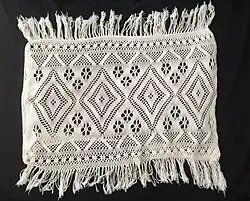
A demonstration of sprang manufacture using a loomSprang pillow case, 20th century
In a study of folk textiles of the Peloponnese in Greece, Linda Welters identifies the zonari as a long fringed belt constructed of sprang. The zonari is a rounded material of indeterminate length around 2 or 3 meters long and is wrapped multiple times when worn. From interviews conducted during the 1980s, Welters found that the technique was practiced by elderly women and regarded as a specialized skill which they worked on pairs of beams. Their vocabulary had no special term to correspond with sprang, so they referred to it with descriptive phrases such as knitting with sticks, plaiting, and weaving without passing through. The zonaria are made from sheep’s wool hand spun with a spindle and dyed red, blue, or black depending on local custom. Zonaria are a custom in much of Argolida and Corinthia where they are traditional dowry items worn by women from marriage onward and associated with fertility and donned on ritual occasions. Welters observes that these were mostly owned by older women who still wore folk clothing.[3]
The sprang technique also survives as a traditional method for making hammocks in Guatemala, Mexico, and Colombia, and also in Colombia for making a shopping bag known as mechita. The work in these locations is generally performed on a backstrap loom. Handmade Mesoamerican sprang hammocks continue to be produced for export to a variety of international markets.[2][5]
Additionally, sprang remains in use for making silk trouser drawstrings for male and female attire in Punjab in India and Pakistan. There, village women still use the technique to create colourful check/stipped/zigzag designs that have been handed down the generations. They finish the ends of the work using a weaving technique to make a hard 2-inch ‘harar’ with bunched twisted threads and knots. These sprang drawstrings are also used for the ‘ghugrai’ (full long skirts worn traditionally by Punjabi women) – it has been fashionable at times to have the drawstring ends on show, hanging with the ‘harar’ having colourful pom-poms or jewellery added on.
The sprang technique is also used to make the black ‘doria’ traditionally braided into women’s hair; they also have a colourful ‘harar’ ending fixed at the end. These can be found on sale in Punjab even now. Hairnets, baby cradles, and hanging baskets for fruit were also made. In attempts to retain traditional Punjabi culture, there are cultural craft centres in and around Jullunder where sprang technique is one of several old textile arts being passed on to young craftspeople.
Contemporary art textiles sometimes employ sprang in wall hangings.[2]
In the 1970s new texts and research prompted makers to explore the craft.[8] Interest in demonstrating and replicating sprang pieces[9] has led to several books that revive the knowledge and expertise. Peter Collingwood’s Techniques of Sprang: Plaiting on Stretched Threads[10] has provided foundational information that has influenced subsequent texts[11].
↑Skowronski, Hella; Reddy, Mary (1974). Sprang; thread twisting: a creative textile technique. New York: Van Nostrand Reinhold Co. ISBN978-0-442-27642-3.
This article is adapted from “Sprang” on Wikipedia, written by its contributors, and used under CC BY-SA 4.0. Text on this page is available under the same licence. Source snapshot: Wikipedia via Kiwix, 2026-07-20.
In the mathematical field of knot theory, a split link is a link that has a (topological) 2-sphere in its complement separating one or more link components from the others.[1] A split link is said to be splittable, and a link that is not split is called a non-split link or not splittable. Whether a link is split or non-split corresponds to whether the link complement is reducible or irreducible as a 3-manifold.
A link with an alternating diagram, i.e. an alternating link, will be non-split if and only if this diagram is connected. This is a result of the work of William Menasco.[2] A split link has many connected, non-alternating link diagrams.
References
↑Cromwell, Peter R. (2004), Knots and Links, Cambridge University Press, Definition 4.1.1, p.78, ISBN9780521548311.
↑Lickorish, W. B. Raymond (1997), An Introduction to Knot Theory, Graduate Texts in Mathematics, vol.175, Springer, p.32, ISBN9780387982540.
This article is adapted from “Split link” on Wikipedia, written by its contributors, and used under CC BY-SA 4.0. Text on this page is available under the same licence. Source snapshot: Wikipedia via Kiwix, 2026-07-20.
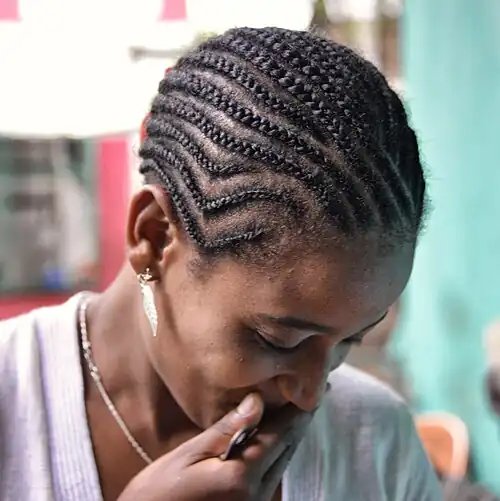
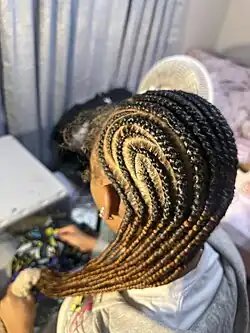
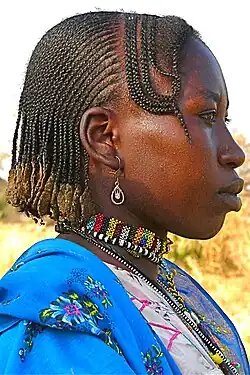
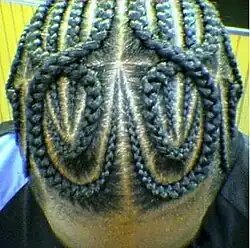
Cornrows (also called canerows in the Caribbean) are a style of three-strand braids in which the hair is braided very close to the scalp, using an underhand, upward motion to make a continuous, raised row.[1][2] Cornrows are often done in simple, straight lines, as the term implies, but they can also be styled in elaborate geometric or curvilinear designs. They are considered a traditional hairstyle of African braiding practice in many African cultures, as well as in the African diaspora.[3][4][5] They are distinct from, but may resemble, box braids, Dutch braids, melon coiffures, and other forms of plaited hair, and are typically tighter than braids used in other cultures.[6]
The name cornrows or canerows refers to the layout of crops in corn and sugarcane fields in the Americas and Caribbean,[1][7][2] where enslaved Africans were displaced during the Atlantic slave trade.[8] According to Black folklore, cornrows were often used to communicate on the Underground Railroad and by Benkos Biohó during his time as a slave in Colombia.[9] They often serve as a form of Black self-expression,[10] especially among African Americans,[1] but have been stigmatized in some cultures.[5][11] Cornrows are traditionally called “kolese” or “irun didi” in Yoruba, and are often nicknamed “didi braids” in the Nigerian diaspora.[12]
Cornrows are worn by both sexes, and are sometimes adorned with beads, shells, or hair cuffs.[1] The duration of braiding cornrows may take up to five hours, depending on the quantity and width.[13] Often favored for their easy maintenance, cornrows can be left in for weeks at a time if maintained through careful washing of the hair and natural oiling of the scalp. Braids are considered a protective styling on African curly hair as they allow for easy and restorative growth; braids pulled too tightly or worn for longer lengths of time and on different hair types can cause a type of hair loss known as traction alopecia.[14]
History
Africa
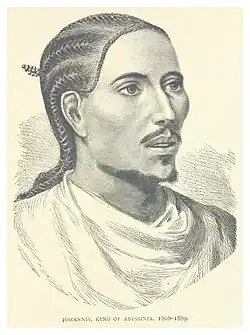
Portrait of Emperor Yohannes IV wearing traditional Ethiopian braids.
Cornrows originated in Africa,[1] where they likely developed in response to the unique textures of African hair,[15][16] and have held significance for different cultures throughout recorded history.[17][18][19] Early depictions of women with what appear to be cornrows have been found in Stone Age paintings in the Tassili Plateau of the Sahara, and have been dated as far back as 3000 B.C. A similar style is also seen in depictions of the ancient Cushitic people of the Horn of Africa, who appear to be wearing this style of braids as far back as 2000 B.C.[20] In Nubia, the remains of a young girl wearing cornrows has been dated to 550–750 A.D.[21] Cornrows have also been documented in the ancient Nok civilization in Nigeria,[22] in the Mende culture of Sierra Leone,[23] and the Dan culture of the Côte d’Ivoire.[17]
Women in West Africa have been attested wearing complex hairstyles of threaded or wrapped braids since at least the 18th century. These practices likely influenced the use of cornrows and headwraps (such as durags) among enslaved Africans taken to the Americas.[16] In Ethiopia and Eritrea, there are many braided hairstyles which may include cornrows or “shuruba”, such as Habesha or Albaso braids, and Tigray shuriba.[24][25] Though such hairstyles have always been popular with women, Ethiopian men have also worn such hairstyles. In 19th century Ethiopia, male warriors and kings such as Tewodros II and Yohannes IV were depicted wearing braided hairstyles, including the shuruba.[26][27][28]
Cornrow hairstyles in Africa also cover a wide social terrain: religion, kinship, status, age, racial diversity, and other attributes of identity can all be expressed in hairstyle. Just as important is the act of braiding, which passes on cultural values between generations, expresses bonds between friends, and establishes the role of professional practitioner.[22][15] Braiding is traditionally a social ritual in many African cultures—as is hairstyling in general—and is often performed communally, as White and White explain:
In African cultures, the grooming and styling of hair have long been important social rituals. Elaborate hair designs, reflecting tribal affiliation, status, sex, age, occupation, and the like, were common, and the cutting, shaving, wrapping, and braiding of hair were centuries-old arts. In part, it was the texture of African hair that allowed these cultural practices to develop; as the historian John Thornton has observed, “the tightly spiraled hair of Africans makes it possible to design and shape it in many ways impossible for the straighter hair of Europeans.”[15]
Europe
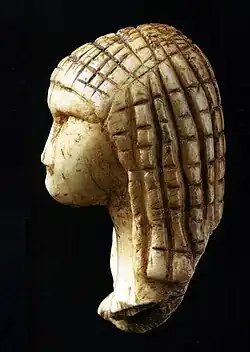
The Venus of Brassempouy is often thought to be wearing a wig or patterned hood, but not cornrows.
Small Herculaneum woman (c.2nd century) with melon coiffure, which has been described as similar to modern cornrows
There have been a number of examples of European art and sculpture described as similar to modern cornrows,[29] such as plaits, the melon coiffure and sini crenes.[30][31][32]
The oldest of these depictions are the statues known as the Venus of Brassempouy[29][33] and the Venus of Willendorf,[31][34][35] which date between 23,000 and 29,000 years ago[36] and were found in modern day France and Austria. Whether these statues feature cornrows, another type of braids, headdresses, or some other styling has been a matter of vigorous debate — most historians rule out cornrows, however.[29][31][37] The Venus of Brassempouy is often said to wear a wig or a patterned hood,[37] while the Venus of Willendorf is said to be wearing plaited hair or a fibrous cap.[31]
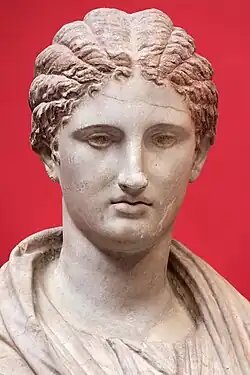
Since the early 5th century B.C., Ancient Greek and Roman art shows men and women with a characteristic melon coiffure, especially in the “Oriental Aphrodite” tradition, which may be confused with cornrows.[38][39][32] The traditional hairstyle of Roman Vestal Virgins, the sini crenes, also incorporates two braids that resemble cornrows.[40][41][30]
Americas
The first recorded use of the word “cornrow” was in America in 1769, referring to the corn fields of the Americas. The earliest recorded use of the term “cornrows” to refer a hairstyle was in 1902.[a][1] The name “canerows” may be more common in parts of the Caribbean due to the historic role of sugar plantations in the region.[7]
As in Africa, grooming was a social activity for Black people on the American plantations; the enslaved Africans were reported helping each other style their hair into a wide variety of appearances. On his visit to a plantation in Natchez, Mississippi, New Englander Joseph lngraham wrote, “No scene can be livelier or more interesting to a Northerner, than that which the negro quarters of a well regulated plantation present, on a Sabbath morning, just before church hour.”[42] Hairstyles were so characteristic of a person, even when their appearance and behaviour was otherwise heavily regulated, that they were often used to identify runaways, and enslaved Africans sometimes had their hair shaved as a form of punishment. Generally, however, slaveholders in the British colonies gave their Black slaves a degree of latitude in how they wore their hair.[15] Thus, wearing traditional hairstyles offered a way to assert their bodily autonomy when they otherwise had none.[43]
Enslaved Black people may have chosen to wear cornrows to keep their hair neat and flat to their scalp while working; the other styles they developed alongside cornrows blended African, European and Native American trends and traditions.[44] African-American, Afro-Latino and Caribbean folklore also relates multiple stories of cornrows being used to communicate or provide maps for slaves across the “New World”.[9][45] Today, such styles retain their link with Black self-expression and creativity, and may also serve as a form of political expression.[10][46][47]
Cornrows gained in popularity in the United States in the 1960s and 1970s, and again during the 1990s and 2000s. In the 2000s, some athletes wore cornrows, including NBA basketball players Allen Iverson, Rasheed Wallace, and Latrell Sprewell.[48] Some female mixed martial artists have chosen to wear cornrows for their fights as it prevents their hair from obscuring their vision as they move.[49][50][51]
Attitudes to cornrows
A Nuba woman wearing cornrows in a traditional styling
Colonial attitudes and practices towards Black hairstyles reinforced racism, exclusion and inequality.[52] For example, during the 18th century, slaves would sometimes have their hair shaved as a lesser form of punishment.[15] Eurocentric beauty standards, which often denigrate Black hairstyles, can lead to internalized racism, colorism, and marginalization, which negatively affect Black people—and Black women in particular.[47][53][54] Related valuations of hair texture—which portray straighter hair as “good hair” and curlier hair as “bad hair”—are emphasized through the media, advertising, and popular culture.[53][55] These attitudes to hair can devalue African heritage and lead to discrimination.[53][56] The unique type of discrimination that arises from prejudice towards Black women’s hair is called natural hair discrimination.[57][58][59] Despite these challenges, cornrows have gained popularity among Black people as a way to express their Blackness, creativity and individuality.[52][53][60]
Cornrows, alongside dreadlocks, have been the subject of several disputes in U.S. workplaces, as well as universities and schools. Some employers and educational institutions[60] have considered cornrows unsuitable or “unprofessional”, and have banned them.[48] Employees and civil rights groups have countered that such attitudes evidence cultural bias or racism, and some disputes have resulted in litigation.[52][61] In 1981, Renee Rogers sued American Airlines for their policy which banned cornrows and other braided hairstyles. Other cases, such as Mitchell vs Marriott Hotel and Pitts vs. Wild Adventures, soon followed.[62] Since other traditional Black hairstyles are also often banned, Black women may be forced to straighten their hair or emulate European hairstyles at significant additional cost.[56] The intersection of racialized and gendered discrimination against Black women is often called misogynoir.[63] In California, the CROWN Act was passed in 2019 to prohibit discrimination based on hair style and hair texture.[64]
In 2011, the High Court of the United Kingdom, in a decision reported as a test case, ruled against a school’s decision to refuse entry to a student with cornrows. The school claimed this was part of its policy mandating “short back and sides” haircuts, and banning styles that might be worn as indicators of gang membership. However, the court ruled that the student was expressing a tradition and that such policies, while possibly justifiable in certain cases (e.g. skinhead gangs), had to accommodate reasonable racial diversities and cultural practices.[65]
In some African nations, regularly changing hairstyles can be seen as a sign of social status for a woman, while advertising continues to promote straighter hairstyles as fashionable. Braids provide a way for women to maintain their hair, and are sometimes used with Chinese or Indian wigs to rotate hairstyles.[55]
↑“Alice hunted up faithful old nurse Calline at once, sure of overflowing black motherly sympathy. She found her perched on the railing of the back gallery, combing her hair in long ‘corn-rows’.” Century Magazine, October 1902, 966/1.
↑Quampah, B., Owusu, E., Adu, V. N. F. A., Agyemang Opoku, N., Akyeremfo, S., & Ahiabor, A. J. (2023). “Cornrow: a medium for communicating escape strategies during the transatlantic slave trade era: evidences from Elmina Castle and Centre for National Culture in Kumasi”. International Journal of Social Sciences: Current and Future Research Trends (IJSSCFRT), 18:1. pp. 127-143.
↑Spellers, R. E. (2000). Cornrows in corporate America: Black female hair/body politics and socialization experiences in dominant culture workplace organizations. Arizona State University. p.iii.
↑Willie F. Page, ed. (2001). Encyclopedia of African history and culture: Ancient Africa (prehistory to 500 CE), Volume 1. Facts on File. p.36. ISBN978-0816044726.
↑DeLongoria, M. (2018). Misogynoir:* Black Hair, Identity Politics, and Multiple Black Realities. Africology: The Journal of Pan African Studies, 12(8), 39-49 (40).
1234“Woman from Willendorf”Archived 2007-10-05 at the Wayback Machine. Christopher L. C. E. Witcombe, 2003: “The rows are not one continuous spiral but are, in fact, composed in seven concentric horizontal bands that encircle the head and two more horizontal bands underneath the first seven on the back of the head.”
↑Shaw Nevins, Andrea (2006). The embodiment of disobedience: fat black women’s unruly political bodies. Lanham, MD. ISBN978-0-7391-5457-1. OCLC856869915.{{cite book}}: CS1 maint: location missing publisher (link)
↑Shell, Ellen Ruppel (2003). The hungry gene: the inside story of the obesity industry (1st Grove Pressed.). New York: Grove Press. ISBN0-8021-4033-5. OCLC53434322.
↑León, Vicki (2013). Working IX to V: orgy planners, funeral clowns, and other prized professions of the ancient world. New York. p.18. ISBN978-0-8027-1862-4. OCLC879285569.{{cite book}}: CS1 maint: location missing publisher (link)
↑Alison Dundes Renteln (2005). The Cultural Defense. Oxford University Press. p.143. ISBN9780195154030. Retrieved 10 August 2011.
↑DeLongoria, M. (2018). Misogynoir:* Black Hair, Identity Politics, and Multiple Black Realities. Africology: The Journal of Pan African Studies, 12(8), 39-49 (45).
The dictionary definition of cornrows at Wiktionary
This article is adapted from “Cornrows” on Wikipedia, written by its contributors, and used under CC BY-SA 4.0. Text on this page is available under the same licence. Source snapshot: Wikipedia via Kiwix, 2026-07-20.
In mathematics, the spherical braid group or Hurwitz braid group is a braid group on n strands. In comparison with the usual braid group, it has an additional group relation that comes from the strands being on the sphere. The group also has relations to the inverse Galois problem.[1]
Definition
The spherical braid group on n strands, denoted or , is defined as the fundamental group of the configuration space of the sphere:[2][3]
The spherical braid group has a presentation in terms of generators with the following relations:[4]
for
for (the Yang–Baxter equation)
The last relation distinguishes the group from the usual braid group.
References
↑Ihara, Yasutaka (2007), “Automorphisms of Pure Sphere Braid Groups and Galois Representations”, in Cartier, Pierre; Katz, Nicholas M.; Manin, Yuri I.; Illusie, Luc (eds.), The Grothendieck Festschrift: A Collection of Articles Written in Honor of the 60th Birthday of Alexander Grothendieck, Modern Birkhäuser Classics, Boston, MA: Birkhäuser, pp.353–373, doi:10.1007/978-0-8176-4575-5_8, ISBN978-0-8176-4575-5, retrieved 2023-11-24
This article is adapted from “Spherical braid group” on Wikipedia, written by its contributors, and used under CC BY-SA 4.0. Text on this page is available under the same licence. Source snapshot: Wikipedia via Kiwix, 2026-07-20.
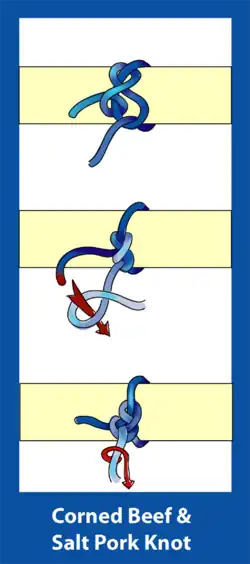
The corned beef knot is a binding knot usually made in small line or string. It gains its name by often being used for binding the meat of the same name while it is being cooked. Since corned beef shrinks during cooking, the knot needs to be tightened several times during the process.
Tying
A buntline hitch is tied to the standing part and moderately tightened. The binding itself is tightened as the meat cooks by sliding the buntline hitch on the standing part. The knot is finished by a half hitch around the working end only after the meat has fully shrunk. It is considered more secure and suitable for this task than the related packer’s knot.[1]
This article is adapted from “Corned beef knot” on Wikipedia, written by its contributors, and used under CC BY-SA 4.0. Text on this page is available under the same licence. Source snapshot: Wikipedia via Kiwix, 2026-07-20.
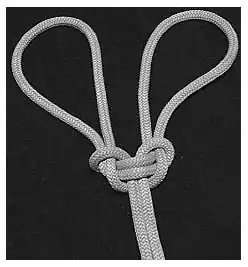
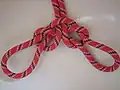
The Spanish bowline[1] is a double loop knot that can be used to lift a person. For a conscious person, each loop is placed around a leg and the person holds onto the standing part of the rope. This knot can serve as a makeshift Bosun’s chair. For an unconscious person one loop is placed around the arm pits and the second loop is placed around the knees.
This knot has an elegant symmetry and can be tied quickly when mastered. Unlike the Portuguese bowline, each loop is separately fixed, which is a nice feature. It is a complicated knot however and if not properly tightened, it can slip. A fireman’s chair knot is another double loop knot which is more practical, easier to tie and less prone to slipping although it lacks the elegance of a Spanish bowline.
This article is adapted from “Spanish bowline” on Wikipedia, written by its contributors, and used under CC BY-SA 4.0. Text on this page is available under the same licence. Source snapshot: Wikipedia via Kiwix, 2026-07-20.
A Conway sphere (black dotted midline) for the Borromean rings
In mathematical knot theory, a Conway sphere, named after John Horton Conway, is a 2-sphere intersecting a given knot or link in a 3-manifold transversely in four points. In a knot diagram, a Conway sphere can be represented by a simple closed curve crossing four points of the knot, the cross-section of the sphere; such a curve does not always exist for an arbitrary knot diagram of a knot with a Conway sphere, but it is always possible to choose a diagram for the knot in which the sphere can be depicted in this way.
A Conway sphere is essential if it is incompressible in the knot complement.[1] Sometimes, this condition is included in the definition of Conway spheres.[2]
References
↑Gordon, Cameron McA.; Luecke, John (2006). “Knots with unknotting number 1 and essential Conway spheres”. Algebraic & Geometric Topology. 6 (5): 2051–2116. arXiv:math/0601265. Bibcode:2006math……1265M. doi:10.2140/agt.2006.6.2051.
↑Lickorish, W. B. Raymond (1997), An introduction to knot theory, Graduate Texts in Mathematics, vol.175, Berlin, New York: Springer-Verlag, ISBN978-0-387-98254-0, MR1472978
This article is adapted from “Conway sphere” on Wikipedia, written by its contributors, and used under CC BY-SA 4.0. Text on this page is available under the same licence. Source snapshot: Wikipedia via Kiwix, 2026-07-20.
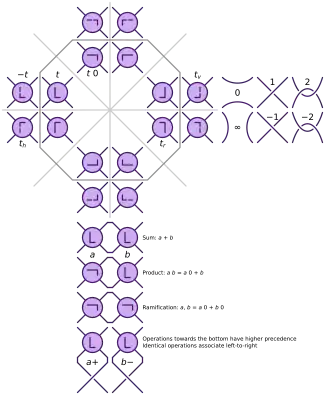
The full set of fundamental transformations and operations on 2-tangles, alongside the elementary tangles 0, ∞, ±1 and ±2.The trefoil knot has Conway notation [3].
In knot theory, Conway notation, invented by John Horton Conway, is a way of describing knots that makes many of their properties clear. It composes a knot using certain operations on tangles to construct it.
Basic concepts
Tangles
In Conway notation, the tangles are generally algebraic 2-tangles. This means their tangle diagrams consist of 2 arcs and 4 points on the edge of the diagram; furthermore, they are built up from rational tangles using the Conway operations.
[The following seems to be attempting to describe only integer or 1/n rational tangles]
Tangles consisting only of positive crossings are denoted by the number of crossings, or if there are only negative crossings it is denoted by a negative number. If the arcs are not crossed, or can be transformed into an uncrossed position with the Reidemeister moves, it is called the 0 or ∞ tangle, depending on the orientation of the tangle.
Operations on tangles
If a tangle, a, is reflected on the NW-SE line, it is denoted by −a. (Note that this is different from a tangle with a negative number of crossings.)Tangles have three binary operations, sum, product, and ramification,[1] however all can be explained using tangle addition and negation. The tangle product, a b, is equivalent to −a+b. and ramification or a,b, is equivalent to −a+−b.
Advanced concepts
Rational tangles are equivalent if and only if their fractions are equal. An accessible proof of this fact is given in (Kauffman and Lambropoulou 2004). A number before an asterisk, *, denotes the polyhedron number; multiple asterisks indicate that multiple polyhedra of that number exist.[2]
Kauffman, Louis H.; Lambropoulou, Sofia (2004). “On the classification of rational tangles”. Advances in Applied Mathematics. 33 (2): 199–237. arXiv:math/0311499. doi:10.1016/j.aam.2003.06.002. S2CID119143716.
This article is adapted from “Conway notation (knot theory)” on Wikipedia, written by its contributors, and used under CC BY-SA 4.0. Text on this page is available under the same licence. Source snapshot: Wikipedia via Kiwix, 2026-07-20.