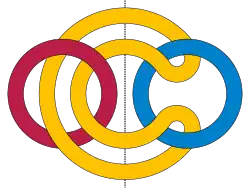
In mathematical knot theory, a Conway sphere, named after John Horton Conway, is a 2-sphere intersecting a given knot or link in a 3-manifold transversely in four points. In a knot diagram, a Conway sphere can be represented by a simple closed curve crossing four points of the knot, the cross-section of the sphere; such a curve does not always exist for an arbitrary knot diagram of a knot with a Conway sphere, but it is always possible to choose a diagram for the knot in which the sphere can be depicted in this way.
A Conway sphere is essential if it is incompressible in the knot complement.[1] Sometimes, this condition is included in the definition of Conway spheres.[2]
References
- ↑ Gordon, Cameron McA.; Luecke, John (2006). “Knots with unknotting number 1 and essential Conway spheres”. Algebraic & Geometric Topology. 6 (5): 2051–2116. arXiv:math/0601265. Bibcode:2006math……1265M. doi:10.2140/agt.2006.6.2051.
- ↑ Lickorish, W. B. Raymond (1997), An introduction to knot theory, Graduate Texts in Mathematics, vol. 175, Berlin, New York: Springer-Verlag, ISBN 978-0-387-98254-0, MR 1472978
This article is adapted from “Conway sphere” on Wikipedia, written by its contributors, and used under CC BY-SA 4.0. Text on this page is available under the same licence. Source snapshot: Wikipedia via Kiwix, 2026-07-20.