| 71 knot | |
|---|---|
 |
|
| Arf invariant | 0 |
| Braid length | 7 |
| Braid no. | 2 |
| Bridge no. | 2 |
| Crosscap no. | 1 |
| Crossing no. | 7 |
| Genus | 3 |
| Hyperbolic volume | 0 |
| Stick no. | 9 |
| Unknotting no. | 3 |
| Conway notation | [7] |
| A–B notation | 71 |
| Dowker notation | 8, 10, 12, 14, 2, 4, 6 |
| Last / Next | 63 / 72 |
| Other | |
| alternating, torus, fibered, prime, reversible | |
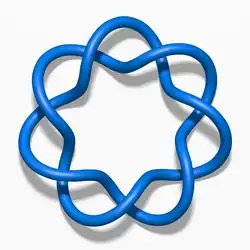
In knot theory, the 71 knot, also known as the septoil knot, the septafoil knot, or the (7, 2)-torus knot, is one of seven prime knots with crossing number seven. It is the simplest torus knot after the trefoil and cinquefoil. This knot is used to construct the simplest counterexample to the conjecture that the unknotting number is additive under connected sum.[1][2]
Properties
The 71 knot is invertible but not amphichiral. Its Alexander polynomial is

its Conway polynomial is

and its Jones polynomial is

Example
See also
- Heptagram
References
- ↑ Brittenham, Mark; Hermiller, Susan (2025). “Unknotting number is not additive under connected sum”. arXiv:2506.24088 [math.GT].
- ↑ Sloman, Leila (2025-09-22). “A Simple Way To Measure Knots Has Come Unraveled”. Quanta Magazine. Retrieved 2025-09-22.
- ↑ “7_1“, The Knot Atlas.
This article is adapted from “71 knot” on Wikipedia, written by its contributors, and used under CC BY-SA 4.0. Text on this page is available under the same licence. Source snapshot: Wikipedia via Kiwix, 2026-07-20.