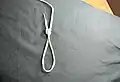
| Trident loop | |
|---|---|
 |
|
| Category | Loop |
| Related | Ashley’s bend, Figure-eight knot, Zeppelin loop |
| Typical use | Forming fixed loop in end of a line |
The trident loop is a fixed loop knot which can jam when heavily loaded. It was proposed as a replacement for the figure-of-eight loop for use in climbing by Robert M. Wolfe, MD, who developed it as a loop form of Ashley’s bend. While some tests indicate its strength lies somewhere between the weaker Bowline and stronger figure-of-eight loop, the trident loop shows exceptional resistance to slipping in shock-loading tests.[1]
Tying
-
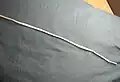 1. Start with a rope end.
 -
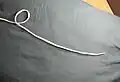 2. Start an overhand knot, leaving enough rope for the loop and the rest of the knot.
 -
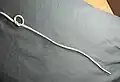 3. Complete the overhand knot.
 -
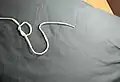 4. Form the loop by wrapping the working end around, and then form a bight in the working end.
 -
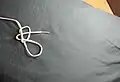 5. Feed the bight through the overhand knot.
 -
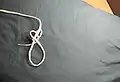 6. Wrap the remaining working end around the back of the knot.
 -
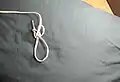 7. Feed the working end up through the bight.
 -
8. Tighten. This is the completed loop.
See also
References
- ↑ Geoffrey Budworth, The Complete Book of Knots (London: Octopus, 1997), 94.
This article is adapted from “Trident loop” on Wikipedia, written by its contributors, and used under CC BY-SA 4.0. Text on this page is available under the same licence. Source snapshot: Wikipedia via Kiwix, 2026-07-20.