In knot theory, the Milnor conjecture says that the slice genus of the  torus knot is
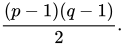
It is in a similar vein to the Thom conjecture.
The conjecture (named after John Milnor) was first proved by gauge theoretic methods by Peter Kronheimer and Tomasz Mrowka.[1] Jacob Rasmussen later gave a purely combinatorial proof using Khovanov homology, by means of the s-invariant.[2]
References
- ↑ Kronheimer, Peter B.; Mrowka, Tomasz S. (1993), “Gauge theory for embedded surfaces, I” (PDF), Topology, 32 (4): 773–826, doi:10.1016/0040-9383(93)90051-V.
- ↑ Rasmussen, Jacob A. (2010). “Khovanov homology and the slice genus”. Inventiones Mathematicae. 182 (2): 419–447. arXiv:math.GT/0402131. doi:10.1007/s00222-010-0275-6.
This article is adapted from “Milnor conjecture (knot theory)” on Wikipedia, written by its contributors, and used under CC BY-SA 4.0. Text on this page is available under the same licence. Source snapshot: Wikipedia via Kiwix, 2026-07-20.