In topology, a branch of mathematics, and specifically knot theory, the lamp cord trick is an observation that two certain spaces are homeomorphic, even if one of the components is knotted. The spaces are 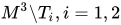 , where
  is a hollow ball homeomorphic to
 ![{\displaystyle S^{2}\times [0,1]}](/wp-content/uploads/wiki-images/884268cee963781da7840b3ea3d36a0cdf06b935-fd35eea3.svg) and
and  a tube connecting the boundary components of . The name comes from R. H. Bing’s book “The Geometric Topology of 3-manifolds”.[1]
References
- ↑ Bing, R. H. (31 December 1983). The Geometric Topology of 3-manifolds. ISBN 9780821810408.
- Lucien Grillet, La Conjecture de Smith en faible régularité.
This article is adapted from “Lamp cord trick” on Wikipedia, written by its contributors, and used under CC BY-SA 4.0. Text on this page is available under the same licence. Source snapshot: Wikipedia via Kiwix, 2026-07-20.