| Kinoshita–Terasaka knot | |
|---|---|
| Crossing no. | 11 |
| Genus | 2 |
| Hyperbolic volume | 11.2191 |
| Thistlethwaite | 11n42 |
| Other | |
| prime, prime, slice | |
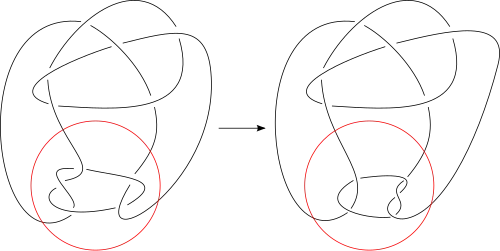
In knot theory, the Kinoshita–Terasaka knot is a particular prime knot with 11 crossings.[1] It is named after Japanese mathematicians Shinichi Kinoshita and Hidetaka Terasaka, who wrote about it in 1957.[2] The Kinoshita–Terasaka knot has a variety of interesting mathematical properties.[3] It is related by mutation to the Conway knot,[4] with which it shares a Jones polynomial. It has the same Alexander polynomial as the unknot.[5]
References
- ↑ Weisstein, Eric W. “Conway’s Knot”. mathworld.wolfram.com. Retrieved 2020-05-19.
- ↑ Kinoshita, S.; Terasaka, H. (1957). “On Unions of Knots”. Osaka Math J. 9: 131–153.
- ↑ Tillmann, Stephan (June 2000). “On the Kinoshita-Terasaka knot and generalised Conway mutation” (PDF). Journal of Knot Theory and Its Ramifications. 09 (4): 557–575. doi:10.1142/S0218216500000311. ISSN 0218-2165.
- ↑ Chmutov, S.V. (2007). “Mutant Knots” (PDF). people.math.osu.edu. Archived from the original (PDF) on 2020-06-12.
- ↑ Boi, Luciano (2 November 2005). Geometries of Nature, Living Systems and Human Cognition: New Interactions of Mathematics with Natural Sciences and Humanities. ISBN 9789814479455.
External links
This article is adapted from “Kinoshita–Terasaka knot” on Wikipedia, written by its contributors, and used under CC BY-SA 4.0. Text on this page is available under the same licence. Source snapshot: Wikipedia via Kiwix, 2026-07-20.