Blog

  • Double bowline

    Double bowline
    Double bowline
    Names Double bowline, round turn bowline, double-knotted bowline
    Category Loop
    Efficiency 70-75%
    Related Bowline, water bowline, double sheet bend, bowline on a bight
    Typical use climbing
    ABoK #1013

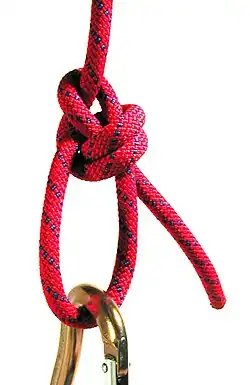
    A double bowline (or round turn bowline) is a type of loop knot. Instead of the single turn of the regular bowline, the double bowline uses a round turn. This forms a more secure loop than a standard bowline.[1]

    Naming

    Though called “double bowline” by Clifford Ashley, this name is also reasonably descriptive of a different knot: the bowline on a bight. Because of this ambiguity
    some sources differentiate by using one of the alternate names above. And at least one other source uses the name “double bowline” for a mid-line loop knot made by tying a basic bowline with a bight of rope instead of the end.[2]

    Tying

    First, learn to tie the bowline by laying the working end on the standing part and twisting to form a loop (the “hole” that the rabbit comes out of). Wrap the loop once more around the working end. Then pass the working end behind the standing part and back down through the double loop.

    Uses

    The double bowline is one of the typical tie-in knots used in climbing, along with the figure eight follow through[3][4] and the Yosemite bowline.[5] The advantage of the double bowline over the figure 8 is that it is easier to untie after being weighted in a fall,[3][4] and so is used by sport climbers who take multiple lead falls and then have trouble untying their figure eights.[3][4] The disadvantages of the double bowline are that it is less secure than a figure eight knot, takes longer to tie, and is not as easy to check.[3][4] Unlike the figure eight, there are many variations of the bowline, with ambiguous names, and some are not safe for climbing.[6][7][8][9]

    The bowline on a bight, when re-threaded instead of being tied on a bight, can also be used for tying into a climbing harness and provides more strength and security than the double bowline.

    See also

    References

    1. Ashley, Clifford W (1944). The Ashley Book of Knots. New York: Doubleday. p. 186. ISBN 978-0-385-04025-9. OCLC 156951323. {{cite book}}: ISBN / Date incompatibility (help)
    2. Cox, Steven M.; Fulsaas, Kris, eds. (2003). Mountaineering: The Freedom of the Hills (7th ed.). The Mountaineers Books. p. 119. ISBN 978-0-89886-827-2.
    3. 1 2 3 4 Luebben, Craig (2004). Rock Climbing: Mastering Basic Skills. Seattle, WA: Mountaineers Books. p. 301. ISBN 978-0-89886-743-5.
    4. 1 2 3 4 Green, Stewart M; Ian, Spencer-Green; Mark, Doolittle (2010). Knack Rock Climbing: A Beginner’s Guide: From the Gym to the Rocks. Guilford, Connecticut: Globe Pequot. p. 256. ISBN 978-1-59921-852-6.
    5. Kidd, Timothy W.; Hazelrigs, Jennifer (2009). Rock Climbing. Human Kinetics. pp. 136. ISBN 9781450409001. Retrieved 12 October 2014.
    6. Heise-Flecken, Detlef; Flecken, Gabi (2016-03-28). Rock Climbing: Technique | Equipment | Safety – With an Introduction to Indoor Climbing. Meyer & Meyer Verlag. p. 20. ISBN 9781782550358. double bowline is more complicated than the Figure Eight and partner checks are harder to verify. … single bowline is not safe while the double bowline is difficult to tie but is easier to undo after taking strain
    7. “Incident: Climber’s Bowline Came Untied While Climbing at Rifle”. Mountain Project. Retrieved 2018-07-14. there are many versions of the bowline, some of which are unsafe for climbing … Bowline on a Bight, Retraced Through Harness w/ Yosemite Finish … is the safest option
    8. Rock Climbing. Human Kinetics. 2009. ISBN 9781450409001. Because this knot unties so easily, sometimes even by simply rubbing against your body
    9. Tilton, Buck (2008-09-02). Knack Knots You Need: Step-by-Step instructions for More Than 100 of the Best Sailing, Fishing, Climbing, Camping and Decorative Knots. Rowman & Littlefield. ISBN 9781599217598. A knot that can be shaken loose to spill of its own accord, such as the bowline … is an insecure knot.

    External links


    This article is adapted from “Double bowline” on Wikipedia, written by its contributors, and used under CC BY-SA 4.0. Text on this page is available under the same licence. Source snapshot: Wikipedia via Kiwix, 2026-07-20.
  • Tangle (mathematics)

    Tangle (mathematics)
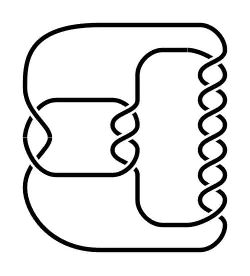
    The (−2,3,7) pretzel knot has two right-handed twists in its first tangle, three left-handed twists in its second, and seven left-handed twists in its third.

    In mathematics, a tangle is generally one of two related concepts:

    • In John Conway’s definition, an n-tangle is a proper embedding of the disjoint union of n arcs into a 3-ball; the embedding must send the endpoints of the arcs to 2n marked points on the ball’s boundary.
    • In link theory, a tangle is an embedding of n arcs and m circles into R 2 × [ 0 , 1 ] {\displaystyle \mathbf {R} ^{2}\times [0,1]} {\displaystyle \mathbf {R} ^{2}\times [0,1]} – the difference from the previous definition is that it includes circles as well as arcs, and partitions the boundary into two (isomorphic) pieces, which is algebraically more convenient – it allows one to add tangles by stacking them, for instance.

    A third, quite different use of tangle—this one graph theoretical—was introduced by Neil Robertson and Paul Seymour,[1] who use it to describe separation in graphs. This usage has been extended to matroids.

    The balance of this article discusses Conway’s sense of tangles; for the link theory sense, see that article.

    Two n-tangles are considered equivalent if there is an ambient isotopy of one tangle to the other keeping the boundary of the 3-ball fixed. Tangle theory can be considered analogous to knot theory except, instead of closed loops, strings whose ends are nailed down are used. See also braid theory.

    Tangle diagrams

    Without loss of generality, consider the marked points on the 3-ball boundary to lie on a great circle. The tangle can be arranged to be in general position with respect to the projection onto the flat disc bounded by the great circle. The projection then gives us a tangle diagram, where we make note of over and undercrossings as with knot diagrams.

    Tangles often show up as tangle diagrams in knot or link diagrams and can be used as building blocks for link diagrams, e.g. pretzel links.

    Rational and algebraic tangles

    Tangle (mathematics)
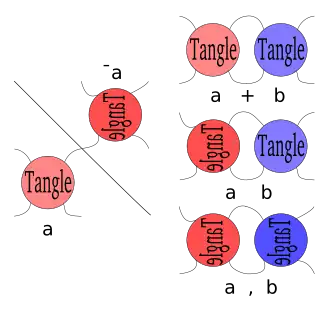
    Some operations on tangles:

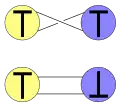
    Left: A tangle a and its reflection a. Top right: Tangle addition, denoted by a + b. Center right: Tangle product, denoted by a b, equivalent to a + b. Bottom right: Ramification, denoted by a , b, equivalent to a + b

    A rational tangle is a 2-tangle that is homeomorphic to the trivial 2-tangle by a map of pairs consisting of the 3-ball and two arcs. The four endpoints of the arcs on the boundary circle of a tangle diagram are usually referred as NE, NW, SW, SE, with the symbols referring to the compass directions.

    An arbitrary tangle diagram of a rational tangle may look very complicated, but there is always a diagram of a particular simple form: start with a tangle diagram consisting of two horizontal (vertical) arcs; add a “twist”, i.e. a single crossing by switching the NE and SE endpoints (SW and SE endpoints); continue by adding more twists using either the NE and SE endpoints or the SW and SE endpoints. One can suppose each twist does not change the diagram inside a disc containing previously created crossings.

    We can describe such a diagram by considering the numbers given by consecutive twists around the same set of endpoints, e.g. (2, 1, -3) means start with two horizontal arcs, then 2 twists using NE/SE endpoints, then 1 twist using SW/SE endpoints, and then 3 twists using NE/SE endpoints but twisting in the opposite direction from before. The list begins with 0 if you start with two vertical arcs. The diagram with two horizontal arcs is then (0), but we assign (0, 0) to the diagram with vertical arcs. A convention is needed to describe a “positive” or “negative” twist. Often, “rational tangle” refers to a list of numbers representing a simple diagram as described.

    The fraction of a rational tangle ( a 0 , a 1 , a 2 , ) {\displaystyle (a_{0},a_{1},a_{2},\dots )} {\displaystyle (a_{0},a_{1},a_{2},\dots )} is then defined as the number given by the continued fraction [ a n , a n 1 , a n 2 , ] {\displaystyle [a_{n},a_{n-1},a_{n-2},\dots ]} {\displaystyle [a_{n},a_{n-1},a_{n-2},\dots ]}. The fraction given by (0,0) is defined as {\displaystyle \infty } {\displaystyle \infty }. Conway proved that the fraction is well-defined and completely determines the rational tangle up to tangle equivalence.[2] An accessible proof of this fact is given in:.[3] Conway also defined a fraction of an arbitrary tangle by using the Alexander polynomial.

    Operations on tangles

    There is an “arithmetic” of tangles with addition, multiplication, and reciprocal operations. An algebraic tangle is obtained from the addition and multiplication of rational tangles.

    The numerator closure of a rational tangle is defined as the link obtained by joining the “north” endpoints together and the “south” endpoints also together. The denominator closure is defined similarly by grouping the “east” and “west” endpoints. Rational links are defined to be such closures of rational tangles.

    Conway notation

    One motivation for Conway’s study of tangles was to provide a notation for knots more systematic than the traditional enumeration found in tables.

    Applications

    Tangles have been shown to be useful in studying DNA topology. The action of a given enzyme can be analysed with the help of tangle theory.[4]

    See also

    • Tanglement puzzle

    References

    1. Robertson, Neil; Seymour, P.D. (Jul 1991). “Graph minors. X. Obstructions to tree-decomposition”. Journal of Combinatorial Theory, Series B. 52 (2): 153–190. doi:10.1016/0095-8956(91)90061-N.
    2. Conway, J. H. (1970). “An Enumeration of Knots and Links, and Some of Their Algebraic Properties” (PDF). In Leech, J. (ed.). Computational Problems in Abstract Algebra. Oxford, England: Pergamon Press. pp. 329–358.
    3. Kauffman, Louis H.; Lambropoulou, Sofia (12 Jan 2004). “On the classification of rational tangles”. Advances in Applied Mathematics. 33 (2): 199–237. arXiv:math/0311499. Bibcode:2003math…..11499K. doi:10.1016/j.aam.2003.06.002. S2CID 119143716.
    4. Ernst, C.; Sumners, D. W. (November 1990). “A calculus for rational tangles: applications to DNA recombination”. Mathematical Proceedings of the Cambridge Philosophical Society. 108 (3): 489–515. Bibcode:1990MPCPS.108..489E. doi:10.1017/s0305004100069383. ISSN 0305-0041.

    Further reading

    • Adams, C. C. (2004). The Knot Book: An elementary introduction to the mathematical theory of knots. Providence, RI: American Mathematical Society. pp. xiv+307. ISBN 0-8218-3678-1.

    External links


    This article is adapted from “Tangle (mathematics)” on Wikipedia, written by its contributors, and used under CC BY-SA 4.0. Text on this page is available under the same licence. Source snapshot: Wikipedia via Kiwix, 2026-07-20.

  • Double affine braid group

    In mathematics, a double affine braid group is a group containing the braid group of an affine Weyl group. Their group rings have quotients called double affine Hecke algebras in the same way that the group rings of affine braid groups have quotients that are affine Hecke algebras.

    For affine An groups, the double affine braid group is the fundamental group of the space of n distinct points on a 2-dimensional torus.

    References

    • Haiman, Mark (2006). “Cherednik algebras, Macdonald polynomials and combinatorics”. International Congress of Mathematicians. Vol. 3. Eur. Math. Soc., Zürich. pp. 843–872. ISBN 978-3-03719-022-7. MR 2275709. Archived from the original on 2011-08-20. Retrieved 2011-06-09.
    • Macdonald, I. G. (2003). Affine Hecke Algebras and Orthogonal Polynomials. Cambridge University Press. ISBN 0-521-82472-9. MR 1976581.


    This article is adapted from “Double affine braid group” on Wikipedia, written by its contributors, and used under CC BY-SA 4.0. Text on this page is available under the same licence. Source snapshot: Wikipedia via Kiwix, 2026-07-20.

  • Takadai

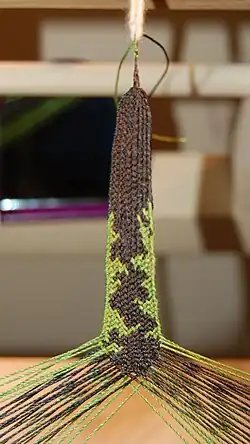
    A takadai (高台), also called kōdai, is a frame used for making kumihimo, a type of Japanese braid. The braids created on the takadai are flat (3D effects can be achieved) as opposed to the braids created on the marudai[1] which have a round or polygonal section. The threads are attached to weighted bobbins called tamas and lay on wood pieces with pegs that are called koma. A wooden sword is used to lightly beat the braid once the braiding has been done. The braiding progresses on a ‘V’ front, as opposed to weaving on a regular loom that progresses on a straight front.

    The art that is worked on the takadai is a braid, not a weave. Although many of the patterns used on this braiding stand resemble the up and down motion of a weave, since each thread takes a turn at being both the weft and the warp, it is a braid.

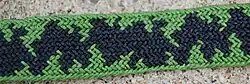
    On the takadai it is possible to make intricate patterns using a technique called “pick-up braids”. The braid has two sides of two contrasting colors and is usually linked on the edges. Then a pattern is formed by interchanging strands from the bottom braid to the upper braid, and by changing the braiding sequence.[2]

    Cultural context

    The takadai is one of several traditional stands used in kumihimo, the Japanese craft of making braided cords. Kumihimo developed in Japan from braiding techniques introduced from continental Asia, and early uses included the decoration of Buddhist objects and scrolls. Over time, kumihimo cords[3] were also used for samurai armour, sword fittings, kimono accessories, and “obijime”, the cord used to secure an “obi”

    Flat kumihimo cords, known as “hira-uchi himo”, are one of the major forms of kumihimo and are used for purposes such as kimono sashes, sword decoration, tea utensils, and accessories. [4]

    Takadai
    Takadai
    Takadai

    Related terms

    • Kumihimo 組紐 – “kumi” from the Japanese verb, “kumu,” meaning “to braid.” “Himo” means “cord” or “string.” May be written as くみひも、組紐、組み紐。
    • Marudai– 丸台 – a wooden braiding stand with a circular top (kagami) which is pierced with a center hole. It is used to make a variety of braids, including round, square, rectangular, flat, triangular, and other polygonal shapes.
    • Obi – 帯 – a sash of varying widths, used to secure a kimono.
    • Obijime – 帯締め – the cord used to secure the obi.[5][6]
    • Tama – 玉 – weighted wooden bobbins used in all types of kumihimo except Karakumi. The weight provides tension on the threads; this is countered by another weight suspended from the braid underneath the kagami.
    • Koma – movable pegged supports used on a takadai to hold and organize the threads.

    References

    1. Wood, Dorothy (2015-01-31). The Beginner’s Guide to Kumihimo: Techniques, Patterns and Projects to Learn How to Braid. David & Charles. ISBN 978-1-4463-7184-8.
    2. Owen, Rodrick (2004). Making Kumihimo: Japanese interlaced braids. Lewes, UK: Guild of Master Craftsman Publications. p. 192. ISBN 9781861083128.
    3. “Kumihimo”: Intricate and Highly Functional Braided Cords from Japan That Continue to Evolve in the Present Day | Web Japan”. Web Japan. Archived from the original on 2026-02-27. Retrieved 2026-06-08.
    4. “Kumihimo”: Intricate and Highly Functional Braided Cords from Japan That Continue to Evolve in the Present Day | Web Japan”. Web Japan. Archived from the original on 2026-02-27. Retrieved 2026-06-08.
    5. Hashimoto, Sumiko (1962). Japanese Accessories. Japan Travel Bureau.
    6. Schlick, Christopher; Trzcieliński, Stefan (2016-07-26). Advances in Ergonomics of Manufacturing: Managing the Enterprise of the Future: Proceedings of the AHFE 2016 International Conference on Human Aspects of Advanced Manufacturing, July 27-31, 2016, Walt Disney World®, Florida, USA. Springer. ISBN 978-3-319-41697-7.

    Books

    • Making Kumihimo, Japanese interlaced braids, by Rodrick Owen
    • Comprehensive Treatrise of Braids V, Taka-dai braids 3, by Makiko Tada

    This article is adapted from “Takadai” on Wikipedia, written by its contributors, and used under CC BY-SA 4.0. Text on this page is available under the same licence. Source snapshot: Wikipedia via Kiwix, 2026-07-20.

  • Distel hitch

    Distel Hitch
    Distel hitch
    Category Hitch
    Related Taut-line hitch, Blake’s hitch
    Typical use Ascending, Descending
    ABoK #1734, #1465, #452, #503, #1230, #1681

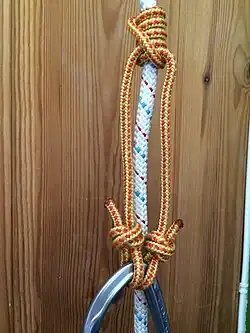
    Distel hitch is a friction hitch knot used to attach a carabiner to a rope, allowing a climber to descend or ascend.[1][2][3] The knot is similar to the prusik knot, however it grips the rope more consistently, making for increased climber control.[4]

    See also

    References

    1. “Distel Hitch”. Animated Knots. Retrieved 30 June 2014.
    2. “Distel hitch”. Climbing Arborist. Archived from the original on 9 February 2014. Retrieved 30 June 2014.
    3. “Distel Hitch”. Netknots. Retrieved 30 June 2014.
    4. Adams, Mark (October 2004). “An Overview of Climbing Hitches” (PDF). Climbers Corner. p. 6. Retrieved 30 June 2014.

    This article is adapted from “Distel hitch” on Wikipedia, written by its contributors, and used under CC BY-SA 4.0. Text on this page is available under the same licence. Source snapshot: Wikipedia via Kiwix, 2026-07-20.

  • Tait conjectures

    The Tait conjectures are three conjectures made by 19th-century mathematician Peter Guthrie Tait in his study of knots.[1] The Tait conjectures involve concepts in knot theory such as alternating knots, chirality, and writhe. All of the Tait conjectures have been solved, the most recent being the Flyping conjecture.

    Background

    Tait conjectures
    A reduced diagram is one in which all the isthmi are removed.

    Tait came up with his conjectures after his attempt to tabulate all knots in the late 19th century. As a founder of the field of knot theory, his work lacks a mathematically rigorous framework, and it is unclear whether he intended the conjectures to apply to all knots, or just to alternating knots. It turns out that most of them are only true for alternating knots.[2] In the Tait conjectures, a knot diagram is called “reduced” if all the “isthmi”, or “nugatory crossings” have been removed.

    Crossing number of alternating knots

    Tait conjectured that in certain circumstances, crossing number was a knot invariant, specifically:

    Any reduced diagram of an alternating link has the fewest possible crossings.

    In other words, the crossing number of a reduced, alternating link is an invariant of the knot. This conjecture was proved by Louis Kauffman, Kunio Murasugi (村杉 邦男), and Morwen Thistlethwaite in 1987, using the Jones polynomial.[3]
    [4]
    [5]

    Writhe and chirality

    A second conjecture of Tait:

    An amphicheiral (or acheiral) alternating link has zero writhe.

    This conjecture was also proved by Kauffman and Thistlethwaite.[3][6]

    Flyping

    Tait conjectures
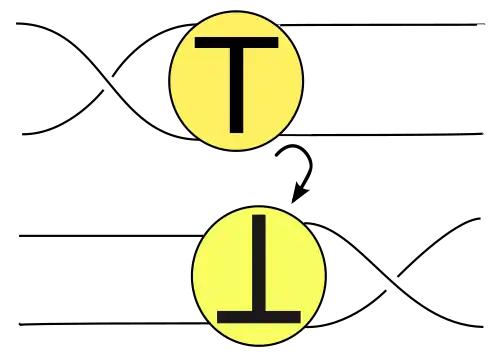
    A flype move.

    The Tait flyping conjecture can be stated:

    Given any two reduced alternating diagrams D 1 {\displaystyle D_{1}} {\displaystyle D_{1}} and D 2 {\displaystyle D_{2}} {\displaystyle D_{2}} of an oriented, prime alternating link: D 1 {\displaystyle D_{1}} {\displaystyle D_{1}} may be transformed to D 2 {\displaystyle D_{2}} {\displaystyle D_{2}} by means of a sequence of certain simple moves called flypes.[7]

    The Tait flyping conjecture was proved by Thistlethwaite and William Menasco in 1991.[8]
    The Tait flyping conjecture implies some more of Tait’s conjectures:

    Any two reduced diagrams of the same alternating knot have the same writhe.

    This follows because flyping preserves writhe. This was proved earlier by Murasugi and Thistlethwaite.[9][6] It also follows from Greene’s work.[10]
    For non-alternating knots this conjecture is not true; the Perko pair is a counterexample.[2]
    This result also implies the following conjecture:

    Alternating amphicheiral knots have even crossing number.[2]

    This follows because a knot’s mirror image has opposite writhe. This conjecture is again only true for alternating knots: non-alternating amphichiral knot with crossing number 15 exist.[11]

    See also

    References

    1. Lickorish, W. B. Raymond (1997), An introduction to knot theory, Graduate Texts in Mathematics, vol. 175, Springer-Verlag, New York, p. 47, doi:10.1007/978-1-4612-0691-0, ISBN 978-0-387-98254-0, MR 1472978, S2CID 122824389.
    2. 1 2 3 Stoimenow, Alexander (2008). “Tait’s conjectures and odd amphicheiral knots”. Bull. Amer. Math. Soc. 45 (2): 285–291. arXiv:0704.1941. CiteSeerX 10.1.1.312.6024. doi:10.1090/S0273-0979-08-01196-8. S2CID 15299750.
    3. 1 2 Kauffman, Louis (1987). “State models and the Jones polynomial”. Topology. 26 (3): 395–407. doi:10.1016/0040-9383(87)90009-7.
    4. Murasugi, Kunio (1987). “Jones polynomials and classical conjectures in knot theory”. Topology. 26 (2): 187–194. doi:10.1016/0040-9383(87)90058-9.
    5. Thistlethwaite, Morwen (1987). “A spanning tree expansion of the Jones polynomial”. Topology. 26 (3): 297–309. doi:10.1016/0040-9383(87)90003-6.
    6. 1 2 Thistlethwaite, Morwen (1988). “Kauffman’s polynomial and alternating links”. Topology. 27 (3): 311–318. doi:10.1016/0040-9383(88)90012-2.
    7. Weisstein, Eric W. “Tait’s Knot Conjectures”. MathWorld.
    8. Menasco, William; Thistlethwaite, Morwen (1993). “The Classification of Alternating Links”. Annals of Mathematics. 138 (1): 113–171. doi:10.2307/2946636. JSTOR 2946636.
    9. Murasugi, Kunio (1987). “Jones polynomials and classical conjectures in knot theory. II”. Mathematical Proceedings of the Cambridge Philosophical Society. 102 (2): 317–318. Bibcode:1987MPCPS.102..317M. doi:10.1017/S0305004100067335. S2CID 16269170.
    10. Greene, Joshua (2017). “Alternating links and definite surfaces”. Duke Mathematical Journal. 166 (11): 2133–2151. arXiv:1511.06329. Bibcode:2015arXiv151106329G. doi:10.1215/00127094-2017-0004. S2CID 59023367.
    11. Weisstein, Eric W. “Amphichiral Knot”. MathWorld.

    This article is adapted from “Tait conjectures” on Wikipedia, written by its contributors, and used under CC BY-SA 4.0. Text on this page is available under the same licence. Source snapshot: Wikipedia via Kiwix, 2026-07-20.

  • Directional figure eight

    Directional figure eight
    Names Directional figure eight, Inline figure-eight loop
    Category Loop
    ABoK #1058
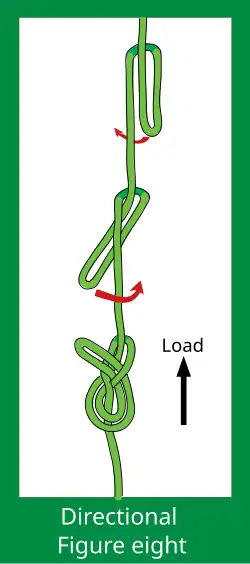
    Directional figure eight loop up
    Loop up
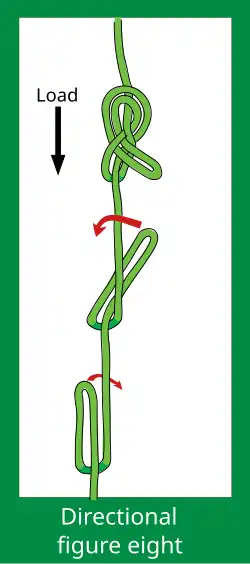
    Directional figure eight loop down
    Loop down
    The directional figure eight should be tied in one way or the other depending on which way the loop will be loaded.

    The directional figure eight (a.k.a. inline figure-eight loop) is a loop knot. It is a knot that can be made on the bight. The loop must only be loaded in the correct direction or the knot may fail. It is useful on a hauling line to create loops that can be used as handholds. It also provides a place to attach a Z-Drag to the line when prusiks are unavailable.

    See also


    This article is adapted from “Directional figure eight” on Wikipedia, written by its contributors, and used under CC BY-SA 4.0. Text on this page is available under the same licence. Source snapshot: Wikipedia via Kiwix, 2026-07-20.

  • Swing hitch

    Swing hitch
    Swing hitch

    SWING HITCH
    Names Swing hitch, Sailor’s hitch
    Category Hitch
    Efficiency firm, strong, secure says ABOK
    Related Clove hitch
    Releasing Easy
    Typical use swing, weights with pendulum movements
    ABoK 1693 (unslipped version)

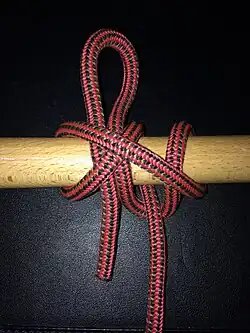
    Swing hitch is a way to tie a swing rope to a branch or other horizontal beam.
    Ashley describes it in ABOK as “… firm, strong, secure, and easily untied once the load has been removed.”

    This knot serves a similar function to the sailor’s hitch.

    Tying

    1. A clove hitch is tied around the beam with the rope end.
    2. The end continues around the beam until it meets the main part.
    3. The end goes around the main part and then gets stuck under the first turn of the main part; preferably under the point where main part and the bridge of the clove hitch cross each other.
      • The end may be slipped for easier dismount or
      • The end may be tied to a stopper knot for more security against loosening under use.

    If the place of attachment is very slippery, near the end of the beam, tapered with less diameter in the pulling direction, then one may start with more than one turn nearest the main part, effectively tying a Gripping sailor’s hitch.

    If the swing is to have two parallel ropes, the standing parts both must hang from the same side of the branch, otherwise there will be forces rotating the swing seat right and left. Swing hitch reduces such forces by having the end pull the main part towards the middle of the beam and fixing it there; Using a simple clove hitch would cause more of these disturbing rotational forces.

    If the swing is attached to a living tree, protecting the sap carrying live layers of the inner bark may be necessary; Suitable measures of tree protection while attaching a swing include

    • Choosing a grabbing and tightly holding knot such as swing hitch rather than a loop knot such as a bowline for the swing, and thus avoiding sawing or sanding type of movements of the rope,
    • Using a cambium protector in between rope and tree that is soft towards the tree and slippery on the rope side, so any movement of the rope slide on the protector, and does not wear off the bark.

    See also

    References

    • Jarman, Colin: Top Knots; NY: Barnes & Noble (2001); ISBN 978-0919028456
    • Clifford W. Ashley. The Ashley Book of Knots. Doubleday, New York. ISBN 0385040253, p. 291

    This article is adapted from “Swing hitch” on Wikipedia, written by its contributors, and used under CC BY-SA 4.0. Text on this page is available under the same licence. Source snapshot: Wikipedia via Kiwix, 2026-07-20.

  • Surgeon’s loop

    Surgeon’s loop
    Surgeon's loop
    Names Surgeon’s loop, Gut Knot[1]
    ABoK 292

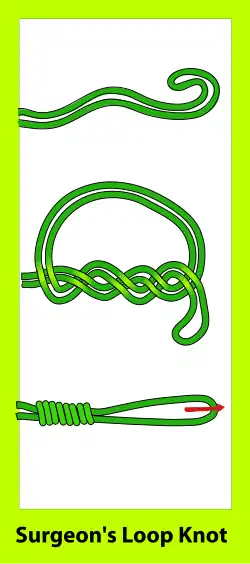
    The Surgeon’s loop (a.k.a. Double Loop) is tied the same way as the surgeon’s knot but with a double strand. Therefore, this knot does use more line than most. It is a bit bulky but is great for making quick, strong loops at the end of lines and leaders for connecting to other loops.

    See also

    References

    1. Ashley, Clifford W. (1944). The Ashley Book of Knots, Doubleday, p.50, #292. ISBN 0-385-04025-3 «Gut Knot»

    External links


    This article is adapted from “Surgeon's loop” on Wikipedia, written by its contributors, and used under CC BY-SA 4.0. Text on this page is available under the same licence. Source snapshot: Wikipedia via Kiwix, 2026-07-20.

  • Diamond knot

    Diamond knot
    Diamond knot
    Names Diamond knot, Knife lanyard knot, Sailor’s knife lanyard knot, Marlinspike lanyard knot, Single-strand diamond knot, Two-strand diamond knot, Bosun’s whistle knot, Friendship knot
    Category Loop
    Related Carrick bend, Fiador knot, Chinese button knot
    ABoK #787, #2474

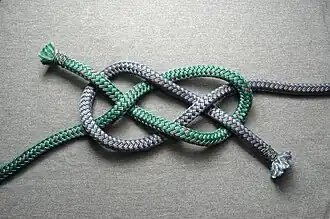
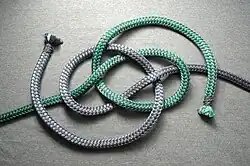
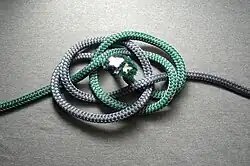
    The diamond knot (or knife lanyard knot) is a knot for forming a decorative loop on the end of a cord such as on a lanyard.[1] A similar knot, also called the diamond knot, is a multistrand stopper knot, that is similar in appearance (although the footrope knot is really more similar, but it is simply an upside down diamond knot). Some people recommend calling this knot the knife lanyard knot in order to avoid confusion. This knot is a four strand diamond knot implemented in two strands. The knife lanyard knot and Chinese button knot are “tied alike, but they are worked differently.”[2] This knot is also used in Prayer ropes by Eastern Christians, who accredit the knot’s creation to a legend relating to Saint Anthony the Great.

    The sailor’s knife lanyard knot, also called marling-spike lanyard knot, single-strand diamond knot, two-strand diamond knot, and Bosun’s whistle knot.

    Tying

    The diamond knot begins as a Carrick bend with the ends exiting diagonally opposite each other. When the steps below are completed the knot is rearranged and tightened so that the ends emerge from the knot parallel and opposite their own standing part. A Chinese button knot is often tied in a very similar manner, but without leaving a loop at the end.

    • Carrick bend start
      Carrick bend start
    • Working ends passed over each other's standing parts
      Working ends passed over each other’s standing parts
    • The ends are passed up through the center of the carrick bend from below.
      The ends are passed up through the center of the carrick bend from below.

    See also

    References

    1. 1 2 Ashley, Clifford W. (1944), The Ashley Book of Knots, New York: Doubleday, p. 141, ISBN 0-385-04025-3 {{citation}}: ISBN / Date incompatibility (help)
    2. Ashley (1944), p.101.


    This article is adapted from “Diamond knot” on Wikipedia, written by its contributors, and used under CC BY-SA 4.0. Text on this page is available under the same licence. Source snapshot: Wikipedia via Kiwix, 2026-07-20.