| Field | Knot theory |
|---|---|
| Conjectured by |
|
| Known cases |
|
| Consequences | Vassiliev invariants detect the unknot |
In the branch of mathematics called knot theory, the volume conjecture is an open problem that relates quantum invariants of knots to the hyperbolic geometry of their complements.
Statement
Let O denote the unknot. For any knot  , let
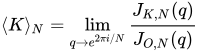
, let  be the Kashaev invariant of , which may be defined as
 ,
,
where  is the
  –Colored Jones polynomial of . The volume conjecture states that[1]
 ,
,
where  is the simplicial volume of the complement of in the 3-sphere, defined as follows. By the JSJ decomposition, the complement
  may be uniquely decomposed into a system of tori
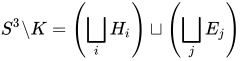
with  hyperbolic and
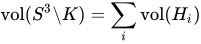
  Seifert-fibered. The simplicial volume is then defined as the sum
 ,
,
where  is the hyperbolic volume of the hyperbolic manifold .[1]
As a special case, if is a hyperbolic knot, then the JSJ decomposition simply reads  , and by definition the simplicial volume agrees with the hyperbolic volume
  .
.
History
The Kashaev invariant was first introduced by Rinat M. Kashaev in 1994 and 1995 for hyperbolic links as a state sum using the theory of quantum dilogarithms.[2][3] Kashaev stated the formula of the volume conjecture in the case of hyperbolic knots in 1997.[4]
Murakami & Murakami (2001) pointed out that the Kashaev invariant is related to the colored Jones polynomial by replacing the variable  with the root of unity
  . They used an R-matrix as the discrete Fourier transform for the equivalence of these two descriptions. This paper was the first to state the volume conjecture in its modern form using the simplicial volume. They also prove that the volume conjecture implies the following conjecture of Victor Vasiliev:
- If all Vassiliev invariants of a knot agree with those of the unknot, then the knot is the unknot.
The key observation in their proof is that if every Vassiliev invariant of a knot is trivial, then  for any .
Status
The volume conjecture is open for general knots, and it is known to be false for arbitrary links. The volume conjecture has been verified in many special cases, including:
- The figure-eight knot (Tobias Ekholm),[5]
- The three-twist knot (Rinat Kashaev and Yoshiyuki Yokota),[5]
- The Borromean rings (Stavros Garoufalidis and Thang Le),[5]
- Torus knots (Rinat Kashaev and Olav Tirkkonen),[5]
- All knots and links with volume zero (Roland van der Veen),[5]
- Twisted Whitehead links (Hao Zheng),[6]
- Whitehead doubles of nontrivial torus knots
 with
with  (Hao Zheng).[6]
Relation to Chern-Simons theory
Using complexification, Murakami et al. (2002) conjectured that for a hyperbolic knot ,
 ,
,
where  is the Chern–Simons invariant of the frame field of the hyperbolic structure of . This suggests a relationship between the colored Jones polynomial and complexified Chern–Simons theory.
References
Notes
- 1 2 Murakami 2010, p. 17.
- ↑ Kashaev, R.M. (1994-12-28). “Quantum Dilogarithm as a 6j-Symbol”. Modern Physics Letters A. 09 (40): 3757–3768. arXiv:hep-th/9411147. Bibcode:1994MPLA….9.3757K. doi:10.1142/S0217732394003610. ISSN 0217-7323.
- ↑ Kashaev, R.M. (1995-06-21). “A Link Invariant from Quantum Dilogarithm”. Modern Physics Letters A. 10 (19): 1409–1418. arXiv:q-alg/9504020. Bibcode:1995MPLA…10.1409K. doi:10.1142/S0217732395001526. ISSN 0217-7323.
- ↑ Kashaev, R. M. (1997). “The Hyperbolic Volume of Knots from the Quantum Dilogarithm”. Letters in Mathematical Physics. 39 (3): 269–275. arXiv:q-alg/9601025. Bibcode:1997LMaPh..39..269K. doi:10.1023/A:1007364912784.
- 1 2 3 4 5 Murakami 2010, p. 22.
- 1 2 Zheng, Hao (2007), “Proof of the volume conjecture for Whitehead doubles of a family of torus knots”, Chinese Annals of Mathematics, Series B, 28 (4): 375–388, arXiv:math/0508138, doi:10.1007/s11401-006-0373-3
Sources
- Murakami, Hitoshi (2010). “An Introduction to the Volume Conjecture”. arXiv:1002.0126 [math.GT]..
- Kashaev, Rinat M. (1997), “The hyperbolic volume of knots from the quantum dilogarithm”, Letters in Mathematical Physics, 39 (3): 269–275, arXiv:q-alg/9601025, Bibcode:1997LMaPh..39..269K, doi:10.1023/A:1007364912784.
- Murakami, Hitoshi; Murakami, Jun (2001), “The colored Jones polynomials and the simplicial volume of a knot”, Acta Mathematica, 186 (1): 85–104, arXiv:math/9905075, doi:10.1007/BF02392716.
- Murakami, Hitoshi; Murakami, Jun; Okamoto, Miyuki; Takata, Toshie; Yokota, Yoshiyuki (2002), “Kashaev’s conjecture and the Chern-Simons invariants of knots and links”, Experimental Mathematics, 11 (1): 427–435, arXiv:math/0203119, doi:10.1080/10586458.2002.10504485.
- Gukov, Sergei (2005), “Three-Dimensional Quantum Gravity, Chern-Simons Theory, And The A-Polynomial”, Communications in Mathematical Physics, 255 (1): 557–629, arXiv:hep-th/0306165, Bibcode:2005CMaPh.255..577G, doi:10.1007/s00220-005-1312-y.
This article is adapted from “Volume conjecture” on Wikipedia, written by its contributors, and used under CC BY-SA 4.0. Text on this page is available under the same licence. Source snapshot: Wikipedia via Kiwix, 2026-07-20.