In the mathematical theory of knots, the Thurston–Bennequin number, or Bennequin number, is an invariant associated with a Legendrian knot in a three dimensional contact manifold. It is named after William Thurston and Daniel Bennequin. The Thurston-Bennequin number measures the “twisting of the contact structure around the knot”.[1] Together with the rotation number, they are often referred as the “classical” invariants of Legendrian knots.
The Thurston-Bennequin number of a Legendrian knot  is usually denoted by
  . The maximal Thurston–Bennequin number,
  , over all Legendrian representatives of a knot in
  is a topological knot invariant.[2]
Definition and properties
Let be a null-homologous oriented Legendrian knot in a co-oriented three-dimensional contact manifold  and fix a Seifert surface
  to , that is an embedded connected, compact, orientable surface with boundary
  . The Thurston-Bennequin number of relative to is the defined as the signed intersection number of the contact plane field
  with .[3]
Let  be a small push-off of obtained by pushing along a vector field
  transverse to . The Thurston-Bennequin number can also be defined as
  , where
  denotes the linking number.[3]
The Euclidean case
We consider the case where  is the standard contact structure on . If we denote
  the coordinates in , the contact structure
  is the kernel of the one-form
  . The applications
  and
and  denote respectively the front projection and the Lagrangian projection. The Thurston-Bennequin number can be computed easily from its front and Lagrangian projections.
Lagrangian projection description
The Thurston-Bennequin number of a Legendrian knot  is the writhe of its Lagrangian projection
  .
.
Front projection description
For a Legendrian knot , its front projection  is called its front diagram. The front diagram of a Legendrian knot does not have vertical tangencies, however cusps can appear. Generically, the front diagram of a knot as no tangency point, no triple intersection and standard cusp singularities. In this case the Thurston-Bennequin number is

where 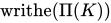 denotes the writhe of the front diagram.[1]
The invariant can also be computed using a grid diagram corresponding to a particular Legendrian representative of a knot.[4][5] In this setting, the number can be computed as the writhe of the diagram minus the number of ‘northwest’ corners.

 and an associated Legendrian representative of it.
By smoothing the ‘northeast’ and ‘southwest’ corners and rotating the diagram and switching all crossings, one can convert a grid diagram into the associated Legendrian knot.
The Bennequin inequality
In his thesis [1], Daniel Bennequin proved an inequality involving the Thurston-Bennequin number. He proved that for all Legendrian knot in the standard contact the following inequality is true:

where  denotes the Euler characteristic of a Seifert surface of and
  denotes the rotation number of .
In particular, the maximal Thurston-Bennequin number gives a lower bound on the genus of a topological knot.
References
- 1 2 3 “Entrelacements et équations de Pfaff”. Astérisque. 107/108: 87–161. 1983. (Bennequin’s doctoral dissertation)
- ↑ Ng, Lenhard (2012). “On arc index and maximal thurston–bennequin number”. Journal of Knot Theory and Its Ramifications. 21 (04): 1250031. arXiv:math/0612356. doi:10.1142/S0218216511009820. ISSN 0218-2165.
- 1 2 Geiges, Hansjörg (2008). An introduction to contact topology; Volume 109 of Cambridge studies in advanced mathematics. Cambridge University Press. p. 94. ISBN 978-0-521-86585-2.
- ↑ Ozsváth, Peter S.; Stipsicz, András I.; Szabó, Zoltán (2015). Grid Homology for Knots and Links. American Mathematical Society. pp. 220–221. ISBN 978-1-4704-3442-7.
- ↑ Dynnikov, I.; Prasolov, M. (2013). “Bypasses for rectangular diagrams. A proof of the Jones conjecture and related questions”. Transactions of the Moscow Mathematical Society. 74: 97–144. arXiv:1206.0898. doi:10.1090/S0077-1554-2014-00210-7. ISSN 0077-1554.
- “Thurston–Bennequin number“, The Knot Atlas.
- Lee Rudolph (1997). “The slice genus and the Thurston–Bennequin invariant of a knot”. Proceedings of the American Mathematical Society. 125: 3049–3050. doi:10.1090/S0002-9939-97-04258-5. MR 1443854.
This article is adapted from “Thurston–Bennequin number” on Wikipedia, written by its contributors, and used under CC BY-SA 4.0. Text on this page is available under the same licence. Source snapshot: Wikipedia via Kiwix, 2026-07-20.