| Pipe hitch | |
|---|---|
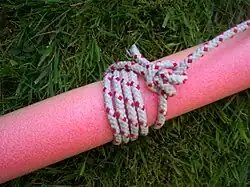
A pipe hitch, finished with a cow hitch
|
|
| Names | Pipe hitch, Well-pipe hitch [1] |
| Category | Hitch |
| Related | rolling hitch, klemheist knot, Tensionless hitch, Taut-line hitch |
| Releasing | Non-jamming |
| Typical use | securing a pipe or pole |
| Caveat | The direction of the pulling force should be away from the wrapped coils. |
| ABoK | 504, 2047 |
A pipe hitch is a hitch-type knot used to secure smooth cylindrical objects,[2] such as pipes, poles, beams, or spars. According to The Ashley Book of Knots, a pipe hitch is “used to lower a pipe or hoist one”[1] and as “another method of tying to a rectangular timber.”[3]
Information
The pipe hitch will not slip when tied correctly to a pipe or pole. This knot is a variation of the Round turn and two half-hitches.[4][5] This knot can be used with a rope to pull a pipe or spar out of the ground,[6] or to hoist a pipe or beam.
Instructions
The pipe hitch is started by wrapping four or more coils around a pipe or pole. It is finished by tying the working end around the standing part with a clove hitch,[1] and less commonly with a cow hitch or a buntline hitch.
See also
References
- 1 2 3 Ashley, Clifford W. (1993) [1944], The Ashley Book of Knots, New York: Doubleday, p. 82, ISBN 0-385-04025-3
- ↑ “Pipe Hitch”. Boy Scouts of America Troup 542 – Gresham Oregon. Archived from the original on 12 May 2008. Retrieved 4 December 2012.
- ↑ Ashley (1944), p.332.
- ↑ Ashley (1944), p.332.
- ↑ “The Scrapboard Guide to Knots” (PDF). Retrieved 17 July 2019.
- ↑ “Pipe Hitch”. Troop 542. Archived from the original on 12 May 2008. Retrieved 2 June 2013.
This article is adapted from “Pipe hitch” on Wikipedia, written by its contributors, and used under CC BY-SA 4.0. Text on this page is available under the same licence. Source snapshot: Wikipedia via Kiwix, 2026-07-20.