In mathematics the Lawrence–Krammer representation is a representation of the braid groups. It fits into a family of representations called the Lawrence representations. The first Lawrence representation is the Burau representation and the second is the Lawrence–Krammer representation.
The Lawrence–Krammer representation is named after Ruth Lawrence and Daan Krammer.[1]
Definition
Consider the braid group  to be the mapping class group of a disc with n marked points,
  . The Lawrence–Krammer representation is defined as the action of on the homology of a certain covering space of the configuration space
  . Specifically, the first integral homology group of is isomorphic to
  , and the subgroup of
 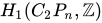 invariant under the action of is primitive, free abelian, and of rank 2. Generators for this invariant subgroup are denoted by
  .
.
The covering space of corresponding to the kernel of the projection map

is called the Lawrence–Krammer cover and is denoted  . Diffeomorphisms of act on , thus also on , moreover they lift uniquely to diffeomorphisms of which restrict to the identity on the co-dimension two boundary stratum (where both points are on the boundary circle). The action of on
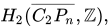
thought of as a
 -module,
is the Lawrence–Krammer representation. The group 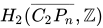 is known to be a free -module, of rank
  .
.
Matrices
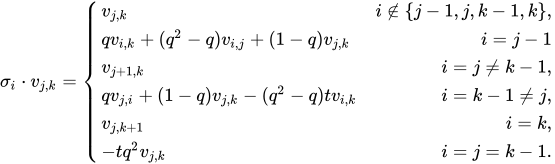
Using Bigelow’s conventions for the Lawrence–Krammer representation, generators for the group are denoted  for
for  . Letting
  denote the standard Artin generators of the braid group, we obtain the expression:
Faithfulness
Stephen Bigelow and Daan Krammer have given independent proofs that the Lawrence–Krammer representation is faithful.
Geometry
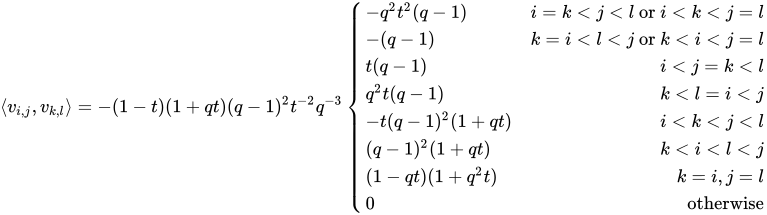
The Lawrence–Krammer representation preserves a non-degenerate sesquilinear form which is known to be negative-definite Hermitian provided are specialized to suitable unit complex numbers (q near 1 and t near i). Thus the braid group is a subgroup of the unitary group of square matrices of size . Recently[2] it has been shown that the image of the Lawrence–Krammer representation is a dense subgroup of the unitary group in this case.
The sesquilinear form has the explicit description:
References
- ↑ Bigelow, Stephen (2003), “The Lawrence–Krammer representation”, Topology and geometry of manifolds, Proc. Sympos. Pure Math., vol. 71, Providence, RI: Amer. Math. Soc., pp. 51–68, MR 2024629
- ↑ Budney, Ryan (2005), “On the image of the Lawrence–Krammer representation”, Journal of Knot Theory and Its Ramifications, 14 (6): 773–789, arXiv:math/0202246, doi:10.1142/S0218216505004044, MR 2172897, S2CID 14196563
Further reading
- Bigelow, Stephen (2001), “Braid groups are linear”, Journal of the American Mathematical Society, 14 (2): 471–486, doi:10.1090/S0894-0347-00-00361-1, MR 1815219
- Bigelow, Stephen (2003), “The Lawrence–Krammer representation”, Topology and geometry of manifolds, Proceedings of Symposia in Pure Mathematics, vol. 71, Providence, RI: American Mathematical Society, pp. 51–68, doi:10.1090/pspum/071, ISBN 9780821835074, MR 2024629
- Budney, Ryan (2005), “On the image of the Lawrence–Krammer representation”, Journal of Knot Theory and Its Ramifications, 14 (6): 773–789, arXiv:math/0202246, doi:10.1142/S0218216505004044, MR 2172897, S2CID 14196563
- Krammer, Daan (2002), “Braid groups are linear”, Annals of Mathematics, 155 (1): 131–156, arXiv:math/0405198, doi:10.2307/3062152, JSTOR 3062152, MR 1888796, S2CID 62899383
- Lawrence, Ruth (1990), “Homological representations of the Hecke algebra”, Communications in Mathematical Physics, 135 (1): 141–191, Bibcode:1990CMaPh.135..141L, doi:10.1007/bf02097660, MR 1086755, S2CID 121644260
- Paoluzzi, Luisa; Paris, Luis (2002). “A note on the Lawrence–Krammer–Bigelow representation”. Algebraic and Geometric Topology. 2: 499–518. arXiv:math/0111186. doi:10.2140/agt.2002.2.499. MR 1917064. S2CID 12672756.
This article is adapted from “Lawrence–Krammer representation” on Wikipedia, written by its contributors, and used under CC BY-SA 4.0. Text on this page is available under the same licence. Source snapshot: Wikipedia via Kiwix, 2026-07-20.