| Heaving line knot | |
|---|---|
 |
|
| Category | Stopper |
| Releasing | Non-jamming |
| Typical use | To serve as a weight, making a rope easier to throw |
| ABoK | #538[1] |
| Stopper knot[2] | |
|---|---|
 |
|
| Names | Stopper knot[3], Franciscan knot,[4] monk’s knot,[4] Heaving line knot[4] |
| Category | Stopper |
| Related | Stevedore knot, Double overhand knot |
| Releasing | Non-jamming |
| Typical use | To serve as a weight, making a rope easier to throw |
| ABoK | #2004 |
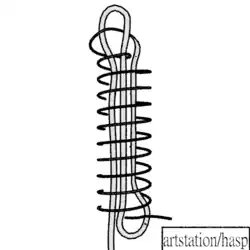
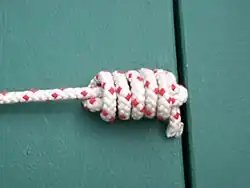
A heaving line knot[1] is a family of knots which are used for adding weight to the end of a rope, to make the rope easier to throw. In nautical use, a heaving line knot is often tied to the end of a messenger line, which is then used for pulling a larger rope, such as a hawser. There are several distinct knots which all share the common name, heaving line knot.[1] The monkey fist is a well-known heaving line knot.
Tying Heaving line knot
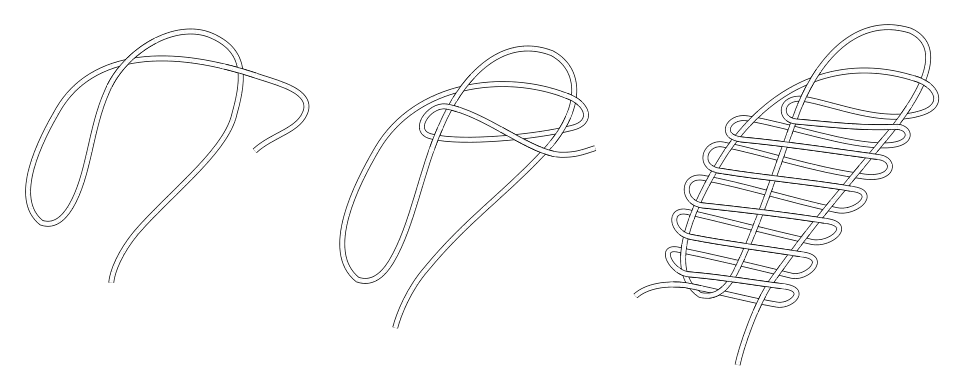
Tying Stopper knot
Make a bight in the tail end of the rope. Wrap the working end around the tail toward the bight end, with multiple turns. Complete the knot by passing the tail end through the bight loop.
-
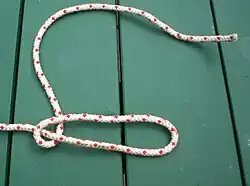 Make a bight
 -
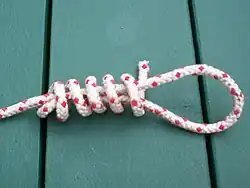 Wrap the working end around
 -
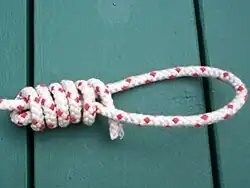 Put the end through the bight
 -
Tighten by pulling on the standing part to close the bight
Similar knots
-
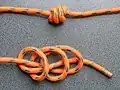 ABOK #2203
 -
-
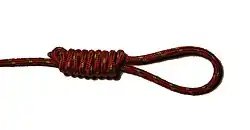
 ABOK #427
Scout coil
See also
- List of knots
- Hangman’s knot
- Heaving line bend – Type of bend knot
Notes
- 1 2 3 Budsworth, Clifford W. Ashley, with amendments by Geoffrey (1993). The Ashley book of knots. New York: Doubleday. p. 88. ISBN 9780385425544.
{{cite book}}: CS1 maint: multiple names: authors list (link) - ↑ Des Pawson. Handbook of Knots, 2004 — ISBN 1-4053-0467-7
- ↑ Des Pawson. Handbook of Knots, 2004 — ISBN 1-4053-0467-7
- 1 2 3 Owen Peter (1993) knots. p14. ISBN 9781561382255“
External links
This article is adapted from “Heaving line knot” on Wikipedia, written by its contributors, and used under CC BY-SA 4.0. Text on this page is available under the same licence. Source snapshot: Wikipedia via Kiwix, 2026-07-20.