The surgeon’s knot is a surgical knot and is a simple modification to the reef knot. It adds an extra twist when tying the first throw, forming a double overhand knot. The additional turn provides more friction and can reduce loosening while the second half of the knot is tied.[1] This knot is commonly used by surgeons in situations where it is important to maintain tension on a suture, giving it its name.[2]
Surgeon’s knots are also used in fly fishing, in tying quilts, and for tying knots with twine; it is particularly useful in tying raw meat with butcher’s twine, as the wet meat creates similar risks of loosening as with surgery. Some sources categorize the surgeon’s knot as a bend, since it can be effective as such.[3]
Like the reef knot, the surgeon’s knot capsizes and fails if one of the working ends is pulled away from the standing end closest to it.
This article is adapted from “Surgeon's knot” on Wikipedia, written by its contributors, and used under CC BY-SA 4.0. Text on this page is available under the same licence. Source snapshot: Wikipedia via Kiwix, 2026-07-20.
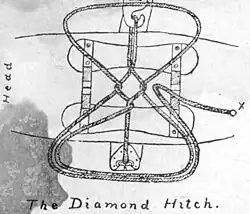
The diamond hitch is a lashing technique used mainly in the field of equine packing, to secure a set of objects, for instance a pair of pack-bags, pack-boxes or other gear onto a base, for instance a pack saddle frame, in which case it requires the use of a lash cinch. In the general sense it requires the base to be equipped with at least two points of anchorage, and a rope which is used to lash the object down onto the base. There are two types of Diamond Hitches, a single, shown here, and a double diamond hitch which is not shown.
Uses
Designed and primarily used to secure a load onto a pack-saddle placed on the back of a pack-animal, usually a horse, mule or donkey (although other animals such as llamas or alpacas are regularly used), the diamond hitch can be used in a more general manner to secure anything “loose” to a base that is equipped with at least two anchor points.
It can also be used effectively on the bed of a truck, or any other moving platform to which a load is to be secured.
How to tie
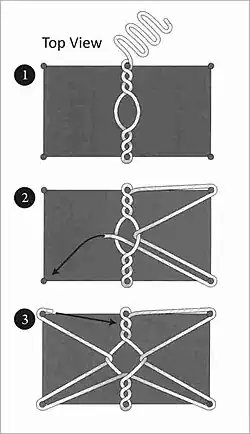
The steps used to tie a diamond hitch with six points of anchorage.
In the diagram shown to the left, six points are used, but the top left, right, bottom left and right points can be ignored by simply “tucking” the rope beneath the load to be tied down, provided its shape and size allow, as is the case when the knot is used on a pack-saddle where those four extra points are simply the four corners of the pack to be tied down.
The following description focuses on the way to tie a diamond hitch so as to secure a load onto a pack-saddle.
Tying a diamond hitch requires that a pack saddle be placed and loaded on the back of a pack animal. A lash cinch, made up of a piece of canvas or hide attached to a loop on one end and a hook on the other, is then placed under the animal’s belly, generally (and according to the diagram above) with the loop on the animal’s right and the hook on its left (the hook allows for easy release of the hitch without the need to feed the long rope through multiple rings).
A long length of rope is attached to the loop by means of a bowline or any other firm knot, and this rope is then passed through the loop once more leaving enough spare to reach over the animal and place the so-formed loop of rope in the hook on the other side. This double length of rope that is passed over the pack is then carefully twisted at least twice (the diagram shows many more twists, but two are generally sufficient), with one twist being forced over towards the right side of the animal, while the other is left on its left, and then it is placed back in the hook, before tightening up the slack.
While maintaining the whole rope tight the running end is then passed under the rear side of the pack-box or pack-bag on the right side, run up towards the top center of the pack where it is passed under the rear of the two strands formed by the twisting, in the center (between the two twists) and then sent over the other side of the animal (at this point unless two people are performing the hitch it is necessary to walk around the animal, while still maintaining tension on the rope).
There it is passed beneath the pack on the animal’s left side, and it is also recommended to pass it in the metal hook on the lash cinch for added security. The rope is then led up around the front end of the left pack-box or pack-bag, and passed under the front one of the two twisted strands, as performed with the rear one previously, and still in between the two twists.
Here another change of sides is required for the single tier, as the rope must then be passed in a similar fashion around the front side of the right pack-box or pack-bag, and finally tightened thoroughly, before being tied off onto the metal loop, by means of a half-hitch for example.
↑The complete guide to knots and knot tying — Geoffrey Budworth — p.222 — ISBN0-7548-0422-4
This article is adapted from “Diamond hitch” on Wikipedia, written by its contributors, and used under CC BY-SA 4.0. Text on this page is available under the same licence. Source snapshot: Wikipedia via Kiwix, 2026-07-20.
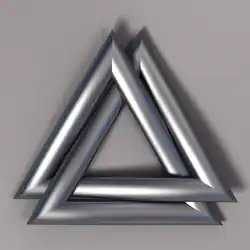
In mathematics, a stuck unknot is a closed polygonal chain in three-dimensional space (a skew polygon) that is topologically equal to the unknot but cannot be deformed to a simple polygon when interpreted as a mechanical linkage, by rigid length-preserving and non-self-intersecting motions of its segments.[1][2]
Similarly a stuck open chain is an open polygonal chain such that the segments may not be aligned by moving rigidly its segments. Topologically such a chain can be unknotted, but the limitation of using only rigid motions of the segments can create nontrivial knots in such a chain.
Consideration of such “stuck” configurations arises in the study of molecular chains in biochemistry.
References
↑G. Aloupis, G. Ewald, and G. T. Toussaint, “More classes of stuck unknotted hexagons,” Contributions to Algebra and Geometry, Vol. 45, No. 2, 2004, pp. 429–434.
↑G. T. Toussaint, “A new class of stuck unknots in Pol-6,” Contributions to Algebra and Geometry, Vol. 42, No. 2, 2001, pp. 301–306.
This article is adapted from “Stuck unknot” on Wikipedia, written by its contributors, and used under CC BY-SA 4.0. Text on this page is available under the same licence. Source snapshot: Wikipedia via Kiwix, 2026-07-20.
In the mathematical area of braid theory, the Dehornoy order is a left-invariant total order on the braid group, found by Patrick Dehornoy.[1][2] Dehornoy’s original discovery of the order on the braid group used huge cardinals, but there are now several more elementary constructions of it.[3]
Definition
Suppose that are the usual generators of the braid group on strings. Define a -positive word to be a braid that admits at least one expression in the elements and their inverses, such that the word contains , but does not contain nor for .
The set of positive elements in the Dehornoy order is defined to be the elements that can be written as a -positive word for some . We have:
and are disjoint (“acyclicity property”);
the braid group is the union of and (“comparison property”).
These properties imply that if we define as then we get a left-invariant total order on the braid group. For example, because the braid word is not -positive, but, by the braid relations, it is equivalent to the -positive word , which lies in .
History
Set theory introduces the hypothetical existence of various “hyper-infinity” notions such as large cardinals. In 1989, it was proved that one such notion, axiom , implies the existence of an algebraic structure called an acyclic shelf which in turn implies the decidability of the word problem for the left self-distributivity law a property that is a priori unconnected with large cardinals.[4][5]
In 1992, Dehornoy produced an example of an acyclic shelf by introducing a certain groupoid that captures the geometrical aspects of the law. As a result, an acyclic shelf was constructed on the braid group, which happens to be a quotient of , and this implies the existence of the braid order directly.[2] Since the braid order appears precisely when the large cardinal assumption is eliminated, the link between the braid order and the acyclic shelf was only evident via the original problem from set theory.[6]
Properties
The existence of the order shows that every braid group is an orderable group and that, consequently, the algebras and have no zero-divisor.
For , the Dehornoy order is not invariant on the right: we have and . In fact no order of with may be invariant on both sides.
For , the Dehornoy order is neither Archimedean, nor Conradian: there exist braids satisfying for every (for instance and ), and braids greater than satisfying for every (for instance, and ).
The Dehornoy order is a well-ordering when restricted to the positive braid monoid generated by .[7] The order type of the Dehornoy order restricted to is the ordinal .[8]
The Dehornoy order is also a well-ordering when restricted to the dual positive braid monoid generated by the elements with , and the order type of the Dehornoy order restricted to is also .[9]
As a binary relation, the Dehornoy order is decidable. The best decision algorithm is based on Dynnikov’s tropical formulas,[10] see Chapter XII of;[3] the resulting algorithm admits a uniform complexity .
Connection with knot theory
Let be Garside’s fundamental half-turn braid. Every braid lies in a unique interval ; call the integer the Dehornoy floor of , denoted . Then the link closure of braids with a large floor behave nicely, namely the properties of can be read easily from . Here are some examples.
If and is a knot, then is a toric knot if and only if is periodic, is a satellite knot if and only if is reducible, and is hyperbolic if and only if is pseudo-Anosov.[12]
References
↑Dehornoy, Patrick (1992), “Deux propriétés des groupes de tresses”, Comptes Rendus de l’Académie des Sciences, Série I, 315 (6): 633–638, ISSN0764-4442, MR1183793
12Dehornoy, Patrick (1994), “Braid groups and left distributive operations”, Transactions of the American Mathematical Society, 345 (1): 115–150, doi:10.2307/2154598, JSTOR2154598, MR1214782
↑Dehornoy, Patrick (1989), “Sur la structure des gerbes libres”, Comptes Rendus de l’Académie des Sciences, Série I, 309 (3): 143–148, MR1005627
↑Laver, Richard (1992), “The left distributive law and the freeness of an algebra of elementary embeddings”, Advances in Mathematics, 91 (2): 209–231, doi:10.1016/0001-8708(92)90016-E, hdl:10338.dmlcz/127389, MR1149623
↑Dehornoy, Patrick (1996), “Another use of set theory”, Bulletin of Symbolic Logic, 2 (4): 379–391, doi:10.2307/421170, JSTOR421170, MR1321290
↑Laver, Richard (1996), “Braid group actions on left distributive structures, and well orderings in the braid groups”, Journal of Pure and Applied Algebra, 108: 81–98, doi:10.1016/0022-4049(95)00147-6, MR1382244
↑Burckel, Serge (1997), “The wellordering on positive braids”, Journal of Pure and Applied Algebra, 120 (1): 1–17, doi:10.1016/S0022-4049(96)00072-2, MR1466094
↑Fromentin, Jean (2011), “Every braid admits a short sigma-definite expression”, Journal of the European Mathematical Society, 13 (6): 1591–1631, arXiv:0811.3902, doi:10.4171/JEMS/289, MR2835325
↑Dynnikov, Ivan (2002), “On a Yang-Baxter mapping and the Dehornoy ordering”, Russian Mathematical Surveys, 57 (3): 151–152, doi:10.1070/RM2002v057n03ABEH000519, MR1918864
↑Malyutin, Andrei; Netsvetaev, Nikita Yu. (2003), “Dehornoy order in the braid group and transformations of closed braids”, Rossiĭskaya Akademiya Nauk. Algebra i Analiz, 15 (3): 170–187, doi:10.1090/S1061-0022-04-00816-7, MR2052167
Kassel, Christian (2002), “L’ordre de Dehornoy sur les tresses”, Astérisque (276): 7–28, ISSN0303-1179, MR1886754
Dehornoy, Patrick (1997), “A fast method for comparing braids”, Advances in Mathematics, 125 (2): 200–235, doi:10.1006/aima.1997.1605, MR1434111
This article is adapted from “Dehornoy order” on Wikipedia, written by its contributors, and used under CC BY-SA 4.0. Text on this page is available under the same licence. Source snapshot: Wikipedia via Kiwix, 2026-07-20.
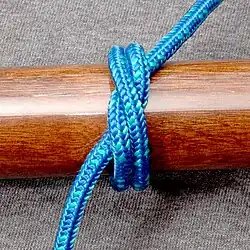
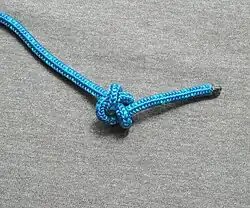
The strangle knot starts with a round turn and the end is stuck under two parts. It may be used to tie up a roll. It can only be tied around a cylindrical shape. If required, a loop may be stuck instead of the end, which makes a slipped knot that is one of the best for tying up sacks and meal bags. With one or two additional turns the strangle knot makes an excellent temporary whipping for the end of a rope.
↑Ashley, Clifford W. (1944). The Ashley Book of Knots, p.224. Doubleday. ISBN0-385-04025-3.
This article is adapted from “Strangle knot” on Wikipedia, written by its contributors, and used under CC BY-SA 4.0. Text on this page is available under the same licence. Source snapshot: Wikipedia via Kiwix, 2026-07-20.
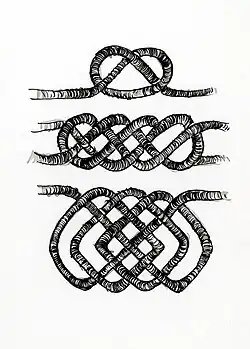
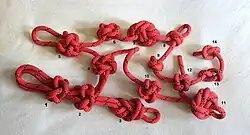
A decorative or ornamental knot (also fancy knot[1]) is an often complex knot exhibiting repeating patterns. A decorative knot is generally a knot that not only has practical use but is also known for its aesthetic or ornamental qualities.[2] Often originating from maritime use, “decorative knots are not only serviceable and functional but also enhance the ship-shape appearance of any vessel.”[3] Decorative knots may be used alone or in combination,[4] and may consist of single or multiple strands.[5][6]
Though the word decorative sometimes implies that little or no function is served, the craft of decorative knot tying generally combines both form and function.[5]
Coxcombing is decorative knotwork performed by sailors during the Age of Sail to dress-up, protect, or help identify specific items and parts of ships and boats.
↑Owen, Peter (2003). The Ultimate Book of Knots: More Than Two-Hundred Practical and Decorative Knots, p.493. Globe Pequot. ISBN9781592281602.
12Penn, Randy (2004). The Everything Knots Book: Step-By-Step Instructions for Tying Any Knot, p.189. Everything Books. ISBN9781440522772.
↑Randall, Peter (2012). The Craft of the Knot: From Fishing Knots to Bowlines and Bends, a Practical Guide to Knot Tying and Usage, p.29. Adams Media. ISBN9781440552502.
This article is adapted from “Decorative knot” on Wikipedia, written by its contributors, and used under CC BY-SA 4.0. Text on this page is available under the same licence. Source snapshot: Wikipedia via Kiwix, 2026-07-20.
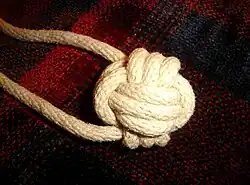
A stopper knot (or simply stopper) is a knot that creates a fixed thicker point on an otherwise-uniform thickness rope for the purpose of preventing the rope, at that point, from slipping through a narrow passage, such as a hole in a block. To pass a rope through a block, or hole, is to reeve it. To pull it out is to unreeve it. Stopper knots prevent the rope from unreeving on its own. They are also used to lower the chances of rappelling off the end of a rope.
“Stopper” has three distinct meanings in the context of knotting and cordage. A decorative stopper knot may be referred to as a lanyard knot.
The single-strand stopper knot is…[one variety] of knob knots. Generally it is tied as a terminal knot in the end of a rope, where it forms a knob or bunch, the general purpose of which is to prevent unreeving. It is found in the ends of running rigging. It secures the end of a sewing thread; it provides a handhold or a foothold in bell ropes and footropes. It adds weight to the end of a heaving line, and it is often employed decoratively, but it should not be used to prevent unlaying and fraying except in small cord, twine, and the like, as a whipping is in every way preferable for large and valuable material.
A monkey’s tail “is a permanent or semipermanent stopper that is put in the bight as well as the end. It is also called single throat seizing, seized round turn, clinch, and pigtail…A small round turn is first taken, and a throat seizing, in length about a quarter of the round of the clinch, is put in. The monkey’s tail is preferred for the purpose just described because it does less damage to rope than any knot. When the monkey’s tail fetches against the rack the seizing takes the burden.”[2]
A stopper knot is tied at the end of a rope to prevent the end from unraveling. It then functions like a whipping knot.
A stopper knot is tied at the end of a rope to prevent the end from slipping through another knot, or passing back through a hole, block, or belay/rappel device. It then functions like a leash handle. Knots commonly used for this purpose are:
When a stopper knot is tied outside another knot and around the standing part it can also be called a backup knot. Tying the end around the standing part helps prevent the knot from unraveling by not allowing the end to slide back into the knot: a kind of insurance against failure of the knot. Examples of this usage are often seen in climbing, rope rescue, and other safety-of-life situations. Common knots used for this purpose are:
In nautical settings, a stopper may refer to a length of rope that is belayed at one end with the other end attached to a tensioned main line using a friction hitch in order to tension the stopper and thereby slacken the portion of the tensioned main line behind the friction hitch. For example, if a sheet becomes jammed on a winch while under sail, a “stopper” can be used to temporarily take the strain off the winch while the riding turn is cleared.
This article is adapted from “Stopper knot” on Wikipedia, written by its contributors, and used under CC BY-SA 4.0. Text on this page is available under the same licence. Source snapshot: Wikipedia via Kiwix, 2026-07-20.
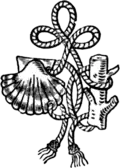
The Dacre knot, a type of decorative unknot, is a heraldic knot used primarily in English heraldry. It is most notable for its appearance on the Dacre family heraldic badge, where its two lower dexter loops entwine a scallop, and its two lower sinister loops entwine a log.[1]
This article is adapted from “Dacre knot” on Wikipedia, written by its contributors, and used under CC BY-SA 4.0. Text on this page is available under the same licence. Source snapshot: Wikipedia via Kiwix, 2026-07-20.
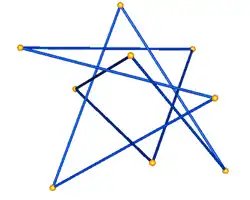
In the mathematical theory of knots, the stick number is a knot invariant that intuitively gives the smallest number of straight “sticks” stuck end to end needed to form a knot. Specifically, given any knot , the stick number of , denoted by , is the smallest number of edges of a polygonal path equivalent to . A related quantity is the equilateral stick number, the smallest number of edges of the same length that are required to form a knot. It is not currently known whether the equilateral stick number is the same as the stick number for every knot.
Known values
Six is the lowest stick number for any nontrivial knot. There are few knots whose stick number can be determined exactly. Gyo Taek Jin determined the stick number of a –torus knot in case the parameters and are not too far from each other:[1]
, if
The same result was found independently around the same time by a research group around Colin Adams, but for a smaller range of parameters.[2]
There are certain knots for which the upper bound and lower bound of the stick number are the same, such that the stick number is known exactly. These include 31 with a stick number of 6, 41 (7), all 5 and 6 crossing knots (8), and all 7 crossing knots (9). The 8 crossing knots 16 through 21 in Alexander-Briggs notation (8 or 9), and 9-crossing knots 29, 34, 35, and 39 through 49 (9), and 10124 (10, a torus knot) have known crossing numbers. There are 19 additional non-alternating 11- and 13-crossing knots with a stick number of exactly 10.[3]
Rendering of a 935 knot with a stick number of 9, from coordinates found by Shonkwiler and Eddy.[4]
Bounds
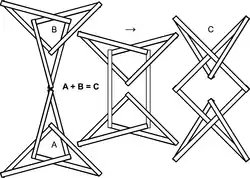
Square knot = trefoil + trefoil reflection.
The stick number of a knot sum can be upper bounded by the stick numbers of the summands:[5]
Related invariants
The stick number of a knot is related to its crossing number by the following inequalities:[6]
These inequalities are both tight for the trefoil knot, which has a crossing number of 3 and a stick number of 6. The upper bound on the stick number does not apply to the unknot, which has crossing number 0 but stick number 3.
Optical Illusions
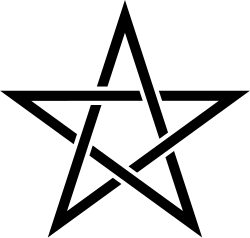
A right-handed interlaced pentagram, which is a diagram of a trefoil knot but cannot be realized in three dimensions without curving the line segments.
Knots can be drawn with fewer straight line segments than their stick number suggests should be possible. These diagrams are optical illusions, and three-dimensional embeddings of such knots would require the apparent lines to curve. An example is a five-segment interlaced pentagram, which is a valid diagram of the trefoil knot but cannot be realized with straight line segments. At least six straight line segments are required to embed a trefoil knot.
Adams, C. C. (May 2001), “Why knot: knots, molecules and stick numbers”, Plus Magazine. An accessible introduction into the topic, also for readers with little mathematical background.
Adams, C. C. (2004), The Knot Book: An elementary introduction to the mathematical theory of knots, Providence, RI: American Mathematical Society, ISBN0-8218-3678-1.
Research articles
Adams, Colin C.; Brennan, Bevin M.; Greilsheimer, Deborah L.; Woo, Alexander K. (1997), “Stick numbers and composition of knots and links”, Journal of Knot Theory and Its Ramifications, 6 (2): 149–161, doi:10.1142/S0218216597000121, MR1452436
Calvo, Jorge Alberto (2001), “Geometric knot spaces and polygonal isotopy”, Journal of Knot Theory and Its Ramifications, 10 (2): 245–267, arXiv:math/9904037, doi:10.1142/S0218216501000834, MR1822491
Eddy, Thomas D.; Shonkwiler, Clayton (2019), “New Stick Number Bounds from Random Sampling of Confined Polygons”, Experimental Mathematics, 31 (4): 1373–1395, arXiv:1909.00917, doi:10.1080/10586458.2021.1926000
Jin, Gyo Taek (1997), “Polygon indices and superbridge indices of torus knots and links”, Journal of Knot Theory and Its Ramifications, 6 (2): 281–289, doi:10.1142/S0218216597000170, MR1452441
Negami, Seiya (1991), “Ramsey theorems for knots, links and spatial graphs”, Transactions of the American Mathematical Society, 324 (2): 527–541, doi:10.2307/2001731, JSTOR2001731, MR1069741
Huh, Youngsik; Oh, Seungsang (2011), “An upper bound on stick number of knots”, Journal of Knot Theory and Its Ramifications, 20 (5): 741–747, arXiv:1512.03592, doi:10.1142/S0218216511008966, MR2806342
This article is adapted from “Stick number” on Wikipedia, written by its contributors, and used under CC BY-SA 4.0. Text on this page is available under the same licence. Source snapshot: Wikipedia via Kiwix, 2026-07-20.
In three-dimensional topology, a branch of mathematics, the cyclic surgery theorem states that, for a compact, connected, orientable, irreducible three-manifold M whose boundary is a torus T, if M is not a Seifert-fibered space and r,s are slopes on T such that their Dehn fillings have cyclic fundamental group, then the distance between r and s (the minimal number of times that two simple closed curves in T representing r and s must intersect) is at most 1. Consequently, there are at most three Dehn fillings of M with cyclic fundamental group. The theorem appeared in a 1987 paper written by Marc Culler, Cameron Gordon, John Luecke and Peter Shalen.[1]
References
↑M. Culler, C. Gordon, J. Luecke, P. Shalen (1987). Dehn surgery on knots. The Annals of Mathematics (Annals of Mathematics) 125 (2): 237-300.
This article is adapted from “Cyclic surgery theorem” on Wikipedia, written by its contributors, and used under CC BY-SA 4.0. Text on this page is available under the same licence. Source snapshot: Wikipedia via Kiwix, 2026-07-20.
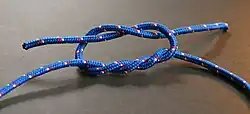
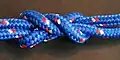 A surgeon’s knot tied in nylon rope and tightened
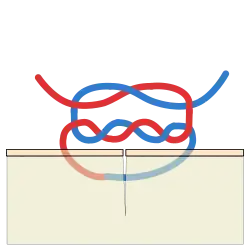 Diagram of a surgeon’s knot
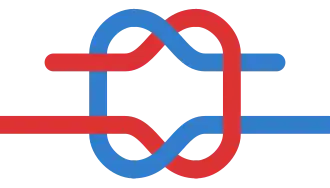 Diagram of a reef knot