| Karash double loop | |
|---|---|
 |
|
| Category | Loop |
| Efficiency | 49-72% (12.5 mm static)[1] |
| Typical use | climbing, rope rescue |
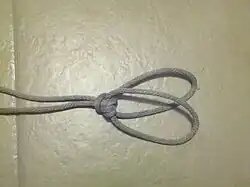
Karash double loop is a common name for a knot forming two loops. This knot has been a known variant of the Bowline on a bight per the International Guild of Knot Tyers, referred to as bowline twist or twisted collar bowline on a bight.[2] The knot is also referred to as nœud de fusion in French references and sometimes called Fusion knot in English.
The name Karash double loop was introduced by Mike Karash, who re-invented the knot to create makeshift harnesses for rescue operations and popularized it among rescue workers.[3][4]
Applications
The knot is used for vertical caving using the single rope technique,[5] particularly by French cavers. It is advertised by the French Federation of Speleology as a safe alternative to the bowline on a bight. Compared to the traditional double loop variant of the figure of eight, its loops remain open under load allowing to clip and unclip carabiners in the loops more easily.
The knot is also popular to create a makeshift harness in rescue operations. The two loops are used as leg loops to sit in. The knot can be further improved by adding two bowlines around a person’s body to create a three-point harness.[6][7]
Technique
The traditional method of tying this knot starts with a reverse loop (like the Eskimo bowline) then wraps around the standing end (AKA the “tree”), you then finish the knot the same way as the BOAB – Bowline on a bight.
An alternative way as advertised by the French Federation of Speleology and Mike Karash is starting with a figure of eight on a bight, then pulls two strands of the rope back through the bight.
-
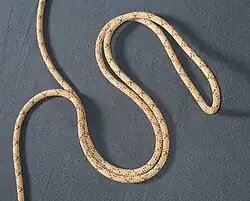 Start with a bight of rope
 -
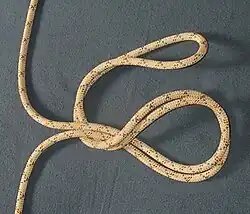 Tie a figure of eight on the bight
 -
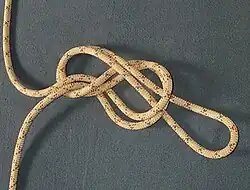
-
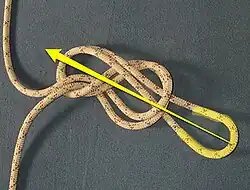 Pull the loop of the figure of eight over the whole knot
 -
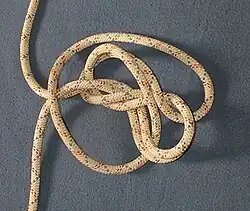
-
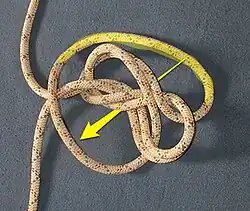
-
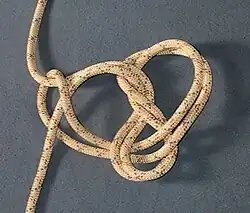 Take the two strands of rope together
 -
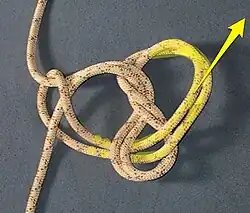 Pull back the two strands of rope closest to the loop inside the knot
 -
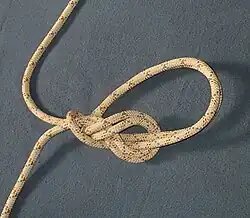 These two form the final two loops of the knot
 -
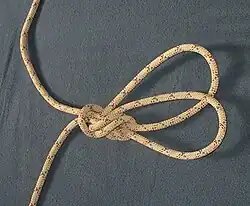 Tighten and dress the knot
References
- ↑ Karash knot test
- ↑ ABOK #1047 Variant – Karash Double Loop Accessed: 3/21/2025
- ↑ Karashknot How-to Archived 2013-09-20 at the Wayback Machine Accessed: 4/27/2012
- ↑ Inventor Background Accessed: 4/27/2012
- ↑ Karash (Fusion) Knot – How to tie Accessed 2/7/2014
- ↑ Karash Double Loop Harness Video Accessed: 4/28/2012
- ↑ A site about nothing: The Best Knots: Optional Knots
External links
This article is adapted from “Karash double loop” on Wikipedia, written by its contributors, and used under CC BY-SA 4.0. Text on this page is available under the same licence. Source snapshot: Wikipedia via Kiwix, 2026-07-20.