| Double overhand noose | |
|---|---|
 |
|
| Names | Double overhand noose, Scaffold,[1][2] Poacher’s Knot[3] |
| Category | Hitch |
| Efficiency | High |
| Related | Noose, Double overhand knot, Double fisherman’s knot |
| Releasing | Jamming |
| Typical use | Bind a carabiner |
| Caveat | Difficult to untie |
| ABoK | #409, #1120, #1228 |
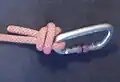
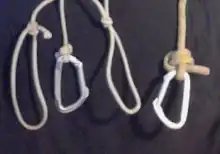
The double overhand noose is a very secure hitch knot. It might be used by cavers and canyoneers to bind a cow tail or a foot loop to a carabiner.[4]
Details
-
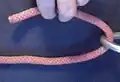 Make a bight
 -
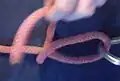 Turn around the standing end
 -
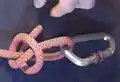 the 2nd round rides the 1st
 -
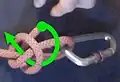 Tie inside the two rounds
 -
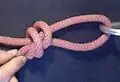
-
Tighten
A heavily tightened double overhand noose will jam. The bound object has to be removed before untying.
As the double overhand knot, it neither slips nor turns around. However, a third round turn might be useful with some highly lubricious spectra/nylon ropes.[5]
See also
Notes
- ↑ The running end is stored in the bight.
- ↑ Foot loops tied with a zeppelin loop and an alpine butterfly knot.
References
- ↑ Ashley, Clifford W.. The Ashley Book of Knots. Published by Faber and Faber, 1993 — #1120 — ISBN 9780571096596
- ↑ The complete guide to knots and knot tying — Geoffrey Budworth — p.37 — ISBN 0-7548-0422-4
- ↑ Ashley, Clifford W. (1944). The Ashley Book of Knots, Doubleday, p.65, #409. ISBN 0-385-04025-3
- ↑ Les longes en spéléologie et descente de canyon Archived March 31, 2012, at the Wayback Machine (in French)
- ↑ Tom Moyer, Paul Tusting, Chris Harmston,(2000) Comparative Testing of High Strength Cord
This article is adapted from “Double overhand noose” on Wikipedia, written by its contributors, and used under CC BY-SA 4.0. Text on this page is available under the same licence. Source snapshot: Wikipedia via Kiwix, 2026-07-20.